Text Annotation Use Cases: Support, Legal & Survey Text
How teams apply text annotation use cases beyond the clinic: support-ticket intent, legal clause tagging, and survey coding, with span evidence and IRR.
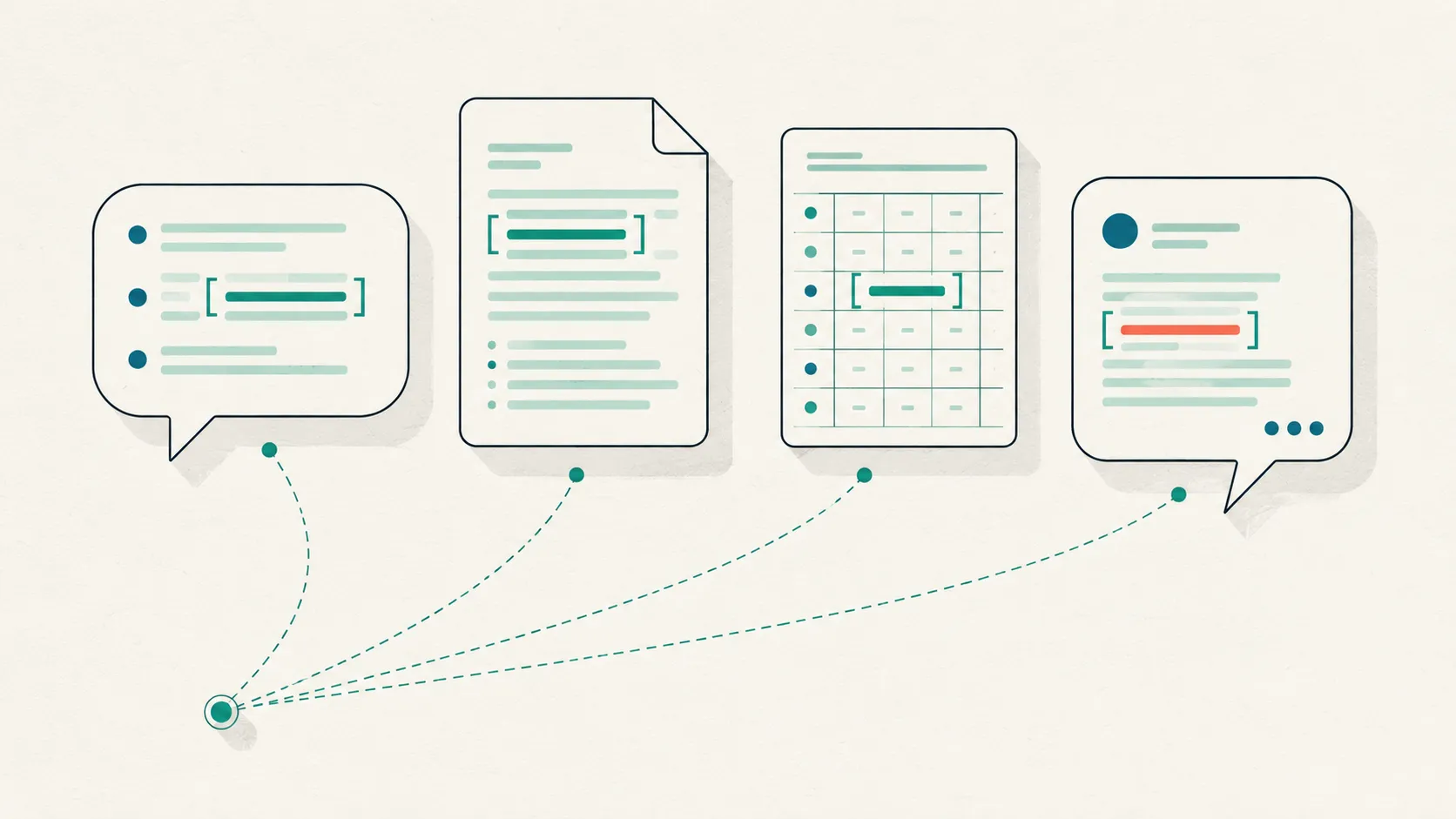
The methods clinical researchers use to turn a messy interview into structured data never stayed in the clinic. Support teams, contract reviewers, and survey analysts reach for the same tools, often without knowing they share a lineage. Most text annotation use cases, whatever the domain, come down to three moves: define a coding scheme, attach each label to a span of evidence, and check that independent people agree.
That shared skeleton is easy to miss because every field renames it. A clinician calls it a rating scale, a data team calls it a label taxonomy, a qualitative researcher calls it a coding frame, and a lawyer calls it a clause checklist. They are the same object. This guide walks the same discipline across customer support, legal documents, open-ended surveys, and the classroom, with the datasets and numbers behind each.
What are text annotation use cases beyond the clinic?
Text annotation use cases beyond the clinic are any task where people apply a defined label set to spans of unstructured text so the result can be counted, routed, audited, or used to train a model. The domains differ, but the unit of work does not: a span of text plus a category drawn from a scheme, produced consistently enough that a second person would produce the same one. Customer support, legal review, market research, and education all fit this shape.
What makes the clinic look special is only that it formalized the discipline first and under the highest stakes. Psychometrics gave us reliability coefficients, operational definitions, and pilot rounds decades before “data labeling” was a job title. Those same ideas are exactly what a support-ops team rediscovers the third time two agents tag the same ticket differently.
The one method under every domain
Every reliable text-annotation project, clinical or not, rests on three parts that travel together. Strip any one out and the labels stop being trustworthy.
- A coding scheme. A defined set of categories, each with a boundary an annotator can apply the same way twice. It goes by many names—taxonomy, codebook, rating scale, clause checklist—but the design problem is identical: enough categories to capture what you care about, few enough to stay consistent.
- Span evidence. Each label points at the exact text that justifies it. The span is what makes a label auditable, trainable, and correctable, rather than an opinion floating above the document.
- An inter-rater reliability check. Two or more people label the same items independently, and you quantify how often they agree after correcting for chance. It is the single number that tells you whether the scheme is teachable or just personal.
O’Connor and Joffe (2020) argue that assessing inter-rater reliability improves “the systematicity, communicability, and transparency of the coding process”—a benefit that has nothing to do with medicine and everything to do with trusting a label set. They also stress that the unit of coding, the number of coders, and the acceptable threshold should be decided before coding begins, not reverse-engineered to hit a target.
Text annotation use cases, mapped across five domains
The clearest way to see the method transfer is to line the domains up side by side. Each row is the same three-part discipline wearing different vocabulary: a scheme, a span of evidence, and a downstream use that depends on both.
| Domain | Typical coding scheme | Span-evidence example (synthetic) | Downstream use |
|---|---|---|---|
| Customer support | Intent taxonomy + sentiment | "my new card still hasn't arrived" → intent: card_arrival; sentiment: negative | Routing, deflection, CSAT drivers |
| Legal / contracts | Clause-type taxonomy (CUAD: 41 types) | "governed by the laws of the State of Delaware" → Governing Law | Contract review, risk flagging |
| Open-ended survey | Inductive + deductive codebook | "politicians are corrupt and need term limits" → political reform | Theme frequencies, policy insight |
| Education (classroom) | IRF/IRE exchange moves | "Can anyone tell me why the ice melted?" → Initiation | Discourse analysis, teacher feedback |
| Reviews / argument | Toulmin argument elements | "because sales fell 30% last quarter" → Grounds | Reasoning quality, review mining |
Read down the middle column and the pattern is obvious: in every row an annotator selects a stretch of text and assigns it a category from a fixed scheme. Change the scheme and you change the domain, not the method.
How do teams annotate support tickets?
Teams annotate support tickets as fine-grained intent classification, usually with a second sentiment or urgency layer stacked on top. You define an intent taxonomy, then tag each incoming message—or the specific phrase that carries the ask—with the one intent it expresses. It is the same move a pragmatic scheme makes when it labels what an utterance does rather than what it is about.
The scale is not trivial. BANKING77 labels 13,083 real customer-service queries with 77 fine-grained intents inside the single domain of banking, precisely because coarse taxonomies with fewer than ten classes do not reflect what production systems actually face (Casanueva et al., 2020). The authors note that some intent categories partially overlap—the built-in tension of any fine-grained scheme, and the reason two thoughtful agents will code the same ticket differently.
For the underlying function of a message, a linguistic scheme is a ready-made backbone. Searle’s five illocutionary classes separate a request (“Could you reset my password?”, a directive) from a complaint (“This is the third time this week”, an expressive) from a commitment, which is often exactly the cut a routing model needs.
Here is where reliability earns its keep. Consider a synthetic run: two agents each label 50 support messages using two neighboring intents, card_not_working and card_arrival. They agree on 41 of 50, a comfortable-looking 82% raw agreement—but because one intent dominates the sample, Cohen’s kappa lands near 0.55, only moderate. Percent agreement hid a scheme problem that the chance-corrected number exposed, the same lesson clinical raters learned long ago.
When your support tickets arrive as voice calls rather than text, the labeling logic is identical once you have a transcript, as we cover in the audio and speech annotation guide.
How do teams annotate legal documents?
Legal document annotation is expert span-tagging: highlighting the portions of a contract or filing that fall under defined categories a reviewer cares about. CUAD is the reference example, and it is span annotation to the letter—over 13,000 annotations across 41 clause types in 510 commercial contracts, each labeled under the supervision of experienced lawyers (Hendrycks et al., 2021). The task is literally to highlight the salient portions a human should review.
That sparsity—labeled clauses average roughly 10% of a contract, and each individual label around a quarter of a percent—is why legal review is a needle-in-a-haystack problem, and why the span, not just the label, is the deliverable. A “Governing Law” tag is useless without the exact clause it marks. The layout and entity layers underneath a scanned contract are their own discipline, which we treat separately in document and PDF annotation.
Legal text also carries argument, not just clauses. When the task is to code why a brief or an opinion reaches its conclusion, Toulmin’s model gives you six functional roles—claim, grounds, warrant, backing, qualifier, rebuttal—for tagging the structure of reasoning rather than its topic.
Because CUAD ships under a permissive CC BY 4.0 license, it is reusable with attribution, but most business contracts and tickets are not. Reusing a public dataset and labeling your own confidential corpus raise different consent and licensing questions, which we work through in annotation data consent and licensing.
How do you code open-ended survey responses?
You code open-ended survey responses with a codebook built iteratively from the responses themselves, then gate it on inter-rater reliability before coding at scale. This is classic qualitative content analysis, mixing inductive codes that emerge from reading with deductive codes set in advance, and it is one of the oldest text annotation use cases outside the lab.
Pew Research Center’s 24-country democracy study is a clean, large worked example. Researchers built the codebook over five iterations of sampling, reviewing disagreements, and refining definitions, reaching a Krippendorff’s alpha of 0.70 across 25 codes. They then trained a larger group of coders and translators, requiring each to hit an alpha of 0.70 or higher before coding independently, and ultimately coded 25,005 responses in 36 languages (Pew Research Center, 2024). The pattern—pilot, measure, revise, then scale—is exactly the pilot round any clinical coding project runs.
The choice that decides everything is the unit of coding. O’Connor and Joffe (2020) list it as an a-priori decision: are you coding sentences, paragraphs, or “conceptually meaningful chunks”? That is the survey-research name for span selection, and getting it wrong makes agreement unmeasurable. Turning a rating scale or construct into a codebook with operational rules is a skill in its own right, which we cover in from scale to codebook.
What about education and other domains?
The method reaches wherever structured human judgment meets text. Classroom research is a compact example: the IRF (Initiation-Response-Feedback) scheme from Sinclair and Coulthard labels the three-move exchange that dominates teacher-led talk, tagging each turn by the function it performs rather than by who speaks (Sinclair & Coulthard, 1975).
The same shape appears in content moderation (policy-violation taxonomies over spans), product review mining (aspect-plus-sentiment), and political-science coding of speeches and manifestos. None of them invented a new method; each picked a scheme, tied labels to spans, and measured whether coders agreed.
Why span evidence matters across every domain
Span evidence matters because a label without its text is an assertion you cannot check, retrain on, or fix. The span is what turns “this ticket is about a refund” into “these words are why,” and that difference is what makes a dataset auditable rather than merely large. It is also the unit that model training and error analysis both consume.
Spans are where quiet defects hide, too. A label can be right while its span is subtly wrong—too wide, too narrow, or attached to the wrong clause in a multi-part sentence—and no field-level check will ever notice. Systematic span review is the only thing that surfaces it, which is why the auditability argument holds equally in a contract, a survey, and a transcript.
Where the method breaks
The method breaks in predictable, portable ways, and knowing them up front is most of the battle.
- Fine-grained schemes lower agreement. More categories capture more nuance and invite more disagreement. BANKING77’s partially overlapping intents and CUAD’s tightly defined clause types both pay this tax (Casanueva et al., 2020; Hendrycks et al., 2021).
- Percent agreement misleads on skewed data. When one label dominates, raw agreement looks high while chance-corrected agreement is mediocre—report Cohen’s kappa or Krippendorff’s alpha and read them against Landis and Koch’s (1977) bands.
- Disagreement needs a resolution rule. A reliability number tells you there is a problem; it does not fix the labels. You still need an explicit adjudication step, covered in adjudication and consensus methods.
- Automation drifts. Model-assisted pre-labeling speeds any of these tasks, but a model trained on last quarter’s tickets quietly decays as the language shifts, so the human reliability check has to keep running.
Most of these are guideline failures, not annotator failures. A sharper category boundary prevents the disagreement before it happens, which is the entire point of writing definitions rather than just names.
Where does Tagaroo fit?
Tagaroo is not a CRM, a contract-lifecycle platform, or a survey tool, and it does not replace the specialized systems each domain already runs. Where it fits is the part every one of these tasks shares: defining a label set, attaching labels to spans, and computing inter-rater reliability as people work. Whether the category is “Directive” on a support message, “Governing Law” on a contract, or “political reform” on a survey answer, the workflow is one workflow.
That is the practical meaning of “tag anything.” A scheme like Searle’s speech acts or the Toulmin argument model drops into the same guided, reliability-tracked workspace you would use for a clinical transcript, because the underlying method never changed—only the words we use for it did.
The practical upshot: the strongest of these text annotation use cases are not really support, legal, or research problems at all. They are the same taxonomy-and-agreement problem wearing five different costumes. Pick the smallest scheme that answers your question, tie every label to its span, measure agreement with a chance-corrected coefficient, and the domain becomes a detail. If that is your problem, start by turning a scheme like the IRF classroom-discourse model into a guided, reliability-tracked workflow.
References
- Hendrycks D, Burns C, Chen A, Ball S. CUAD: An Expert-Annotated NLP Dataset for Legal Contract Review. NeurIPS Datasets and Benchmarks, 2021. arXiv:2103.06268
- Casanueva I, Temčinas T, Gerz D, Henderson M, Vulić I. Efficient Intent Detection with Dual Sentence Encoders (BANKING77). NLP4ConvAI, ACL 2020. DOI · arXiv:2003.04807
- O’Connor C, Joffe H. Intercoder Reliability in Qualitative Research: Debates and Practical Guidelines. International Journal of Qualitative Methods, 2020. DOI
- Pew Research Center. Appendix A: Coding Methodology (Global Views of Democracy). 2024. Report
- Searle JR. A classification of illocutionary acts. Language in Society. 1976;5(1):1-23. DOI
- Toulmin SE. The Uses of Argument. Cambridge University Press; 1958.
- Sinclair JM, Coulthard M. Towards an Analysis of Discourse: The English Used by Teachers and Pupils. Oxford University Press; 1975.
- Landis JR, Koch GG. The measurement of observer agreement for categorical data. Biometrics. 1977;33(1):159-174. DOI
If your annotation problem is a structured label set on text rather than a domain-specific workflow, Tagaroo turns schemes like Searle’s speech acts and the Toulmin model into guided, reliability-tracked projects.
Frequently asked questions
- Can the same annotation method work outside clinical research?
- Yes. Whatever the domain, most text annotation reduces to the same three moves: define a coding scheme with clear category boundaries, attach every label to the span of text that justifies it, and check that independent people agree using a chance-corrected coefficient. Clinical research formalized this early, but the discipline is domain-independent, and intercoder-reliability assessment is recommended as good practice across qualitative and applied coding generally (O'Connor & Joffe, 2020).
- How do you annotate customer support tickets?
- Support-ticket annotation is fine-grained intent classification, usually paired with a sentiment or urgency layer. You define an intent taxonomy, then tag each message (or the specific phrase that carries the request) with the single intent it expresses, the same way a pragmatic scheme labels what an utterance does. BANKING77 shows the scale of a real taxonomy: 13,083 online-banking queries labeled with 77 fine-grained intents in a single domain (Casanueva et al., 2020).
- What is legal document annotation?
- Legal document annotation is expert span-tagging: highlighting the portions of a contract or filing that belong to defined categories such as governing law, termination, or an assignment clause. CUAD is the canonical example, with over 13,000 span annotations across 41 clause types in 510 commercial contracts, labeled under the supervision of experienced lawyers (Hendrycks et al., 2021). It is the same span-plus-label unit used to code a transcript, applied to a contract.
- How do you code open-ended survey responses reliably?
- Code open-ended responses with a codebook built iteratively from the data, then gate it on inter-rater reliability before coding at scale. In its 24-country democracy study, Pew developed a codebook over several iterations, then trained coders to a Krippendorff's alpha threshold of 0.70 or higher before they could code independently, ultimately coding 25,005 responses (Pew Research Center, 2024). Deciding the unit of coding and the reliability threshold up front is standard practice (O'Connor & Joffe, 2020).
- Do I need inter-rater reliability for business text labeling?
- If a human applies judgment to assign a label, yes. Percent agreement alone flatters fine-grained or skewed schemes because it ignores agreement expected by chance, so report a chance-corrected coefficient such as Cohen's kappa or Krippendorff's alpha instead (O'Connor & Joffe, 2020). The conventional reading of those coefficients follows Landis and Koch (1977): 0.61 to 0.80 is substantial and 0.81 to 1.00 is almost perfect.
Keep reading
 Image & Multimodal Annotation
Document Annotation: Layout, Entities & Key-Value Fields
How document annotation works for ML: layout regions, document entities, key-value pairs, and table structure, plus the datasets. See the tasks.
 Image & Multimodal Annotation
Audio Annotation: From Transcription to Labeled Events
Audio annotation turns raw speech into labeled data: transcription, speaker diarization, timestamped events, and prosody tags. Compare the types.
 Methods & Frameworks
Rating Scale to Codebook: Operationalize Any Instrument
A step-by-step method to go from rating scale to codebook: turn each item into a code, anchors, examples, and decision rules coders apply consistently.
Put this into practice
Tagaroo turns any rating scale or coding scheme into a guided annotation workflow—with inter-rater reliability computed as you go.