Plutchik's Wheel of Emotions: 8 Primaries, Explained
Plutchik's wheel of emotions maps eight primaries into four opposing pairs, with intensity rings and dyads. See how to label emotion in text.
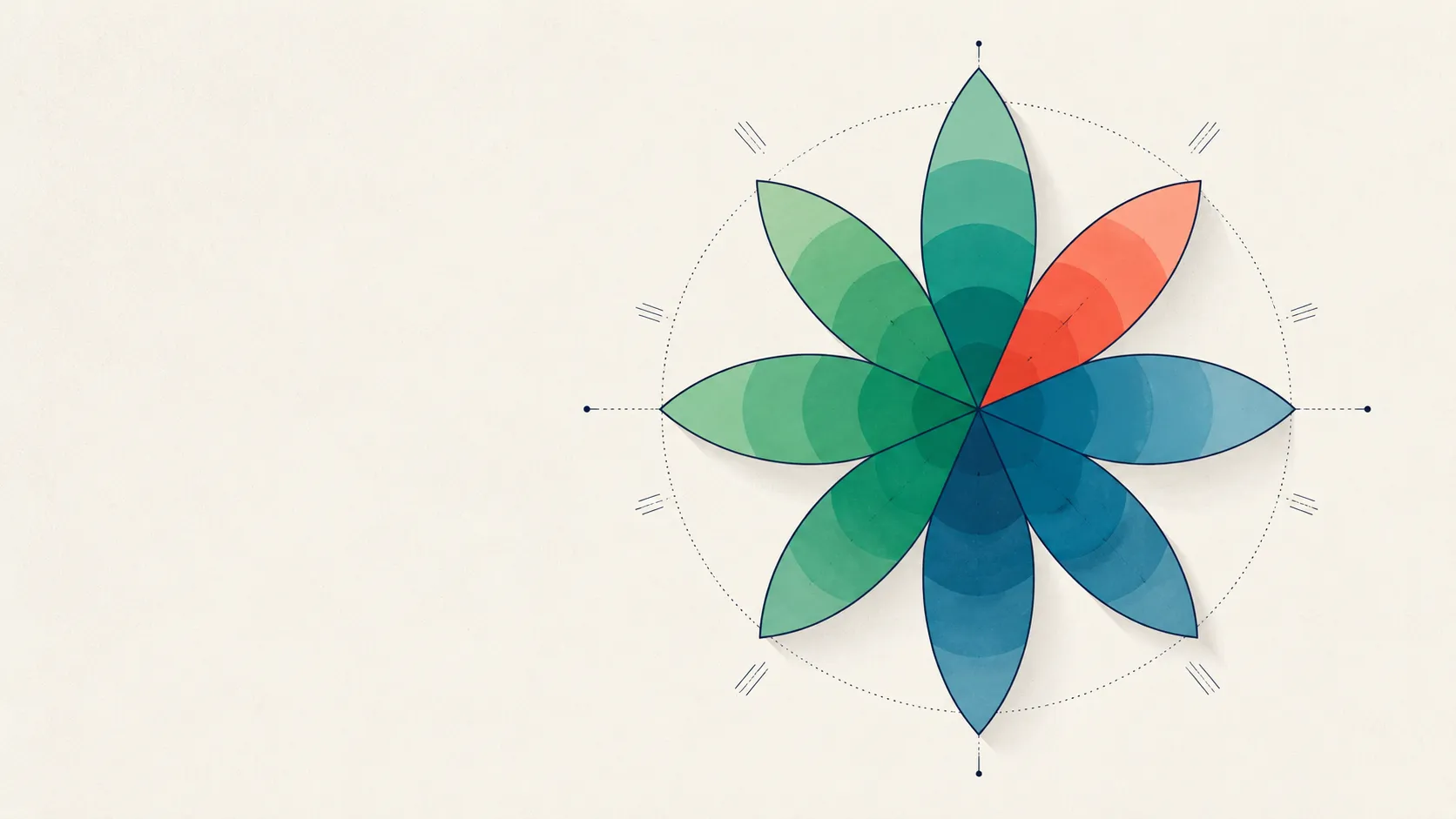
Plutchik’s wheel of emotions arranges affect into eight primary emotions set in four opposing pairs: joy against sadness, trust against disgust, fear against anger, and surprise against anticipation (Plutchik, 1980). What makes the wheel more than a pretty diagram is the structure underneath it. Each primary comes in graded intensities, opposites sit across from each other, and neighbors blend into named blends called dyads. That structure is exactly why the model outlived its 1980 origins and became a default label set for emotion annotation—including one of the most-used lexicons in natural language processing.
What is Plutchik’s wheel of emotions?
Plutchik’s wheel of emotions is a model that organizes affect into eight primary emotions, arranged so that opposites sit across from one another and related emotions sit side by side (Plutchik, 1980). Robert Plutchik built it on a psychoevolutionary argument: emotions are adaptive reactions with survival value that can be traced, in some form, across the whole animal kingdom, not just in humans.
The visual is a color wheel for feelings. Move around the rim and you pass through the eight primaries; move inward toward the center and the same emotion intensifies; fold the flat wheel into a cone and the vertical axis becomes intensity. Plutchik was blunt about why the field needed a structure at all—he opened his 2001 restatement by noting that “more than 90 definitions of ‘emotion’ were proposed over the course of the 20th century” (Plutchik, 2001). A wheel is an attempt to impose order on that mess.
Two design choices make the model useful for anyone who has to label emotion rather than theorize about it: emotions have degrees, and they combine. Both are things a flat list of categories cannot express, and both matter the moment you try to tag real speech.
What are the eight primary emotions?
The eight primary emotions are joy, trust, fear, surprise, sadness, disgust, anger, and anticipation, organized into four pairs of opposites (Plutchik, 1980). Each primary has an emotion directly across the wheel that it cannot co-occur with in the same moment—you are not joyful and sad about the same thing at the same instant.
| Primary emotion | Its opposite | Adaptive function (Plutchik) |
|---|---|---|
| Joy | Sadness | Gain / reproduce—hold on to what rewards you |
| Trust | Disgust | Affiliate / incorporate what is safe |
| Fear | Anger | Protect—withdraw from threat |
| Anger | Fear | Destroy—remove an obstacle |
| Sadness | Joy | Reintegrate after loss; signal for help |
| Disgust | Trust | Reject / expel what is harmful |
| Surprise | Anticipation | Orient—reset attention to the unexpected |
| Anticipation | Surprise | Explore / prepare for what is coming |
The adaptive framing is what separates Plutchik from a simple sentiment list. He argued each primary is the felt side of a behavioral response that helped organisms survive: fear drives withdrawal, disgust drives rejection, anticipation drives exploration. You can see the complete set of definitions on the Plutchik’s Wheel of Emotions scale page.
How do intensity and opposites work?
Each primary emotion exists at three intensities, so the eight primaries expand into 24 graded states (Plutchik, 1980). Intensity is the wheel’s radial axis: the mild version sits on the outer rim, the primary in the middle, and the most intense version toward the center.
| Mild | Primary | Intense |
|---|---|---|
| Serenity | Joy | Ecstasy |
| Acceptance | Trust | Admiration |
| Apprehension | Fear | Terror |
| Distraction | Surprise | Amazement |
| Pensiveness | Sadness | Grief |
| Boredom | Disgust | Loathing |
| Annoyance | Anger | Rage |
| Interest | Anticipation | Vigilance |
For an annotator, intensity is not a nicety—it is often the whole point. “It’s a little annoying” and “I could scream” are both anger, but tagging them identically throws away the signal that separates a mild complaint from a crisis. The wheel gives you a principled vocabulary for that gradient instead of an ad-hoc 1-to-5 slider.
What are emotion dyads?
Emotion dyads are the blends formed when two primary emotions combine, and Plutchik named the eight formed by adjacent primaries (Plutchik, 1980). They are how the model represents mixed feelings—the everyday reality that a single moment can carry two emotions at once.
| Dyad | Primary + Primary | Everyday reading |
|---|---|---|
| Love | Joy + Trust | Warmth toward someone you rely on |
| Submission | Trust + Fear | Deferring to someone more powerful |
| Awe | Fear + Surprise | Struck by something vast or sudden |
| Disapproval | Surprise + Sadness | Let down by an unexpected turn |
| Remorse | Sadness + Disgust | Regret over one's own act |
| Contempt | Disgust + Anger | Scornful rejection of another |
| Aggressiveness | Anger + Anticipation | Readiness to confront |
| Optimism | Anticipation + Joy | Looking forward with hope |
Dyads are where the wheel earns its keep for fine-grained work. “Love” and “contempt” are not on the eight-emotion list, yet both are common in interview and social-media text, and both decompose cleanly into primaries you can tag. That gives you a way to record a rich emotion without inventing an unbounded label set.
Plutchik vs Ekman: which model for a labeling scheme?
Ekman’s model gives you six discrete basic emotions; Plutchik’s gives you eight primaries plus intensities and blends—so the choice comes down to granularity against agreement. Ekman anchored his six (anger, disgust, fear, happiness, sadness, surprise) in universal facial expressions and treated them as separate families with no formal geometry (Ekman, 1992). Plutchik’s eight add trust and anticipation and wire the whole set together with opposites and dyads.
| Ekman (1992) | Plutchik (1980) | |
|---|---|---|
| Number of categories | 6 basic emotions | 8 primaries |
| Primary evidence | Universal facial expressions | Psychoevolutionary / adaptive function |
| Intensity built in? | No formal ladder | Yes—3 levels per primary |
| Blends built in? | No | Yes—named dyads |
| Set relationship | Subset of Plutchik's eight | Superset (adds trust, anticipation) |
| Negative-emotion skew | Higher (4 of 6 negative) | Balanced (4 positive-leaning) |
| Best for | High-agreement coarse labels | Fine-grained, mixed, graded emotion |
There is a real trade-off here, and it is not decided by which theory is “more correct.” More categories give finer resolution but lower inter-annotator agreement, because there are more boundaries for two coders to disagree about. Whichever taxonomy you pick, the agreement it produces is measurable—and worth measuring with a coefficient like Cohen’s kappa rather than raw percent agreement. For the head-to-head at the category level, see the Ekman’s basic emotions guide.
Why NLP teams still reach for Plutchik’s eight
Plutchik’s eight emotions are the default taxonomy behind two widely used affect resources, which is the clearest evidence that the model is more than a psychology-class diagram. The NRC Emotion Lexicon (EmoLex) annotates about 14,000 words for exactly these eight emotions plus positive and negative sentiment, in 40-plus languages (Mohammad & Turney, 2013).
Its authors were explicit about why they chose Plutchik. In their words, the set was preferred because, “unlike some other choices, for example that of Ekman, it is not composed of mostly negative emotions” and “it is a superset of the emotions proposed by some others” (Mohammad & Turney, 2013). The same eight primaries, plus the dyads love, optimism, and pessimism, form the eleven-label scheme of the SemEval-2018 emotion-classification task (Mohammad et al., 2018).
The wheel is not the last word, though, and honesty about that is part of using it well. Newer, data-driven work argues emotion is higher-dimensional than any eight-category scheme: analyzing more than 2,000 evocative videos, Cowen and Keltner (2017) found 27 distinct categories of emotion “bridged by continuous gradients” rather than sharp boundaries.
The Google-built GoEmotions dataset followed that lead with 27 categories, not Plutchik’s eight (Demszky et al., 2020). The practical read: Plutchik’s eight remain the sweet spot when you want balanced coverage and coders who can actually agree, while a 27-category scheme buys resolution you may not be able to label reliably.
How to label emotion in a transcript with Plutchik’s wheel
To use Plutchik’s wheel on a transcript, tag the span where the speaker expresses an emotion in their own words, assign the primary, and optionally mark the intensity—rather than rating a whole passage with a single global impression. Plutchik’s scheme is an instance-mode taxonomy: you mark the utterance that is the emotion, not a severity score for the interview as a whole.
Consider a short synthetic exchange:
Interviewer: How did you feel when the results finally came back?
Subject: I couldn’t sit still. I kept refreshing my email, half sure it was going to be bad news.
That reply supports tagging anticipation on “I kept refreshing my email” and a thread of fear on “sure it was going to be bad news”—and the blend of the two is exactly Plutchik’s dyad for anxiety-like readiness. Tagging the spans, rather than labeling the turn “negative,” keeps the evidence attached to the label so a second coder can check it. That is what makes the Plutchik emotion taxonomy reproducible enough to compute agreement across annotators.
On data handling: emotion labeling usually means working with personal, sometimes sensitive text, so the sane default is de-identified data and a privacy-first setup. Tagaroo supports a browser-side anonymous mode, so content can stay local rather than being uploaded—worth checking against your ethics approval before real data touches any tool. If you want the coarser, higher-agreement option instead, the same evidence-first approach applies to Ekman’s six basic emotions, and the qualitative lineage of coding affect from language runs back through Gottschalk-Gleser content analysis.
Common mistakes when using the wheel
The most common mistake is treating Plutchik’s wheel as a validated measurement instrument rather than a labeling framework, but a few others recur:
- Ignoring intensity. Collapsing serenity, joy, and ecstasy into one “joy” tag discards the gradient that is half of what the wheel offers. Record the intensity when the text supports it.
- Forcing single labels onto mixed feelings. Real utterances carry blends. Use the dyads (love, remorse, contempt) or tag two primaries rather than picking one and losing the other.
- Coding the interviewer’s words. Emotion words in a question (“did that make you angry?”) are not the subject’s emotion. Tag what the speaker expresses, not what the prompt names.
- Comparing agreement across different schemes. Kappa on an eight-category scheme is not comparable to kappa on a six-category one; the number of categories changes the ceiling. State the scheme alongside the coefficient.
None of these are reasons to avoid the wheel—it is compact, balanced, and structured in a way that suits real annotation. They are reasons to use it deliberately: pick the granularity your coders can sustain, keep intensity and blends when the text earns them, and measure the agreement you actually get.
The practical upshot: Plutchik’s wheel of emotions is valuable precisely because it is more than a list—opposites, intensities, and dyads give you a vocabulary for graded, mixed emotion that a flat category set can’t express. Use it as a framework to operationalize, ground every label in the words that justify it, and pick the taxonomy for the resolution your project can reliably reach.
References
- Plutchik, R. (1980). A general psychoevolutionary theory of emotion. In R. Plutchik & H. Kellerman (Eds.), Emotion: Theory, Research, and Experience, Vol. 1 (pp. 3–33). Academic Press. doi:10.1016/B978-0-12-558701-3.50007-7
- Plutchik, R. (2001). The nature of emotions. American Scientist, 89(4), 344–350. doi:10.1511/2001.28.344
- Ekman, P. (1992). An argument for basic emotions. Cognition and Emotion, 6(3–4), 169–200. doi:10.1080/02699939208411068
- Cowen, A. S., & Keltner, D. (2017). Self-report captures 27 distinct categories of emotion bridged by continuous gradients. Proceedings of the National Academy of Sciences, 114(38), E7900–E7909. doi:10.1073/pnas.1702247114
- Mohammad, S. M., & Turney, P. D. (2013). Crowdsourcing a word–emotion association lexicon. Computational Intelligence, 29(3), 436–465. doi:10.1111/j.1467-8640.2012.00460.x
- Mohammad, S. M., Bravo-Marquez, F., Salameh, M., & Kiritchenko, S. (2018). SemEval-2018 Task 1: Affect in tweets. Proceedings of the 12th International Workshop on Semantic Evaluation, 1–17. aclanthology.org
- Demszky, D., Movshovitz-Attias, D., Ko, J., Cowen, A., Nemade, G., & Ravi, S. (2020). GoEmotions: A dataset of fine-grained emotions. Proceedings of the 58th Annual Meeting of the ACL, 4040–4054. aclanthology.org
If you build emotion-labeled datasets from interviews or social text, Tagaroo turns Plutchik’s wheel of emotions into a guided, evidence-anchored annotation workflow—with inter-rater reliability computed as your coders work.
Frequently asked questions
- What are the 8 emotions in Plutchik's wheel?
- Plutchik's wheel has eight primary emotions arranged in four opposing pairs: joy and sadness, trust and disgust, fear and anger, and surprise and anticipation (Plutchik, 1980). Each primary also comes in three intensities—for example annoyance, anger, and rage—and adjacent primaries blend into named dyads such as joy plus trust equals love.
- What is the difference between Plutchik and Ekman?
- Ekman proposed six discrete basic emotions grounded in universal facial expressions—anger, disgust, fear, happiness, sadness, and surprise (Ekman, 1992). Plutchik proposed eight primaries on a psychoevolutionary basis, adding trust and anticipation, plus a formal structure of intensities, opposites, and blends (Plutchik, 1980). Plutchik's set is a superset of Ekman's and is less skewed toward negative emotions.
- What are the primary dyads in Plutchik's wheel?
- Primary dyads are the emotions formed by two adjacent primaries: joy + trust = love, trust + fear = submission, fear + surprise = awe, surprise + sadness = disapproval, sadness + disgust = remorse, disgust + anger = contempt, anger + anticipation = aggressiveness, and anticipation + joy = optimism (Plutchik, 1980).
- Why do NLP teams use Plutchik's eight emotions?
- The NRC Emotion Lexicon, one of the most-used affect resources in NLP, annotates roughly 14,000 words for Plutchik's eight emotions plus positive/negative sentiment (Mohammad & Turney, 2013). Its authors chose Plutchik because the set is balanced rather than mostly negative, is a superset of Ekman's six, and has a clean opposition structure. SemEval-2018's emotion task uses the same eight primaries plus three dyads.
- Is Plutchik's wheel scientifically valid?
- Plutchik's wheel is an influential theoretical model, not a validated measurement instrument, and modern data-driven work finds emotion is higher-dimensional than any small fixed set—Cowen and Keltner (2017) reported 27 categories bridged by continuous gradients. The wheel remains useful as a labeling taxonomy precisely because it is compact and structured, but it is a framework to operationalize, not a diagnostic tool.
Keep reading
 Clinical Phenomena
Ekman vs Plutchik: Which Emotion Model to Label With?
Ekman vs Plutchik for annotation: 6 discrete emotions or 8 with intensities and dyads, and why more categories lower agreement. See which to pick.
 Clinical Phenomena
Cognitive Distortions List: 10 CBT Patterns, Coded
The cognitive distortions list, explained: all 10 CBT thinking errors with definitions and examples, where the list came from, and why they resist coding.
 Clinical Phenomena
Ekman's Basic Emotions: The Six, and How to Label Them
Ekman's basic emotions are six universal states: anger, disgust, fear, happiness, sadness, surprise. See why they anchor most emotion datasets.
Put this into practice
Tagaroo turns any rating scale or coding scheme into a guided annotation workflow—with inter-rater reliability computed as you go.