How to Write Annotation Guidelines That Reduce Disagreement
Write annotation guidelines that reduce annotator disagreement: operational definitions, positive and negative examples, and an edge-case decision log.
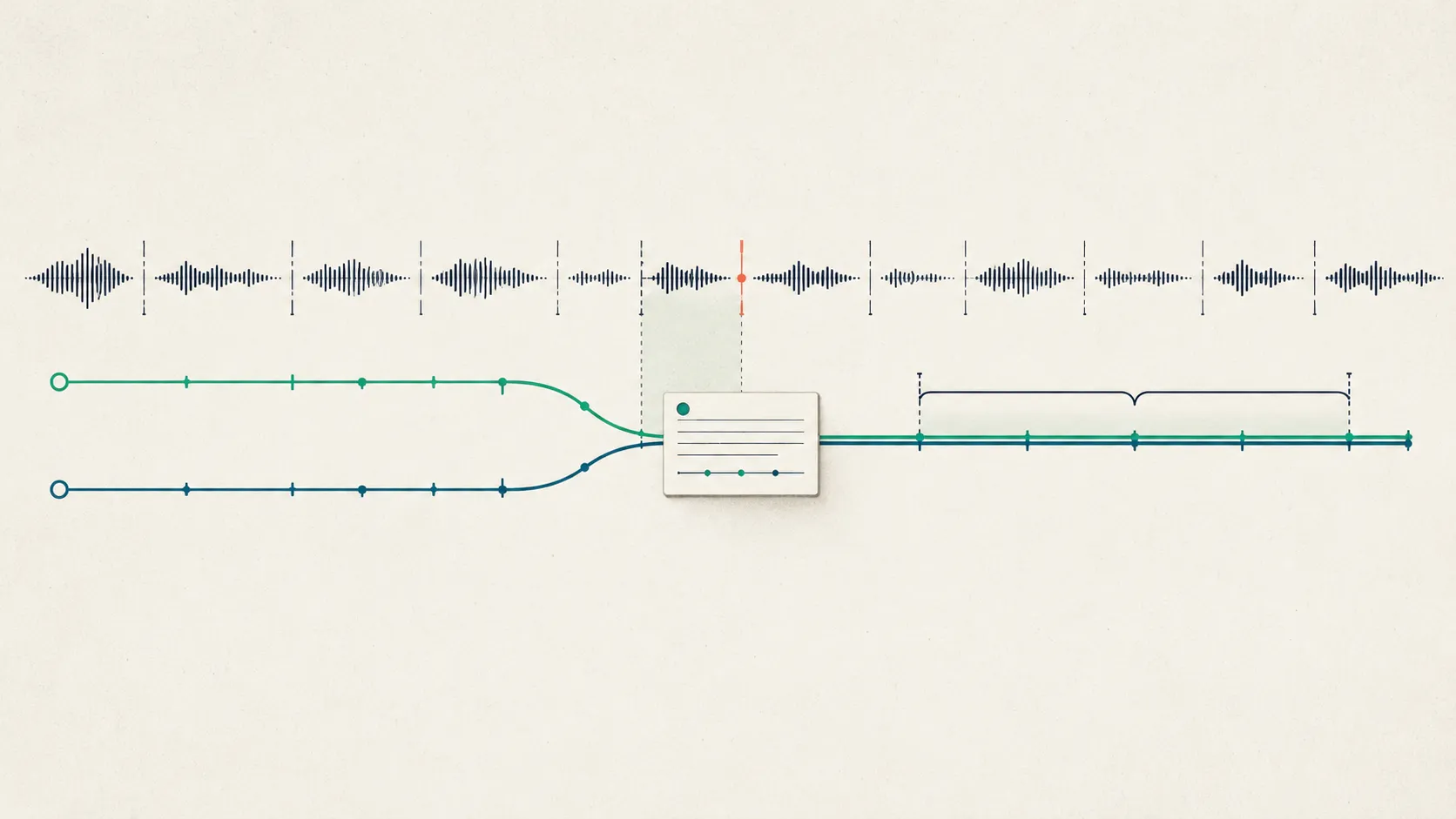
The fastest way to make two annotators agree is also the fastest way to make them both wrong. Write a guideline vague enough and coders will quietly converge on the easy reading of every hard case: high agreement, low validity. Good annotation guidelines do the opposite: they push agreement up by removing the ambiguity a tired coder would otherwise resolve by guessing, without smoothing over the disagreements that actually mean something. In a meta-analysis of 96 annotation studies, trained coders averaged 81% agreement against 70% for untrained ones, and agreement fell steadily as schemes added categories (Bayerl & Paul, 2011).
This is a working guide to writing annotation guidelines that reduce disagreement: how to turn a vague instruction into an operational definition, why every category needs a positive and a negative example, how to write boundary rules for the cases that overlap, and how to keep an edge-case decision log so the scheme learns instead of drifting. The examples are synthetic clinical-transcript snippets, but the mechanics transfer to any labeling task, from named-entity spans to image classes.
What makes annotation guidelines usable?
Usable annotation guidelines are the ones where two people who never spoke to each other produce the same labels. That is the only test that matters, and it is stricter than it sounds. A manual can be exhaustive and still be unusable if the exhaustiveness lives in prose a coder skims once and never reopens. The working definition of quality is operational: agreement between independent coders on held-out material, not the page count of the instructions.
This reframes the whole exercise. You are not documenting a category system; you are writing a decision procedure a non-expert can run in a few seconds per span. Corpus annotation only became reliable once the field started treating the scheme itself as the object under test, with explicit attention to consistency and validity rather than to how principled the categories looked on paper (Hovy & Lavid, 2010). Every sentence in the guidelines should change a label somewhere; if a paragraph does not resolve a choice a coder actually faces, it is decoration, and decoration is where consistency leaks away.
The stakes are quantifiable. Bayerl and Paul’s (2011) synthesis of 346 agreement indices found that agreement is not a fixed property of a task but moves with decisions you control: whether coders were trained, how homogeneous their expertise was, and how many categories the scheme carried. That is the good news. It means guidelines are a lever, not a formality.
Vague vs operationalized: a before-and-after
The single highest-impact move is converting a vague instruction into an operational definition. A vague guideline names the category and trusts the coder to fill the gap; an operational one specifies the observable trigger, the inclusions, the exclusions, and the contrast with the nearest neighbor. Consider a synthetic snippet of subject speech an annotator has to label for formal thought disorder:
S: “I was heading to the pharmacy, and pharmacies always have that smell, and my grandmother’s kitchen had the same smell, she cooked every Sunday, Sundays were quieter back then.”
Is that derailment or tangentiality? Under a one-line instruction, two conscientious coders will split. Under an operational definition, the answer is a lookup. Here is the same guideline written both ways, grounded in the TLC glossary’s operational definitions for disorganized speech (Andreasen, 1986).
| Guideline element | Vague version (guessable) | Operationalized version (applicable) |
|---|---|---|
| Operational rule | "Label derailment when the subject goes off topic." | "Derailment = the reply slips from one idea to an obliquely related or unrelated idea between clauses, with no sign the speaker notices the shift." |
| Inclusion | (unstated) | Idea-to-idea slippage within a single turn; the link between clauses is oblique or absent. |
| Exclusion | (unstated) | A reply that over-elaborates but stays on the thread and returns to the point (that is Circumstantiality); a reply that answers, then drifts on a related aside (that is Tangentiality). |
| Positive example | (none) | "Where do you live?" "In an apartment, and apartments are just boxes really, boxes remind me of the ships that come into the harbor." |
| Negative example (contrastive) | (none) | "Where do you live?" "Downtown, near the harbor, which is loud but I like watching the ships." This stays linked to the question: Tangentiality at most, not Derailment. |
| When in doubt | (none) | If you cannot decide between Derailment and Tangentiality in about ten seconds, apply the 'uncertain' label and log the case rather than committing a silent guess. |
Notice what the operational version is not: it is not more verbose everywhere. It adds words only where a word removes a real ambiguity. That discipline keeps a guidelines document usable at scale instead of becoming a wall of text nobody rereads. If your scheme starts from a published instrument, the same idea applies to the whole thing at once, which is the subject of turning a scale into a working codebook.
Why every definition needs a positive and a negative example
Every category needs at least one positive and one negative example because the boundary between two categories is almost always easier to show than to write. A single well-chosen negative example, a near-miss that belongs to the neighboring category, resolves an ambiguity that three paragraphs of prose leave open. The exclusion rule and the negative example do the heavy lifting in any definition, because boundaries are defined by what sits just outside the category.
Clinical coding schemes learned this decades before the phrase “annotation guidelines” existed. The TLC glossary pairs each item with an operational definition and verbatim examples, and it goes further by adding contrastive guidance for the pairs that blur, spelling out how to choose Tangentiality versus Derailment or Circumstantiality versus Loss of Goal (Andreasen, 1986). That is exactly the structure a modern span-labeling scheme needs, and it is why an example is not a decoration on top of the definition but part of the definition itself.
There is a measurement reason to prefer positives and negatives over more prose, too. In Bayerl and Paul’s (2011) synthesis, more intensively trained coders reached markedly higher agreement (about 86% at high training intensity versus 70–75% at lower levels), while whether a group’s expertise was homogeneous or mixed made no significant overall difference. Worked examples are how you deliver that training cheaply: they align a team on the same reading and make onboarding faster and more uniform. Fewer words, more worked cases, is usually the better trade.
How do you write boundary rules for overlapping categories?
You write boundary rules by refusing to leave a tie to intuition. When two categories can both apply to the same span, name which one wins and why, in a rule a coder looks up rather than reasons through. Two moves carry most of the weight: a priority order and a contrastive rule.
- Priority order. State which label wins when two apply. “If a span qualifies as both Derailment and Tangentiality, code Derailment” turns a coin flip into a lookup. The order is documented once and applied identically by everyone.
- Contrastive rules. Write “A vs B” notes that name the one feature separating near neighbors. For Tangentiality vs Derailment, the deciding feature is whether the reply ever engages the question before drifting; state that feature explicitly instead of hoping coders infer it.
Fewer categories help here for a structural reason, not just a stylistic one: agreement fell as schemes grew, at β = −0.28 (p < 0.001) across the meta-analysis, replicated in every domain examined (Bayerl & Paul, 2011). Each category you add is another boundary a coder can misjudge. Collapse distinctions your research question does not need, and let coders label at the level they are confident, rolling finer labels up from coarser ones rather than forcing false precision.
How do you document edge cases? Keep a decision log
Document edge cases with a running decision log: a dated table where every hard call becomes a ruling with a short rationale and, when warranted, a new rule folded back into the guidelines. The log is the mechanism that turns a one-off judgment into shared precedent, so the tenth coder inherits the first coder’s resolved cases instead of re-deciding them. Without it, a scheme drifts, and agreement decays as the team grows and each new person quietly reinvents the boundaries.
Each entry answers four questions: what was the case, what question did it raise, what did you decide, and what rule did that produce? Keep it lightweight enough that logging a case is faster than debating it in a meeting. Date every row, because the date is what lets you re-audit later.
| Date | Case (synthetic) | Question | Ruling | Rule added to guidelines |
|---|---|---|---|---|
| 2026-03-04 | Subject answers the question fully, then drifts onto a related aside and stops | Derailment or Tangentiality? | Tangentiality | "If the reply engages the question before drifting, it is Tangentiality, not Derailment." |
| 2026-03-11 | A quoted song lyric that is loosely on-theme | Code the lyric as the subject's speech? | Do not code | "Exclude verbatim quotations, song lyrics, and read-aloud text from thought-disorder coding." |
| 2026-03-19 | Two derailments inside one long turn | One span or two? | Two spans | "Label each distinct slippage separately, even within a single turn." |
| 2026-04-02 | Interviewer interrupts mid-clause, subject restarts | Is the broken clause codeable? | Do not code the fragment | "When an external interruption breaks a clause, code only complete subject-produced utterances." |
The decision log is also your cheapest audit trail. Because it timestamps every ruling, you can tell exactly when a boundary changed and re-check only the material coded under the old rule, rather than re-reviewing everything. That property, decisions you can trace back to a rule and a date, is the same discipline behind auditable, span-grounded scoring, and it is what makes a coding decision defensible to a reviewer months later.
How do you version annotation guidelines?
Version annotation guidelines the way you version code: every substantive change gets a date and a reason, and you can reconstruct which rules were in force when any batch was labeled. A decision log gives you this almost for free, because each new rule is already dated. The missing piece is a version stamp on the guidelines document itself, so a coder can see at a glance whether they are working from the current rules.
Two practices keep versioning honest. First, when a decision-log ruling changes an existing definition rather than adding a new one, flag the batches labeled under the superseded definition; those are your relabeling candidates. Second, freeze the guidelines during a labeling run and batch changes between runs, so a single dataset is never labeled under two different definitions of the same category. Silent mid-run changes are how a scheme develops an invisible seam that surfaces later as unexplained disagreement.
This is not bureaucracy for its own sake. It is what lets you answer the question a careful reviewer eventually asks, which is not “what is your kappa” but “which rules produced these labels, and when did they change.” Guidelines without a version history cannot answer it.
How do you test annotation guidelines before scaling?
Test annotation guidelines the way you would test any instrument: on a small pilot, with more than one coder, measured with a chance-corrected statistic before you commit the budget. Have at least two coders independently label the same modest sample, then treat every disagreement as a bug report against a definition rather than a fault of the coder. This is the inner loop of the annotation development cycle Pustejovsky and Stubbs (2012) call Model-Annotate-Model-Annotate: annotate a little, inspect the disagreements, revise the model of the task, and annotate again.
Measure with a chance-corrected coefficient such as Cohen’s kappa, not raw percent agreement, because raw agreement flatters rare categories and hides the disagreements that matter (Artstein & Poesio, 2008). Our guide to Cohen’s kappa and inter-rater reliability covers the mechanics; when many coders label many items, Krippendorff’s alpha, computed step by step generalizes the same idea. Watch which categories drive the disagreement, rewrite those definitions, add the resolved cases to the decision log, and re-run. When agreement stops climbing, the scheme is stable enough to scale.
Two practical notes. Decide how many coders you actually need for the reliability you want before the pilot, not after, a question we work through in how many annotators you need. And remember that crowd or non-expert coders can reach usable agreement on a well-specified scheme but degrade fast on an ambiguous one, so the pilot is also a test of whether your definitions survive contact with coders who did not help write them (Nowak & Rüger, 2010). Get the guidelines stable first; scale second.
What curated clinical scales teach guideline writing
Curated clinical scales are, in effect, annotation guidelines that have already survived decades of piloting, and they are worth studying as worked examples. Each one is a published coding manual with the properties this article argues for: operational definitions, verbatim examples, contrastive rules for near neighbors, and an explicit rating procedure.
The TLC scale for thought, language, and communication is the clearest model for span labeling: every item has an operational definition plus examples, and the glossary spells out how to separate the pairs that blur (Andreasen, 1986). The Montgomery-Åsberg Depression Rating Scale shows the anchored-severity pattern, where each of ten items carries defined severity levels so different raters map the same interview onto the same score, by design sensitive to change (Montgomery & Åsberg, 1979). And a heavily scripted protocol like the NICHD investigative interview scheme shows how far operationalization can go when stakes are high, specifying not just categories but the exact prompt types an interviewer may use (Lamb et al., 2007). Borrow their structure even when your categories are your own.
Where Tagaroo fits: guidelines as a shared discipline
The discipline in this article, turning a coding scheme into a decision procedure and measuring whether coders actually agree, is exactly what Tagaroo is built around. The curated scales above ship as pre-written, battle-tested guidelines: operational definitions, examples, and contrastive rules, presented as a guided workflow with inter-rater reliability computed as coders work. You are not starting from a blank manual; you are starting from an instrument that already reduced disagreement in the literature.
It generalizes beyond clinical text. The same structure that separates Derailment from Tangentiality separates a “rider” from a “pedestrian” in an image scheme, which is why the guideline mechanics here match the ones in image labeling taxonomy design. Definitions, negative examples, boundary rules, a decision log, and a pilot are modality-agnostic. If you try Tagaroo on your own data, annotations stay scoped to your project and are never used to train shared models; see our privacy policy for specifics.
The practical upshot: judge your annotation guidelines by whether strangers agree, operationalize every category into a rule with a positive and a negative example, resolve overlaps with priority and contrastive rules, log and date every edge case, and prove the scheme on a small pilot before you spend the budget. Guidelines are the cheapest place to buy agreement, and the most expensive place to skimp.
References
- Bayerl PS, Paul KI. What Determines Inter-Coder Agreement in Manual Annotations? A Meta-Analytic Investigation. Comput Linguist. 2011;37(4):699-725. DOI · ACL Anthology
- Artstein R, Poesio M. Survey Article: Inter-Coder Agreement for Computational Linguistics. Comput Linguist. 2008;34(4):555-596. DOI
- Pustejovsky J, Stubbs A. Natural Language Annotation for Machine Learning: A Guide to Corpus-Building for Applications. O’Reilly Media; 2012. ISBN 9781449306663.
- Hovy E, Lavid J. Towards a “Science” of Corpus Annotation: A New Methodological Challenge for Corpus Linguistics. Int J Transl. 2010;22:13-36.
- Nowak S, Rüger S. How Reliable Are Annotations via Crowdsourcing? A Study About Inter-Annotator Agreement for Multi-Label Image Annotation. MIR ’10. 2010:557-566. DOI
- Andreasen NC. The Scale for the Assessment of Thought, Language, and Communication (TLC). Schizophr Bull. 1986;12(3):473-482. DOI
- Montgomery SA, Åsberg M. A New Depression Scale Designed to Be Sensitive to Change. Br J Psychiatry. 1979;134:382-389. DOI
- Lamb ME, Orbach Y, Hershkowitz I, Esplin PW, Horowitz D. A structured forensic interview protocol improves the quality and informativeness of investigative interviews with children: A review of research using the NICHD Investigative Interview Protocol. Child Abuse Negl. 2007;31(11-12):1201-1231. DOI
If your labeling problem is clinical language or structured text, Tagaroo turns curated schemes like the TLC and MADRS into guided, reliability-tracked workflows with the guideline discipline built in.
Frequently asked questions
- How do you write annotation guidelines that reduce disagreement?
- Turn every instruction into a decision procedure a tired coder can run in seconds: a one-line operational rule, an explicit inclusion rule, an exclusion rule, a positive example, and a contrastive negative example that belongs to the neighboring category. Keep the scheme small, because agreement falls as the number of categories rises, and train coders on it, because trained annotators averaged 81% agreement versus 70% for untrained ones across 96 studies (Bayerl & Paul, 2011). Then test the guidelines on a small pilot and revise the definitions that produced disagreement before scaling.
- What is the difference between a vague and an operationalized annotation guideline?
- A vague guideline names the category and hopes ('label derailment when the subject goes off topic'); an operationalized one specifies the observable trigger, what is included, what is excluded, and how to tell it from its nearest neighbor, with worked examples. The distinction matters because vague guidelines can raise agreement while lowering validity, as coders quietly converge on the easy reading of every hard case. Corpus annotation is only reliable when the scheme is specified precisely enough to be applied consistently by different people (Hovy & Lavid, 2010).
- What is an edge-case decision log?
- An edge-case decision log is a running, dated table where every hard call becomes a ruling with a short rationale and, when needed, a new rule folded back into the guidelines. Each entry records the case, the question it raised, the decision, and the rule it produced, so the tenth coder inherits the first coder's resolved cases instead of re-litigating them. It is the mechanism that turns one-off judgments into shared precedent and keeps a revise step honest, in the spirit of the Model-Annotate-Model-Annotate cycle (Pustejovsky & Stubbs, 2012).
- How do you test annotation guidelines before scaling?
- Run a small pilot: have at least two coders independently label the same modest sample, compute a chance-corrected agreement statistic such as Cohen's kappa rather than raw percent agreement, then treat every disagreement as a bug report against a definition (Artstein & Poesio, 2008). Revise the definitions that failed, add the resolved cases to the decision log, and re-run until agreement stabilizes. Only then commit the full budget, because fixing a category after thousands of items are labeled means relabeling them (Pustejovsky & Stubbs, 2012).
- Do more categories reduce annotator agreement?
- Yes. In a meta-analysis of 96 annotation studies, inter-annotator agreement fell steadily as the number of categories in a coding scheme rose (β = −0.28, p < 0.001), a relationship that held across all three domains examined (Bayerl & Paul, 2011). The practical rule is to use the fewest categories your question can tolerate, roll finer distinctions up from coarser ones where you can, and add an explicit 'uncertain' label so coders are not forced to invent precision the scheme cannot support.
Keep reading
 Methods & Frameworks
Rating Scale to Codebook: Operationalize Any Instrument
A step-by-step method to go from rating scale to codebook: turn each item into a code, anchors, examples, and decision rules coders apply consistently.
 Reliability & Agreement
Cohen's Kappa: How to Compute and Interpret Agreement
How to compute Cohen's kappa and weighted kappa by hand, read the result honestly, and know when to use Krippendorff's alpha, ICC, or Gwet's AC1 instead.
 Rating Scales
Auditable Clinical Ratings: Score From the Transcript
Build an auditable clinical rating by tying every scale item to a quoted line, not a global impression. See how span-grounded scoring works.
Put this into practice
Tagaroo turns any rating scale or coding scheme into a guided annotation workflow—with inter-rater reliability computed as you go.