Multimodal Annotation for Foundation Models: One Schema
Annotate aligned text, image, and audio in one schema for foundation models: cross-modal alignment, unified taxonomies, and QA that keeps labels in sync.
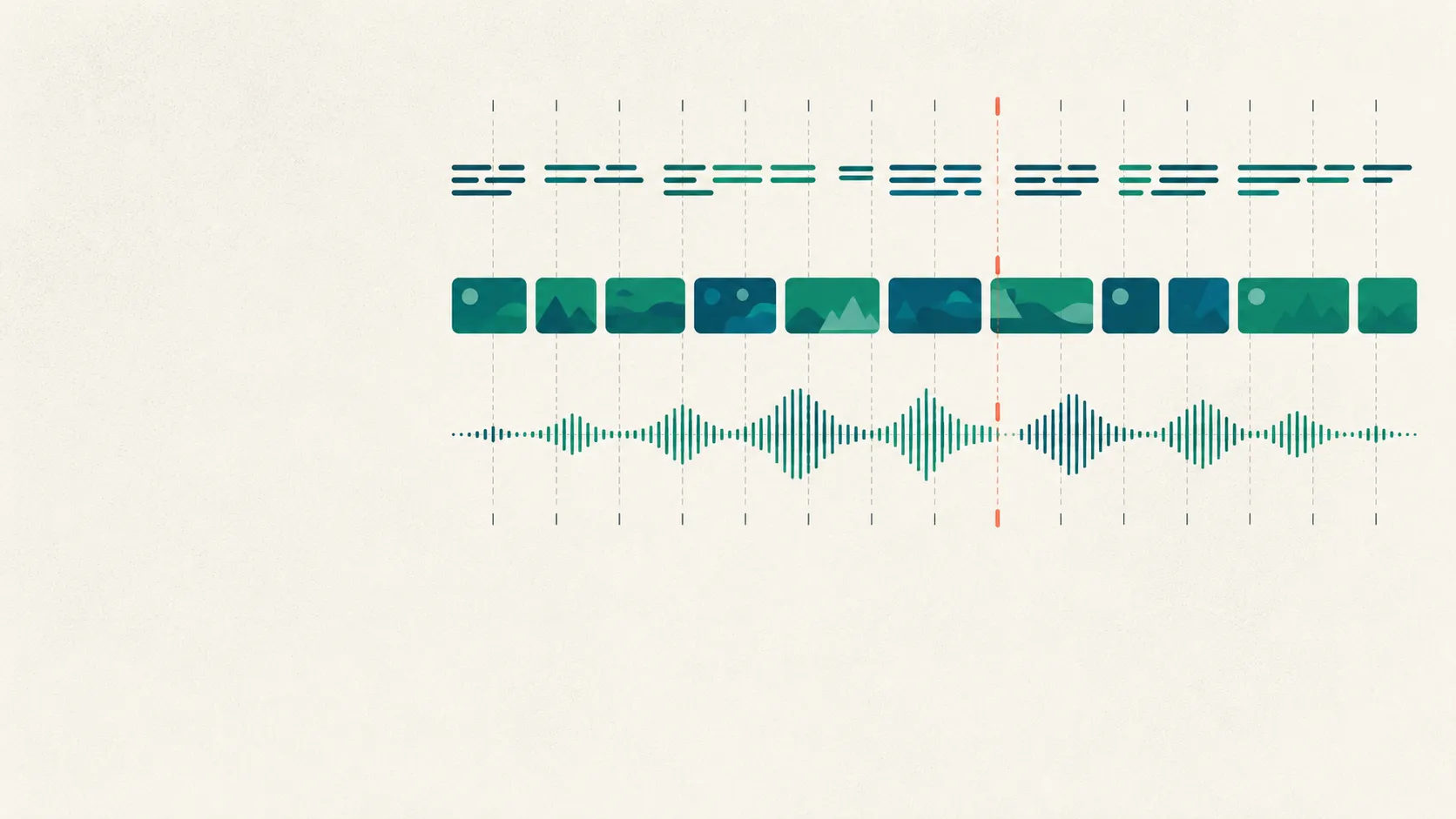
Multimodal annotation for foundation models is the practice of labeling aligned text, image, and audio as one linked record, so a model learns how a single moment reads, looks, and sounds at the same time—not as three disconnected label sets. It is the data problem sitting underneath every model that can look at a photo, listen to a clip, and answer in words, and it stays invisible until you try to build the dataset yourself.
The modern recipe runs on paired data at a scale that is hard to picture. CLIP was pretrained on 400 million image-text pairs scraped from the internet (Radford et al., 2021); Whisper on 680,000 hours of audio and transcripts (Radford et al., 2022). But a pile of co-occurring text, pixels, and sound is not annotated ground truth. The value comes from a decision made early and enforced everywhere: one schema that spans all three modalities and keeps their labels aligned.
What is multimodal annotation for foundation models?
Multimodal annotation for foundation models is labeling data that spans more than one modality—text, image, and audio—so the annotations in each modality are explicitly tied together rather than produced as separate jobs. Instead of labeling a transcript, tagging a frame, and marking an audio segment in three unconnected passes, you record how the three line up around the same underlying moment or entity.
That linking is the whole point, because it is what a foundation model needs. A vision-language model such as Flamingo learns from large corpora of interleaved images and text (Alayrac et al., 2022); an audio model such as Whisper learns from speech paired with its transcript (Radford et al., 2022). The correspondence between modalities is the supervision. Break it, and you are training on noise dressed up as ground truth.
Most teams underestimate this because pairing looks free. Two files with the same ID feel aligned. They are not aligned until a schema says, at the level of a span, a region, and a time offset, that this word, this pixel region, and this sound all refer to one thing.
Why does cross-modal alignment matter so much?
Cross-modal alignment matters because it is the single hardest constraint in the whole pipeline: labels that span modalities have to stay in sync, and they break silently when they drift. A dropped frame, a re-transcription that nudges timestamps, a cropped image, or a taxonomy term renamed in the text schema but not the audio schema—any one of these severs links that no error message will flag.
In our own synthetic pilots, the first failure is almost never a wrong label. It is a broken link: a re-transcription shifts word timings by a couple hundred milliseconds, and every audio-to-text alignment quietly points one word to the left. The individual labels still look correct in isolation. The dataset is wrong anyway, because the correspondence is what the model consumes.
The good news is that you do not have to align everything to everything. ImageBind’s central result is that all combinations of paired data are not necessary to learn a joint embedding, and that image-paired data alone is enough to bind six modalities together (Girdhar et al., 2023). That is a design gift for annotators: pick one anchor modality—usually the image or the timeline—and align the rest to it, instead of paying to label every possible modality pair.
One schema, three modalities: the unifying idea
The idea that makes multimodal annotation tractable is a single record shape used for every modality: one annotation is a taxonomy term, a modality, a locator, and an alignment key. The term says what (a label from a shared vocabulary); the modality says where it lives (text, image, audio); the locator says exactly where (a character span, a region box, a time range); and the alignment key is the shared anchor—an example ID plus a timestamp—that ties records across modalities to the same moment.
Get that record shape right and the modalities stop being separate projects. A text span, an image region, and an audio segment that share an alignment key and a term are, by construction, three views of one labeled thing. The table below shows the same discipline applied to each modality: the tasks differ, but the record shape and the thing that ties them together do not.
| Modality | Typical annotation tasks | One label (synthetic) | What ties it to the others |
|---|---|---|---|
| Text | Span tagging, entity linking, classification, preference ranking | Span 'my chest gets tight' → Fear | Example ID + utterance ID + shared term |
| Image / video frame | Bounding box, segmentation, region caption, classification | Box on a face → Fear | Example ID + frame timestamp + shared term |
| Audio | Diarization, event tagging, transcription, prosody rating | Segment 12.4–14.1 s → rising pitch, Fear | Example ID + time offset + shared term |
Naming the levels of alignment keeps a schema honest, because each level buys something different and each fails differently.
| Alignment level | What it links | Shared anchor | What it buys you |
|---|---|---|---|
| Co-reference (coarse) | Samples that describe the same event or entity | An example or clip ID | The model knows the three belong together |
| Temporal (mid) | A text token span, an audio time range, an image frame | A shared time axis | Labels line up moment to moment |
| Semantic (fine) | The label each modality carries | One controlled taxonomy term | A label in one modality is checkable against the others |
How do you scale multimodal annotation for foundation models?
You scale multimodal annotation for foundation models by fixing the schema first, anchoring on one modality, and pushing machine pre-labels through a human review gate—in that order. The sequence matters, because every shortcut taken out of order shows up later as a broken alignment you cannot cheaply repair.
- Define one taxonomy before anyone labels. A shared, controlled vocabulary is what makes a term in text mean the same as the same term in audio. Draft it once and reuse it across modalities.
- Choose an anchor modality. Following ImageBind’s logic, align everything to the image or the timeline rather than labeling every pair (Girdhar et al., 2023). Fewer links, fewer ways to drift.
- Pre-label with models, then gate on humans. Use a captioner, a detector, and a transcriber to draft labels; treat every machine label as a first pass a person confirms. Unreviewed model output is how silent errors enter at scale.
- Version the alignment, not just the labels. Store timestamps, spans, and IDs as first-class fields so a re-transcription or a re-crop updates the links instead of orphaning them.
- Document as you go. Ship a datasheet recording motivation, composition, collection, and recommended uses (Gebru et al., 2021), with per-modality consent and licensing noted.
This is also where instruction and preference data enters the picture. Multimodal instruction tuning does not require humans to write every example: LLaVA generated its instruction-following data by prompting language-only GPT-4 with image annotations, then trained the vision encoder and language model together (Liu et al., 2023). Preference and evaluation data extends ordinary RLHF across modalities—the same ranking task, but the response now references a clip or a region. If that side of the work is new to you, our guide to annotating for RLHF and LLM evaluation covers the ranking and rubric mechanics that carry straight over.
A worked cross-modal example
Take one synthetic moment and run it through the schema. A participant in a recorded interview says a line while their voice tightens and their face reacts, all inside the same two-second window. Three modalities, one moment, one label—if the schema holds.
| Modality | Raw evidence (synthetic) | Label | Alignment key |
|---|---|---|---|
| Audio | Voice tightens, pitch rises across 12.4–14.1 s | Fear (prosodic) | clip_071 · 12.4–14.1 s |
| Text (transcript) | 'my chest gets tight when the phone rings' | Fear (lexical) | clip_071 · utt_09 |
| Video frame | Brow raised, eyes widened, frame at 13.0 s | Fear (facial) | clip_071 · frame_390 |
Now change one detail: suppose the face reads as Surprise while the voice and words read as Fear. Under three separate labeling jobs, that mismatch never surfaces—each modality looks internally fine. Under one aligned schema, it surfaces immediately as three records sharing a key but not a term, which is exactly the disagreement worth a second look. Cross-modal disagreement is not an error to scrub; it is often the most informative label in the set, and only a shared schema makes it visible.
Where curated taxonomies come in
The shared vocabulary at the center of a multimodal schema is not something to invent from scratch, because well-defined coding schemes already exist and travel across modalities cleanly. Emotion is the clearest case: the same affect shows up in the words a person chooses, the prosody of their voice, and the expression on their face, so a single emotion taxonomy can label all three.
Ekman’s basic emotions—anger, disgust, fear, happiness, sadness, and surprise—were argued to be recognized across cultures and carried by distinct, universal signals in the face and voice (Ekman, 1992), which is precisely why the taxonomy ports from text to audio to image without redefinition. When you need finer granularity, Plutchik’s wheel of emotions organizes eight primary emotions into four opposing pairs with intensity and blends (Plutchik, 1980), giving a richer term set for the same cross-modal job. Either one gives you the semantic anchor: a defined term that means the same thing whether it is tagged on a span, a segment, or a region.
The discipline is the same one text annotation has always required—a controlled vocabulary so that “tense,” “anxious,” and “on edge” collapse to one label—only now the label has to hold its meaning across a modality boundary. The mechanics of designing those label sets for each modality are covered in image annotation types explained and the audio and speech annotation guide; the tri-modal version simply insists they share terms.
Where does multimodal annotation break down?
Multimodal annotation breaks at the seams between modalities, and the failures are predictable enough to plan around. Four recur often enough to design against from the start.
Alignment drifts silently. Re-transcription, frame drops, resampling, and cropping all shift the locators that links depend on, and nothing throws an error—so alignment has to be versioned and re-validated, not assumed. This is the failure that turns a clean-looking dataset into a data cascade downstream, where a small upstream data fault compounds into model failures nobody can trace back.
Taxonomies fork per modality. A term renamed or split in the text schema but not the audio schema quietly desynchronizes the semantic layer. One vocabulary, versioned once, is the only defense.
Machine pre-labels get trusted. Captioners, detectors, and transcribers are strong drafters and unreliable oracles; treating their output as truth rather than a human-checked first pass is how noise enters at web scale. The corpora that anchor the field are honest about this—their automatically derived labels ship with smaller, manually validated gold subsets for exactly this reason.
Consent and licensing differ by modality. A face, a voice, and a written record can carry different identifiability and licensing constraints, and a dataset-level note that ignores the difference is a liability. Document rights per modality—the consent and licensing picture for multimodal training data is genuinely harder than for a single stream, and it belongs in the datasheet (Gebru et al., 2021).
Where Tagaroo fits
Tagaroo is a schema-first annotation workspace: you define a coding scheme once, then tag against it across modalities, with the evidence link and inter-rater reliability built into the workflow rather than bolted on. The design bet is that multimodal projects live or die on the schema and the correspondence between modalities—so the same engine that binds an Ekman term to a span of transcript also binds it to an audio segment and an image region, sharing one alignment key.
Be clear about the boundary. If your work is industrial-scale pixel segmentation of video or bulk audio-event detection across millions of clips—the scale of datasets like AudioSet (Gemmeke et al., 2017)—a dedicated computer-vision or audio platform is the right tool, and the deep dives on image-text pairing and document and PDF annotation cover those adjacent ends of the spectrum. Tagaroo’s strength is guided, schema-driven annotation where every label is anchored to the evidence that justifies it—which is exactly the shape of a cross-modal alignment key.
On data handling, recordings and transcripts can be sensitive, so Tagaroo takes a de-identify-first stance: its anonymous trial mode runs entirely in the browser, so trial data never leaves your machine, and the stack is EU-hosted and GDPR-oriented. Any AI pre-label is a first pass for a qualified human to review, never a final judgment. Put your specific consent and licensing constraints to any vendor—including this one—before uploading identifiable audio, images, or text.
The practical upshot
Multimodal annotation for foundation models comes down to one schema and three levels of alignment—co-reference, temporal, and semantic—and the value concentrates in the two levels most teams skip. Pairing is cheap and nearly automatic; the alignment that keeps a shared term, a span, a region, and a time offset pointing at the same moment is the work, and it is what turns co-occurring data into multimodal ground truth. Fix the schema first, anchor on one modality, gate machine labels on humans, and version the links, and the correspondence between modalities takes care of itself.
If you want a workspace that treats the shared scheme and the evidence link as first-class from label one, start by building a coding scheme around Ekman’s basic emotions—then extend the same terms, and the same alignment key, from transcripts to the audio and images beside them.
References
- Radford A, Kim JW, Hallacy C, et al. Learning Transferable Visual Models From Natural Language Supervision (CLIP). ICML 2021. arXiv:2103.00020
- Alayrac JB, Donahue J, Luc P, et al. Flamingo: a Visual Language Model for Few-Shot Learning. NeurIPS 2022. arXiv:2204.14198
- Liu H, Li C, Wu Q, Lee YJ. Visual Instruction Tuning (LLaVA). NeurIPS 2023. arXiv:2304.08485
- Girdhar R, El-Nouby A, Liu Z, et al. ImageBind: One Embedding Space To Bind Them All. CVPR 2023. arXiv:2305.05665
- Radford A, Kim JW, Xu T, et al. Robust Speech Recognition via Large-Scale Weak Supervision (Whisper). 2022. arXiv:2212.04356
- Gemmeke JF, Ellis DPW, Freedman D, et al. Audio Set: An ontology and human-labeled dataset for audio events. ICASSP 2017. doi:10.1109/ICASSP.2017.7952261
- Gebru T, Morgenstern J, Vecchione B, et al. Datasheets for Datasets. Communications of the ACM. 2021;64(12):86-92. doi:10.1145/3458723
- Ekman P. An argument for basic emotions. Cognition and Emotion. 1992;6(3-4):169-200. doi:10.1080/02699939208411068
- Plutchik R. A general psychoevolutionary theory of emotion. In: Emotion: Theory, Research, and Experience, Vol. 1. Academic Press; 1980. doi:10.1016/B978-0-12-558701-3.50007-7
Frequently asked questions
- What is multimodal annotation for foundation models?
- Multimodal annotation for foundation models is labeling aligned text, image, and audio as one linked record, so a model learns how a single moment reads, looks, and sounds rather than three disconnected label sets. It is the data problem underneath models that pair modalities: CLIP was pretrained on 400 million image-text pairs from the internet (Radford et al., 2021), and Whisper on 680,000 hours of audio and transcripts (Radford et al., 2022). Raw co-occurring data is not an annotated dataset; the value comes from a schema that spans the modalities and keeps their labels in sync.
- What does cross-modal alignment mean in annotation?
- Cross-modal alignment means recording how a label in one modality corresponds to labels in the others, at three levels: co-reference (the samples describe the same event), temporal (a text span, an audio time range, and an image frame share a time axis), and semantic (all three carry the same taxonomy term). ImageBind showed how central the image is as the anchor: only image-paired data is sufficient to bind six modalities into one embedding space (Girdhar et al., 2023). Alignment is the hard part because those links break silently when timestamps shift or a taxonomy term is renamed in one modality but not another.
- Do you have to annotate every pair of modalities separately?
- No. ImageBind demonstrated that all combinations of paired data are not necessary to train a joint embedding, and that image-paired data alone is sufficient to bind images, text, audio, depth, thermal, and IMU data into one space (Girdhar et al., 2023). In practice this means you can anchor annotation on one modality (often the image or the timeline) and align the others to it, rather than paying to label every modality pair.
- How do you build multimodal instruction or preference data?
- One practical route is to generate instruction-following examples with a strong language model and then verify them against the paired modality. LLaVA built its multimodal instruction data by prompting language-only GPT-4 to write question-answer pairs from image annotations, then training a vision encoder and language model together (Liu et al., 2023). Preference and evaluation data extends the same RLHF machinery across modalities, ranking responses that reference an image or clip rather than text alone.
- How should a multimodal training dataset be documented?
- Ship it with a datasheet. Datasheets for Datasets proposes that every dataset be accompanied by documentation of its motivation, composition, collection process, and recommended uses, so downstream users can judge fitness and provenance (Gebru et al., 2021). For multimodal corpora this matters twice over, because each modality can carry its own consent, licensing, and identifiability constraints that must be recorded per modality, not just for the dataset as a whole.
Keep reading
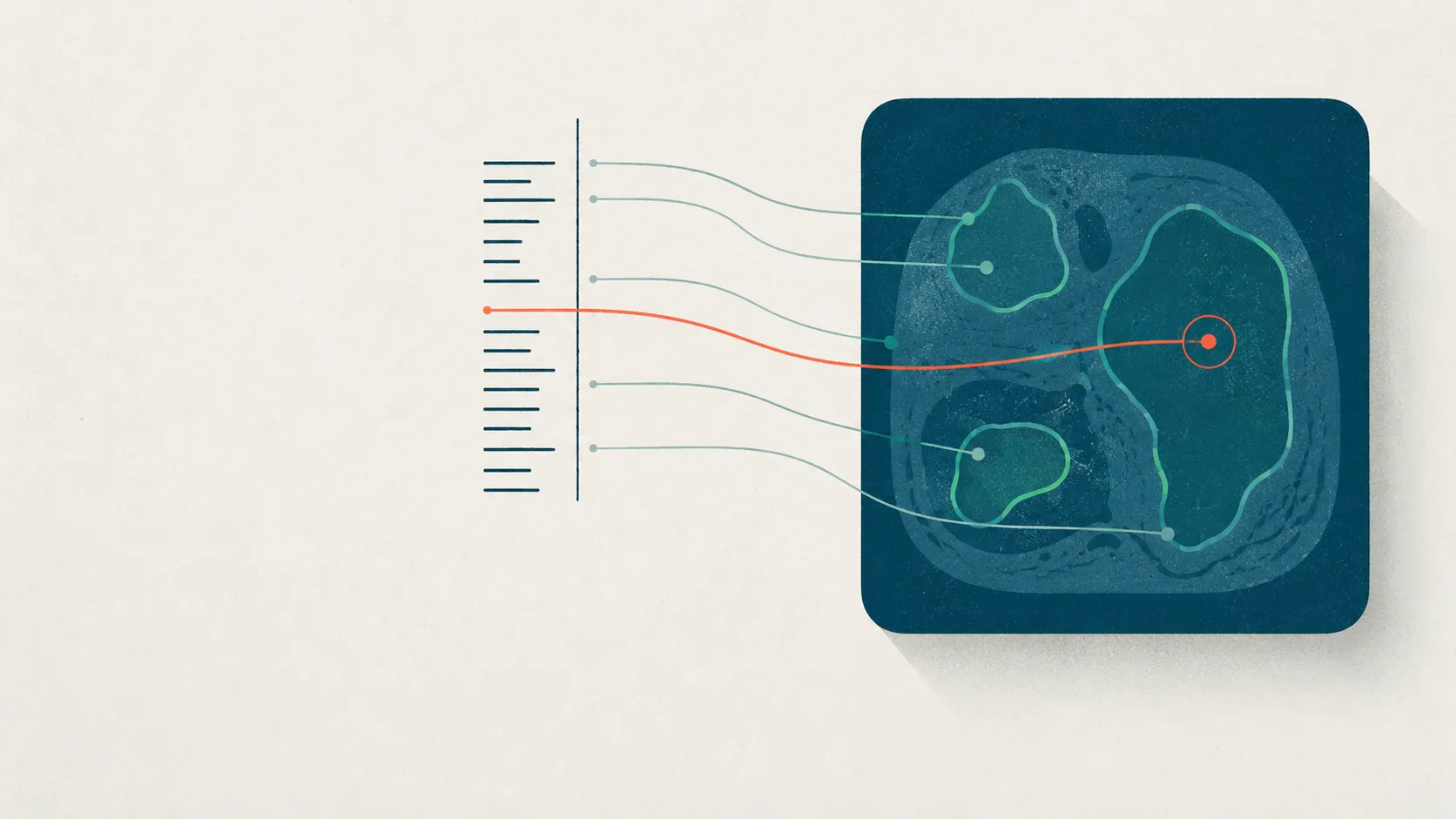 Image & Multimodal Annotation
Multimodal Annotation: Linking Images to Their Reports
How to build multimodal image-text annotation datasets: pair reports to images, ground report phrases to regions, and link findings across modalities.
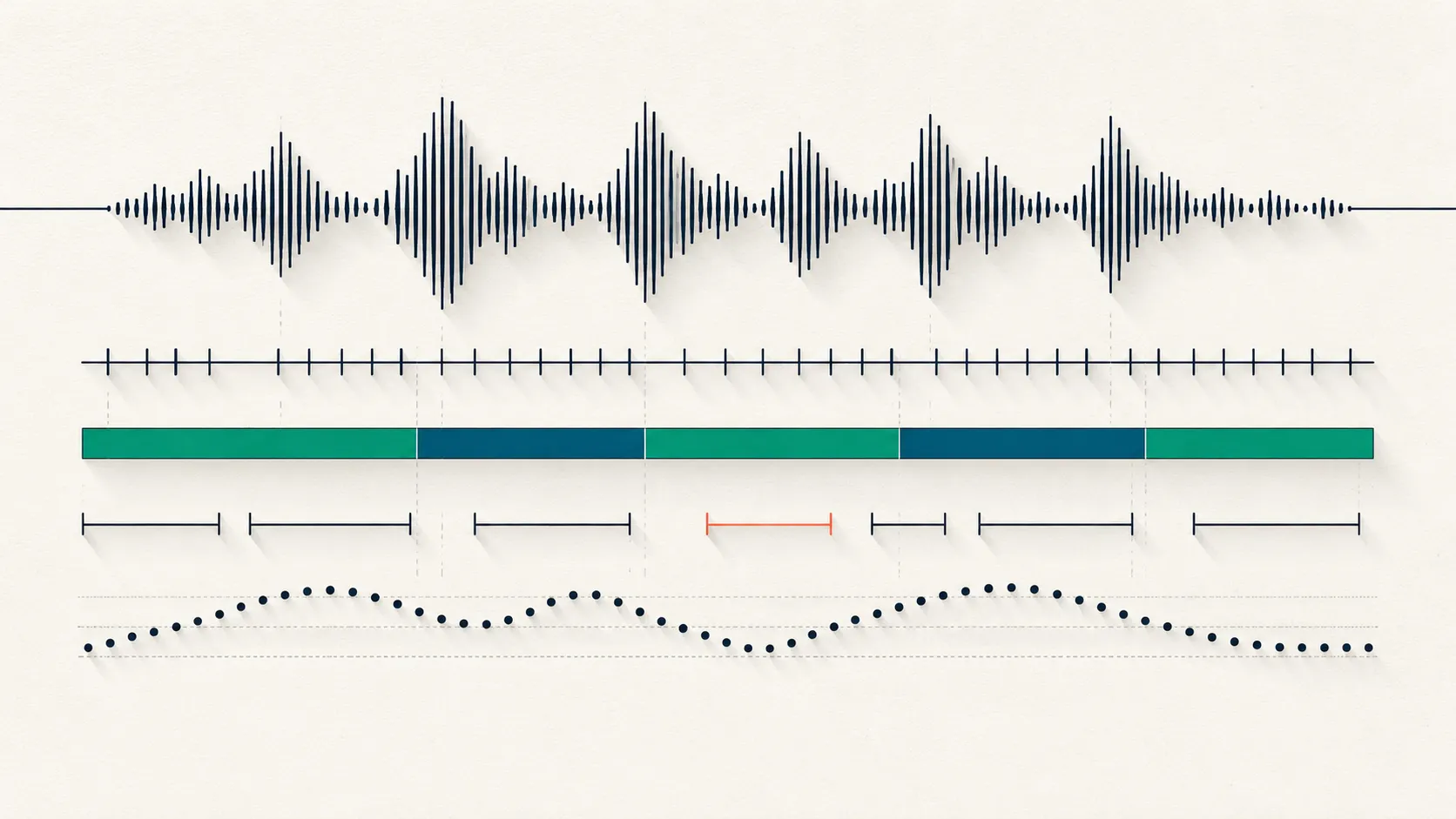 Image & Multimodal Annotation
Audio Annotation: From Transcription to Labeled Events
Audio annotation turns raw speech into labeled data: transcription, speaker diarization, timestamped events, and prosody tags. Compare the types.
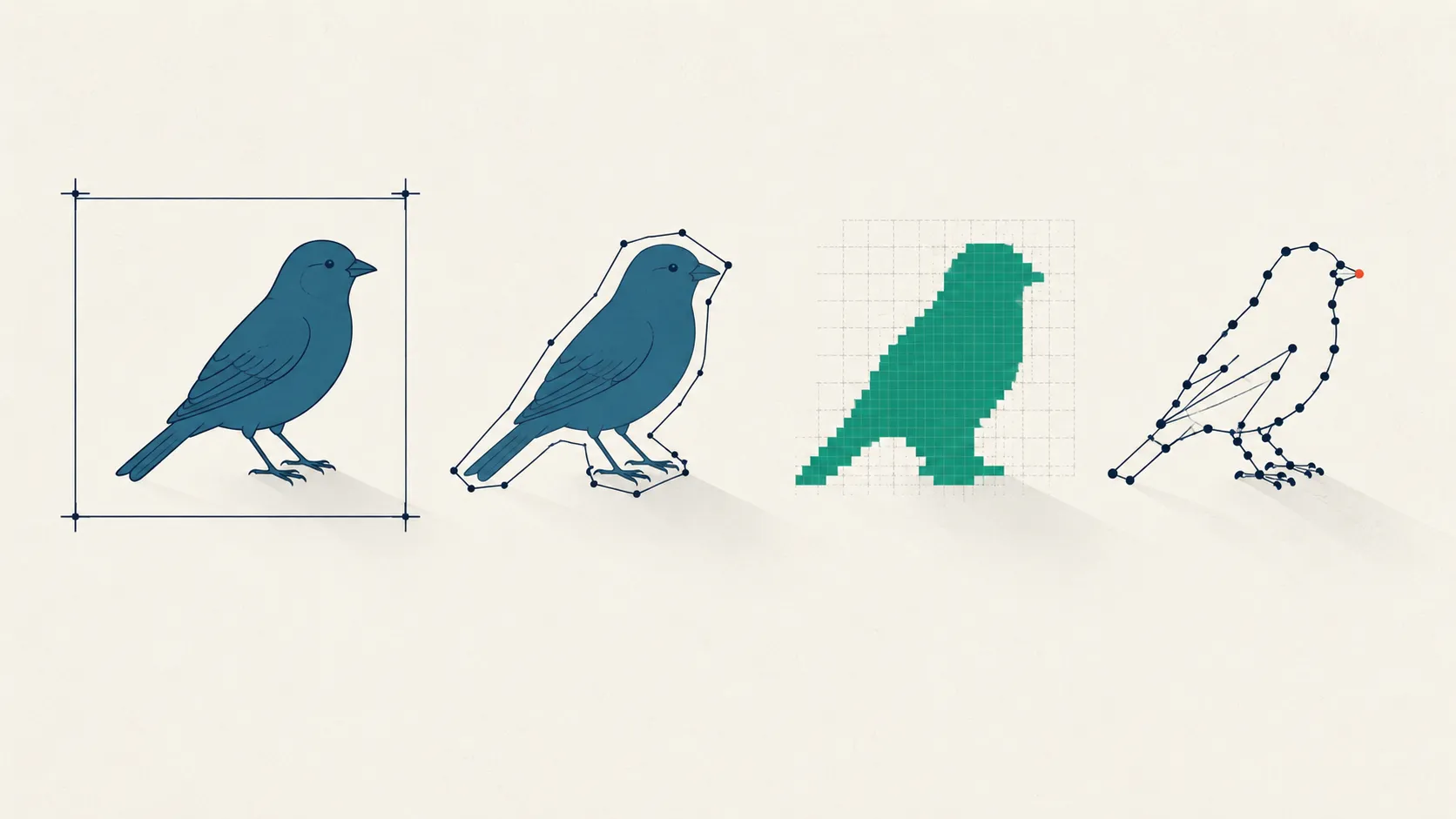 Image & Multimodal Annotation
Image Annotation Types: Cost vs Precision, Explained
Bounding box, polygon, semantic vs instance vs panoptic masks, or keypoints? Compare image annotation types by cost, precision, and downstream task.
Put this into practice
Tagaroo turns any rating scale or coding scheme into a guided annotation workflow—with inter-rater reliability computed as you go.