Annotation Fatigue: Why Label Quality Drops Over Time
Annotation fatigue erodes label quality within a session. See the vigilance-decrement evidence and the breaks, caps, and catch-trials that hold it steady.
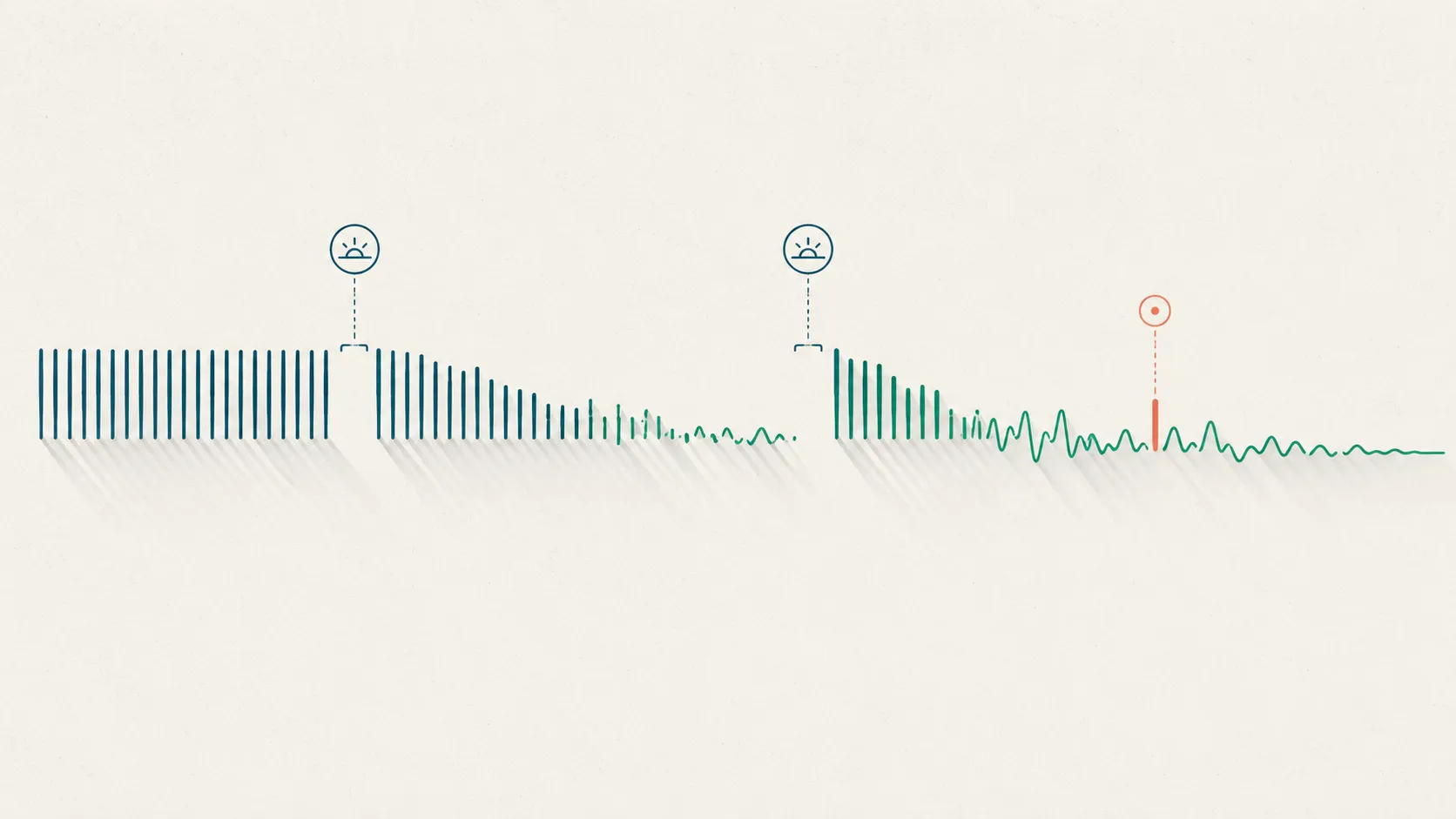
Annotation fatigue is the measurable decline in a coder’s attention and accuracy over a working session, and it degrades label quality in a way that is easy to miss because the coder rarely feels it happening. The mechanism has a name from cognitive science: the vigilance decrement, the well-documented fall in detection performance during sustained attention that Norman Mackworth first quantified in 1948 (Mackworth, 1948). For anyone running a labeling project, the practical consequence is blunt. How long you let someone code in one sitting is a data-quality decision, not just a comfort one.
This guide covers what annotation fatigue is, how it differs from burnout, why annotation triggers the vigilance decrement unusually fast, how the decline shows up in your labels and your reliability statistics, and what the field evidence actually says (it is more nuanced than “quality always drops”). It ends with the countermeasures that hold quality steady: session caps, break cadence, batch sizing, task rotation, and embedded catch-trials. Every example uses synthetic transcript text, never real interview content.
What is annotation fatigue, and how is it different from burnout?
Annotation fatigue is the acute, within-session erosion of the attention, consistency, and effort that careful labeling depends on. It builds over minutes and hours of continuous coding and recovers with rest. That makes it distinct from annotator burnout, which is a chronic occupational syndrome that accumulates over weeks or months and does not lift after a weekend off. The two share drivers and feed each other, but they operate on different clocks and call for different fixes.
The distinction matters because it tells you which lever to pull. If accuracy sags in the last hour of a shift but returns the next morning, that is fatigue, and the fix is session design. If a coder is exhausted, detached, and doubting the point of the work across a whole project, that is closer to burnout, and the fix is workload and support over time. We treat the chronic side separately in annotator burnout: causes, warning signs, and prevention; this post stays on the acute, quality-facing side.
The vigilance decrement, in one paragraph
The vigilance decrement is the systematic decline in detection performance that occurs when a person sustains attention on a monitoring task, with the steepest drop typically arriving early in the watch rather than only at the end. Mackworth demonstrated it in 1948: observers watching a clock pointer for occasional irregular jumps detected fewer of them as time went on, with a marked fall inside the first half hour (Mackworth, 1948). A later meta-analysis established that this sensitivity decrement is substantial and reliable across many tasks, and that it is worse for successive discriminations, where the observer must compare each item against a standard held in memory rather than judge it on the spot (See, Howe, Warm & Dember, 1995). That single distinction is why annotation is more exposed than it looks.
Why does annotation trigger the vigilance decrement so fast?
Annotation triggers the decrement quickly because most real coding is successive discrimination under a heavy memory load, the exact condition that makes the decrement worse. When a coder applies an anchored severity scale, they are not reacting to an obvious signal; they are holding operational definitions, prior decisions, and category boundaries in working memory and judging each new passage against them. See and colleagues found the sensitivity decrement was significantly larger for successive tasks than for simultaneous ones (See, Howe, Warm & Dember, 1995), and that is precisely the mode clinical and qualitative coding runs in.
It also costs more than it appears. The old view treated watch-keeping as dull but easy. Warm, Parasuraman and Matthews overturned that: across behavioral, neural, and subjective measures, they showed that vigilance draws heavily on limited information-processing resources and that it is genuinely stressful, with workload and distress rising as the task gets harder (Warm, Parasuraman & Matthews, 2008). Transcranial Doppler measures of cerebral blood-flow velocity fell over time on task, pointing to real resource depletion rather than mere boredom.
Consider a synthetic example. A coder rating excerpts for a memory-loaded construct like the kind of language disturbance captured by the Thought, Language and Communication (TLC) scale has to keep a dozen fine distinctions live at once, deciding whether a passage is derailment, tangentiality, or neither.
Early in a session those distinctions are sharp. An hour of unbroken coding later, the same passage gets a faster, coarser call, because the resources that separated the categories have drained. Nothing in the transcript changed; the reader did.
How does annotation fatigue degrade label quality?
Annotation fatigue degrades label quality by producing more misses, more careless commissions, and a drift toward the easy default rather than the correct call. In a controlled study where participants performed a visual-attention task for three hours without rest, reaction times, misses, and false alarms all increased with time on task, and the fatigued participants shifted from goal-directed, top-down attention toward stimulus-driven, bottom-up responding (Boksem, Meijman & Lorist, 2005). Translated to coding: a tired annotator stops actively hunting for the criterion and starts reacting to whatever is most salient on the screen.
For the ordinal rating tasks common in clinical and process coding, the failure mode is usually quieter than a missed label. Fatigued raters add measurement noise, compress their use of the scale, and lose sensitivity to the difference between adjacent categories, drifting toward safe midpoints.
That has a direct statistical cost. Because coefficients like Cohen’s kappa and the intraclass correlation penalize disagreement, fatigue-driven noise depresses inter-rater reliability even when no single rater is biased. A codebook that piloted at a defensible level can quietly slide below threshold in the back half of long sessions, and a project-wide reliability average can hide it entirely.
Does quality actually drop in real labeling projects?
Here the honest answer is: it depends, and the field data is more reassuring than the lab data on its own would suggest. The vigilance decrement is reliably reproduced in continuous, controlled tasks. But real annotators do not behave like lab participants strapped to a single unbroken watch.
When Hata and colleagues analyzed nine million annotations from three long-running Amazon Mechanical Turk projects, they found worker quality was remarkably stable over weeks and months, contradicting the assumption that people simply fatigue or satisfice into worse work over time (Hata, Krishna, Fei-Fei & Bernstein, 2017). The reason is instructive: workers who could not sustain quality tended to self-select out of the task rather than continue producing bad labels.
Other work lands in between. An experimental study of an image-tagging crowd task found that fatigue after a batch was common and significant, yet throughput often still rose because familiarity and skill offset the tiredness (Zhang, Ding & Gu, 2018).
The data points somewhere less comfortable than a simple “quality always falls” story: within a single unbroken block, sustained attention degrades, but over a whole project, the outcome depends on whether people can pace, stop, and recover. That is the entire case for the countermeasures below. They do not fight human nature; they make the self-regulation that already protects quality a structural feature of the workflow instead of a matter of luck.
Countermeasures: session length, breaks, batch size, and catch-trials
The reliable levers against annotation fatigue are the ones a project lead already controls: how long a block runs, how often breaks come, how big each batch is, whether tasks rotate, and how densely you seed catch-trials. The table below pairs each lever with an evidence-informed starting point. Treat the settings as defaults to calibrate in a pilot annotation round, not as validated prescriptions, since the vigilance literature is about sustained attention in general rather than your specific codebook.
| Lever | Evidence-informed starting point | Why it helps | What it targets |
|---|---|---|---|
| Session length | Focused blocks of ~25-30 min; cap total daily coding rather than leaving it open-ended | The steepest sensitivity loss lands early and compounds over hours (Mackworth, 1948; See et al., 1995) | The within-session decrement |
| Break cadence | Brief micro-breaks within a block; a longer recovery break between blocks | Sustained monitoring is resource-draining, so short recovery restores the depleted resource (Warm et al., 2008) | Resource depletion |
| Batch size | Small, bounded batches with a visible finish line, not an infinite queue | A clear end lets annotators pace and stop, the behavior that keeps field quality stable (Hata et al., 2017) | Pacing and satisficing |
| Task rotation | Alternate task types; move people off the heaviest queue periodically | Reduces monotony and cumulative memory load in successive-discrimination coding (See et al., 1995) | Memory-loaded judgment |
| Catch-trial rate | Seed pre-scored gold items at roughly 1 in 20, placed unpredictably | Converts silent decay into a measured, actionable signal you can watch in real time | Detection and drift |
Two of these deserve emphasis. First, batch size is underrated: an open queue removes the natural stopping point that field studies suggest is doing the real protective work (Hata, Krishna, Fei-Fei & Bernstein, 2017), so bounding the batch is often cheaper and more effective than any exhortation to “stay focused.” Second, catch-trials are how you stop flying blind. Seeding known-answer items into the stream lets you plot accuracy against time-on-task and see a decrement forming before it contaminates a day’s output; our guide to gold questions and honeypots for annotation QA covers how to build and place them without tipping off coders.
A worked example: the same task, two schedules
To make the levers concrete, here is a synthetic, illustrative comparison of two ways to run the same job: rating 240 synthetic therapy excerpts on a four-point severity anchor. The numbers are invented to show the shape of the effect, not measured results, but the direction is the one the evidence predicts.
| Design choice | Grind schedule | Paced schedule |
|---|---|---|
| Structure | One open 3-hour block until the queue is empty | Six 25-30 min batches with micro-breaks and two longer breaks |
| What happens to attention | Resources drain; responding drifts stimulus-driven late in the block (Boksem et al., 2005) | Each batch starts near full capacity; recovery between batches |
| Likely label pattern | Sharp early calls, coarser late calls, midpoint drift, more misses | More even severity use across the full set |
| Reliability effect | Back-half noise quietly depresses kappa/ICC, hidden in the project average | Less time-linked noise; per-batch QA can catch drift early |
| Catch-trials | None, so the decline is invisible until adjudication | 1-in-20 gold items flag a dip while there is still time to act |
The point is that every row is a rule you set before anyone starts coding. You are not asking people to be more disciplined; you are changing the conditions under which their attention is spent.
Where scale-guided review fits
The studies behind this guide share a discipline worth borrowing: they measure attention and error with instruments rather than a gut read. That is the same reason clinical work uses standardized scales at all. A clinician tracking depressive severity might use the ten-item, clinician-rated Montgomery-Åsberg Depression Rating Scale (MADRS), which was designed to be sensitive to change (Montgomery & Åsberg, 1979); each rating is a successive-discrimination judgment against a fixed anchor, exactly the memory-loaded work that fatigues fast. The lesson for annotation is not “rate your coders clinically.” It is that reliable measurement, of a symptom or of a dataset, takes structure, and structure is what fatigue erodes first.
Tagaroo’s bet is to spend scarce human attention where it is worth spending. It is a schema-first workspace where you define a coding scheme once with anchored definitions, an AI agent takes a first pass, and human reviewers correct and adjudicate, with inter-rater reliability tracked as you go. Shifting people from generating every label to reviewing a first draft shortens the sustained-vigilance stretch that drives the decrement.
That position has limits worth naming. A first-pass model does not remove the need for skilled reviewers, review is still attention work that needs the same caps and breaks, and the quality of your training and pay still sets the ceiling. Fair, well-designed roles are upstream of all of this; how you screen and train annotators and whether pay is structured to reward accuracy over raw speed shape how fatigue plays out long before any timer starts.
The practical upshot
Annotation fatigue is the within-session face of a century-old finding: sustained attention decays, fastest early, and worst for the memory-loaded judgments that clinical and qualitative coding demand (Mackworth, 1948; See, Howe, Warm & Dember, 1995; Warm, Parasuraman & Matthews, 2008). In the lab that decay is stark; in the field it is buffered by people pacing and stopping themselves (Hata, Krishna, Fei-Fei & Bernstein, 2017), which is precisely why the fix is to build that pacing into the work.
If you change one thing, change the schedule before the coder: cap the block, bound the batch, add real breaks, rotate the heaviest queues, and seed catch-trials so a dip is visible while you can still act on it. Then turn your coding scheme into a guided, reviewable workflow where human attention goes to judgment and the grinding, decrement-prone throughput is the machine’s job, not a person’s.
References
- Mackworth NH. The breakdown of vigilance during prolonged visual search. Quarterly Journal of Experimental Psychology. 1948;1(1):6-21. doi:10.1080/17470214808416738
- See JE, Howe SR, Warm JS, Dember WN. Meta-analysis of the sensitivity decrement in vigilance. Psychological Bulletin. 1995;117(2):230-249. doi:10.1037/0033-2909.117.2.230
- Warm JS, Parasuraman R, Matthews G. Vigilance requires hard mental work and is stressful. Human Factors. 2008;50(3):433-441. doi:10.1518/001872008X312152
- Boksem MAS, Meijman TF, Lorist MM. Effects of mental fatigue on attention: An ERP study. Cognitive Brain Research. 2005;25(1):107-116. doi:10.1016/j.cogbrainres.2005.04.011
- Hata K, Krishna R, Fei-Fei L, Bernstein MS. A Glimpse Far into the Future: Understanding Long-term Crowd Worker Quality. CSCW ’17: Proceedings of the 2017 ACM Conference on Computer Supported Cooperative Work and Social Computing. 2017. arXiv:1609.04855
- Zhang Y, Ding X, Gu N. Understanding Fatigue and its Impact in Crowdsourcing. 2018 IEEE 22nd International Conference on Computer Supported Cooperative Work in Design (CSCWD). 2018:57-62. doi:10.1109/CSCWD.2018.8465305
- Montgomery SA, Åsberg M. A new depression scale designed to be sensitive to change. British Journal of Psychiatry. 1979;134:382-389. doi:10.1192/bjp.134.4.382
- Andreasen NC. The Scale for the Assessment of Thought, Language, and Communication (TLC). Schizophrenia Bulletin. 1986;12(3):473-482. doi:10.1093/schbul/12.3.473
Frequently asked questions
- What is the vigilance decrement?
- The vigilance decrement is the systematic decline in detection performance that happens when a person sustains attention on a monitoring task, with the sharpest fall arriving early in the watch. Norman Mackworth first quantified it in 1948 using a clock-monitoring test (Mackworth, 1948), and a later meta-analysis confirmed the sensitivity decrement is substantial and reliable across paradigms, and larger for successive tasks that require comparison against a remembered standard (See, Howe, Warm & Dember, 1995). Annotation is a sustained detection-and-judgment task, so it is subject to the same effect.
- Does annotation quality really drop within a session?
- In controlled sustained-attention tasks, yes: after three hours of continuous work, reaction times, misses, and false alarms all rose with time on task (Boksem, Meijman & Lorist, 2005). In real labeling projects the picture is more mixed. A study of nine million Amazon Mechanical Turk annotations found workers were remarkably stable in quality over long periods, in part because those who tired self-selected out rather than grinding on at low quality (Hata, Krishna, Fei-Fei & Bernstein, 2017). The lesson is that quality is protected when annotators can stop; countermeasures make that structural instead of accidental.
- How long should an annotation session be?
- There is no single validated number for annotation specifically, but the vigilance evidence supports short, bounded blocks with recovery breaks rather than open-ended sessions, because sustained monitoring is resource-draining and stressful, not effortless (Warm, Parasuraman & Matthews, 2008). A common working practice is focused blocks of roughly 25 to 30 minutes with brief micro-breaks and a cap on total daily coding; treat these as starting points to calibrate in a pilot, not as clinical prescriptions.
- What is a catch-trial in annotation, and how often should I use one?
- A catch-trial (also called a gold question or honeypot) is an item with a known, pre-scored answer, seeded unpredictably into the real queue so you can measure a coder's accuracy in real time without them knowing which item is being checked. Seeding roughly one gold item per twenty real items is a reasonable starting rate to tune against your budget. Catch-trials turn a silent quality decline into a measured signal you can act on; see our guide to gold questions and honeypots for the mechanics.
- Is annotation fatigue the same as annotator burnout?
- No. Annotation fatigue is an acute, within-session decline in attention and accuracy that recovers with rest, while annotator burnout is a chronic occupational syndrome that builds over weeks or months and does not lift after a weekend. They share drivers (monotony, ambiguity, throughput pressure) and compound each other, but the fixes operate on different timescales. Fatigue is managed with session design; burnout is prevented with sustained workload and support changes.
Keep reading
 Annotation Operations & Ethics
Annotator Burnout: Causes, Warning Signs, and Prevention
Annotator burnout has clear causes and warning signs. Learn the drivers, symptoms to watch for, and the workload and rotation practices that prevent it.
 Annotation Operations & Ethics
Gold Questions & Honeypots: Annotation QA That Works
Gold questions, honeypots, and attention checks catch bad annotations—if thresholds spare legitimate disagreement. See how each QA method works.
 Methods & Frameworks
How to Run a Pilot Annotation Round Before You Scale
Run a pilot annotation round before you scale: scope, sample size, double-coding, measuring agreement, and revising the codebook. See the checklist.
Put this into practice
Tagaroo turns any rating scale or coding scheme into a guided annotation workflow—with inter-rater reliability computed as you go.