Searle's Speech Acts: The Five Illocutionary Types
Searle's speech acts sort every utterance into five illocutionary types. See the classes, direction of fit, examples, and the tie to dialogue-act tagging.
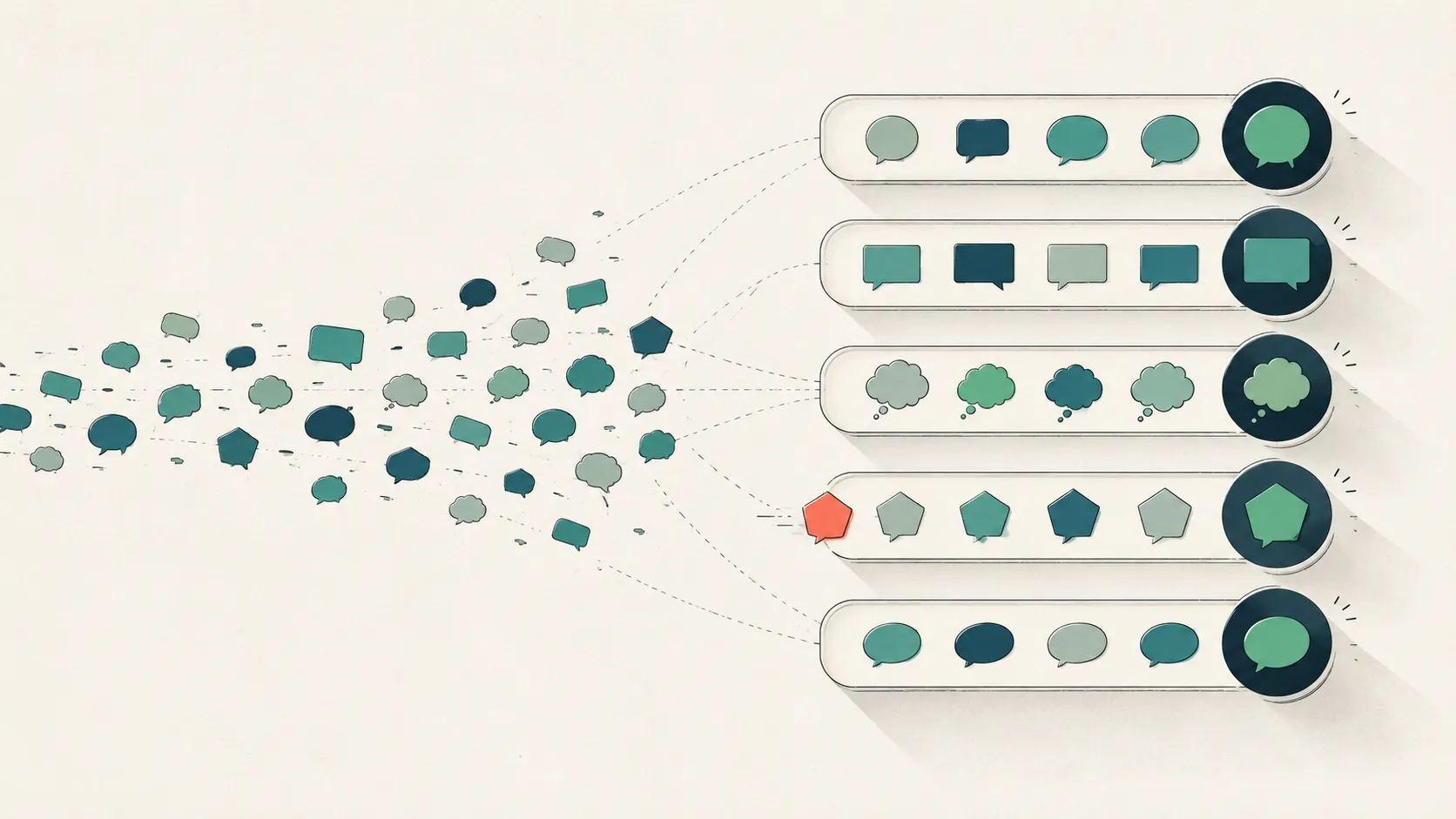
Every time you speak, you do something as well as say something. “The meeting is at three” reports a fact; “Be there at three” tries to move you; “I’ll be there at three” commits the speaker. Same topic, three different actions. Searle’s speech acts are the taxonomy that makes that difference codeable: John Searle’s 1976 classification sorts every utterance into five classes by what the speaker is doing with it, and because the classes are defined by function rather than topic, the scheme doubles as an annotation vocabulary for pragmatics and for conversational AI (Searle, 1976).
What are Searle’s speech acts?
Searle’s speech acts are five classes of illocutionary act—the act you perform in saying something, as opposed to the words themselves or their effect on the listener (Searle, 1976). The idea traces to J. L. Austin, who split any utterance into its locution (the words), its illocution (what the speaker does—asserting, asking, promising), and its perlocution (the effect on the hearer).
Searle took Austin’s insight and gave it a rigorous classification. The move that matters for annotation is the shift from what is said to what is done. “It’s cold in here” can be an assertion about temperature or, in the right context, a directive to close the window. The taxonomy labels the illocutionary force, which is why it captures something a topic model or sentiment classifier misses: the social function of the utterance.
The five illocutionary acts, defined
Searle’s five classes each answer a different question about what the speaker is doing. The table gives the illocutionary point of each, its direction of fit, and a synthetic example.
| Class | What the speaker does | Direction of fit | Example |
|---|---|---|---|
| Assertive | Commits to the truth of a proposition | Word-to-world | "The 9:15 train is running late." |
| Directive | Tries to get the hearer to do something | World-to-word | "Close the window, please." |
| Commissive | Commits the speaker to a future action | World-to-word | "I'll email the file by Friday." |
| Expressive | Conveys a psychological state | None | "Thank you for waiting." |
| Declaration | Changes the world by the saying itself | Both | "I now call this meeting to order." |
Two of these carry a common confusion. Directives and commissives both point from the world to the words—something is to be made true—but they differ in who is on the hook: a directive puts the hearer to work, a commissive binds the speaker. “Send me the report” is a directive; “I’ll send you the report” is a commissive. Keeping the responsible party straight is most of the battle when coding the two.
What is “direction of fit”?
Direction of fit is the concept that organizes the whole taxonomy: it asks whether the words are supposed to match the world or the world is supposed to match the words (Searle, 1976). Searle draws the term from Austin and credits the underlying distinction to the philosopher Elizabeth Anscombe.
An assertion has a word-to-world fit—if “the train is late” is wrong, you correct the words. A directive or commissive has a world-to-word fit—if I promise to send the report and don’t, the fault is in the world, not the sentence.
Expressives (“thank you,” “I’m sorry”) have no direction of fit, because they presuppose the truth of their content rather than asserting or changing it. Declarations have both at once: saying “you’re fired,” by someone with the authority to fire, makes it so and describes the new state in the same breath. Direction of fit is the single most useful discriminator when an utterance’s surface form is ambiguous.
How did Searle refine Austin’s theory?
Searle replaced Austin’s rough, verb-based list with five classes built from consistent criteria. Austin (1962) had proposed his own five categories—verdictives, exercitives, commissives, behabitives, and expositives—but he built them by sorting English performative verbs, and he admitted the groups overlapped and leaked.
Searle’s objection was methodological: a classification of acts should not be a classification of verbs, and it needs a principled basis. He derived his five classes from illocutionary point (the purpose of the act), direction of fit, and the psychological state the act expresses—belief for assertives, want for directives, intention for commissives, and so on (Searle, 1976). Only “commissive” survives from Austin’s list by name; the mapping between the two schemes is not one-to-one, so treat them as different taxonomies. One historical footnote worth knowing: Searle originally called the truth-committing class representatives, and he and Vanderveken later relabeled it assertives, which is now standard—the same class under two names.
From speech acts to dialogue acts: tagging conversation for NLP
Speech-act theory is the direct ancestor of dialogue-act tagging, the scheme that labels each turn in a conversation for what it does—and this is where the taxonomy earns its keep in machine learning. To train or evaluate a conversational system, you need labeled data: this turn is a question, that one an answer, the next a backchannel.
The landmark resource here is Switchboard-DAMSL: 1,155 telephone conversations hand-labeled with a 42-tag dialogue-act set, on which human labelers agreed at κ = 0.80 (84% raw agreement), and an automatic tagger reached 71% accuracy on transcripts against a 35% chance baseline and 84% human ceiling (Stolcke et al., 2000). That scheme, and the later ISO 24617-2 standard for dialogue-act annotation, both descend from Searle and Austin (Bunt et al., 2012).
But note the gap: dialogue-act tag sets are more granular and conversation-specific than Searle’s five classes, adding backchannels, floor-management moves, and backward-looking functions like accept and reject. Speech acts are the theory; dialogue acts are the operational scheme built on top of it, and they are not the same list. If you are measuring how well two annotators agree on those tags, the Cohen’s kappa and inter-rater reliability guide covers why κ = 0.80 counts as strong agreement.
How do you annotate speech acts in a transcript?
To annotate speech acts, tag each utterance with the single class that best captures its primary illocutionary force—instance-mode annotation, where the label describes what the utterance does rather than what it is about. When an utterance blends functions, code the dominant act and record the secondary force in the rationale.
Consider a short synthetic exchange:
Clinician: How has your sleep been this week?
Patient: Pretty broken, honestly. I’ll try the wind-down routine you suggested.
The clinician’s turn is a directive (a question is a directive—it tries to get the hearer to supply information). The patient’s first sentence is an assertive (it commits to the truth of “sleep has been broken”), and the second is a commissive (“I’ll try…” binds the speaker to a future action). Tagging each span with its force keeps the evidence attached to the label, which is what makes the Searle speech-act scheme reproducible enough to compute agreement across annotators. It is the same instance-mode logic behind coding the structure of an argument with the Toulmin model.
The hard case is the indirect speech act. “Can you pass the salt?” is literally a question but functionally a request (Searle, 1975), and the one-utterance-one-label rule forces a choice. Code the intended force, not the surface form, and note the mismatch—indirect acts are a documented source of annotator disagreement, so they are exactly where a clear codebook rule pays off. If you work with conversation transcripts, the sane default is de-identified text and a privacy-first setup; Tagaroo supports a browser-side anonymous mode so content can stay local.
Common mistakes when coding speech acts
The recurring errors come from coding the surface instead of the act:
- Tagging the form, not the force. A question mark does not make an assertion, and a declarative sentence can be a request. Code what the speaker is doing (Searle, 1976).
- Confusing directives and commissives. Both change the world to match the words; the discriminator is who acts—the hearer (directive) or the speaker (commissive).
- Over-tagging declarations. A declaration only works when the speaker has the institutional authority to make it so (“I now pronounce…,” “you’re fired”). Absent that authority, the utterance is usually an assertive or expressive, not a declaration.
- Ignoring indirect acts. “Could you send that over?” is a directive dressed as a question. Decide the rule in advance and apply it consistently.
The practical upshot: Searle’s speech acts work as an annotation scheme because they classify function, not form. Pick the class by what the utterance does, use direction of fit to break ties, and remember that the dialogue-act tag sets used to train conversational models are descendants of this taxonomy, not the taxonomy itself.
References
- Searle, J. R. (1976). A classification of illocutionary acts. Language in Society, 5(1), 1–23. doi:10.1017/S0047404500006837
- Searle, J. R. (1969). Speech Acts: An Essay in the Philosophy of Language. Cambridge University Press.
- Searle, J. R. (1975). Indirect speech acts. In P. Cole & J. L. Morgan (Eds.), Syntax and Semantics, Vol. 3: Speech Acts (pp. 59–82). Academic Press.
- Austin, J. L. (1962). How to Do Things with Words. Clarendon Press. (2nd ed., 1975).
- Stolcke, A., Ries, K., Coccaro, N., Shriberg, E., Bates, R., Jurafsky, D., et al. (2000). Dialogue act modeling for automatic tagging and recognition of conversational speech. Computational Linguistics, 26(3), 339–373. doi:10.1162/089120100561737
- Core, M. G., & Allen, J. F. (1997). Coding dialogs with the DAMSL annotation scheme. In Working Notes of the AAAI Fall Symposium on Communicative Action in Humans and Machines (pp. 28–35).
- Bunt, H., Alexandersson, J., Choe, J.-W., Fang, A. C., Hasida, K., Petukhova, V., et al. (2012). ISO 24617-2: a semantically-based standard for dialogue annotation. In Proceedings of LREC 2012 (pp. 430–437).
If you tag speech acts or dialogue acts in transcripts, Tagaroo turns the Searle speech-act taxonomy into a guided, evidence-anchored annotation workflow—with inter-rater reliability computed as your annotators work. It pairs naturally with the Toulmin argument model for the structure of reasoning.
Frequently asked questions
- What are Searle's five speech acts?
- Searle's five classes of illocutionary act are assertives (commit the speaker to the truth of a proposition), directives (try to get the hearer to do something), commissives (commit the speaker to a future action), expressives (convey a psychological state), and declarations (change the world by the saying itself) (Searle, 1976). He derived them from three criteria: illocutionary point, direction of fit, and the expressed psychological state.
- What is the difference between Austin's and Searle's speech acts?
- Austin (1962) first distinguished locutionary, illocutionary, and perlocutionary acts and proposed five rough categories (verdictives, exercitives, commissives, behabitives, expositives) based on sorting English performative verbs. Searle (1976) argued these conflated verbs with acts and lacked a principled basis, and replaced them with five criterion-driven classes (assertive, directive, commissive, expressive, declaration). Only 'commissive' survives by name.
- What is direction of fit in speech act theory?
- Direction of fit describes whether words are meant to match the world or the world is meant to match the words (Searle, 1976). Assertives have a word-to-world fit (the words describe how things are); directives and commissives have a world-to-world fit (the world is to be changed to match the words); expressives have no direction of fit; and declarations have both at once.
- Are speech acts the same as dialogue acts in NLP?
- No. Dialogue-act schemes used in natural language processing—such as DAMSL, the 42-tag Switchboard-DAMSL set, and the ISO 24617-2 standard—are inspired by speech-act theory but are more granular and conversation-specific, adding categories like backchannels and floor management. A dialogue-act tag set is not a direct implementation of Searle's five classes.
- Why are indirect speech acts hard to annotate?
- An indirect speech act performs one illocutionary act by way of another—'Can you pass the salt?' is literally a question but functionally a request (Searle, 1975). This breaks the one-utterance-one-label assumption behind span annotation, because the literal form and the intended force point to different classes, and it is a well-known source of annotator disagreement.
Keep reading
 Methods & Frameworks
The Toulmin Model of Argumentation: The Six Elements
The Toulmin model of argumentation breaks an argument into six functional parts. See the elements, a worked example, and why warrants are hardest to code.
 Methods & Frameworks
Labov and Waletzky Narrative Analysis: The Six Parts
Labov and Waletzky narrative analysis breaks an oral story into six parts. See each part, why evaluation is the heart, and how reliably it can be coded.
 Reliability & Agreement
Cohen's Kappa: How to Compute and Interpret Agreement
How to compute Cohen's kappa and weighted kappa by hand, read the result honestly, and know when to use Krippendorff's alpha, ICC, or Gwet's AC1 instead.
Put this into practice
Tagaroo turns any rating scale or coding scheme into a guided annotation workflow—with inter-rater reliability computed as you go.