The Toulmin Model of Argumentation: The Six Elements
The Toulmin model of argumentation breaks an argument into six functional parts. See the elements, a worked example, and why warrants are hardest to code.
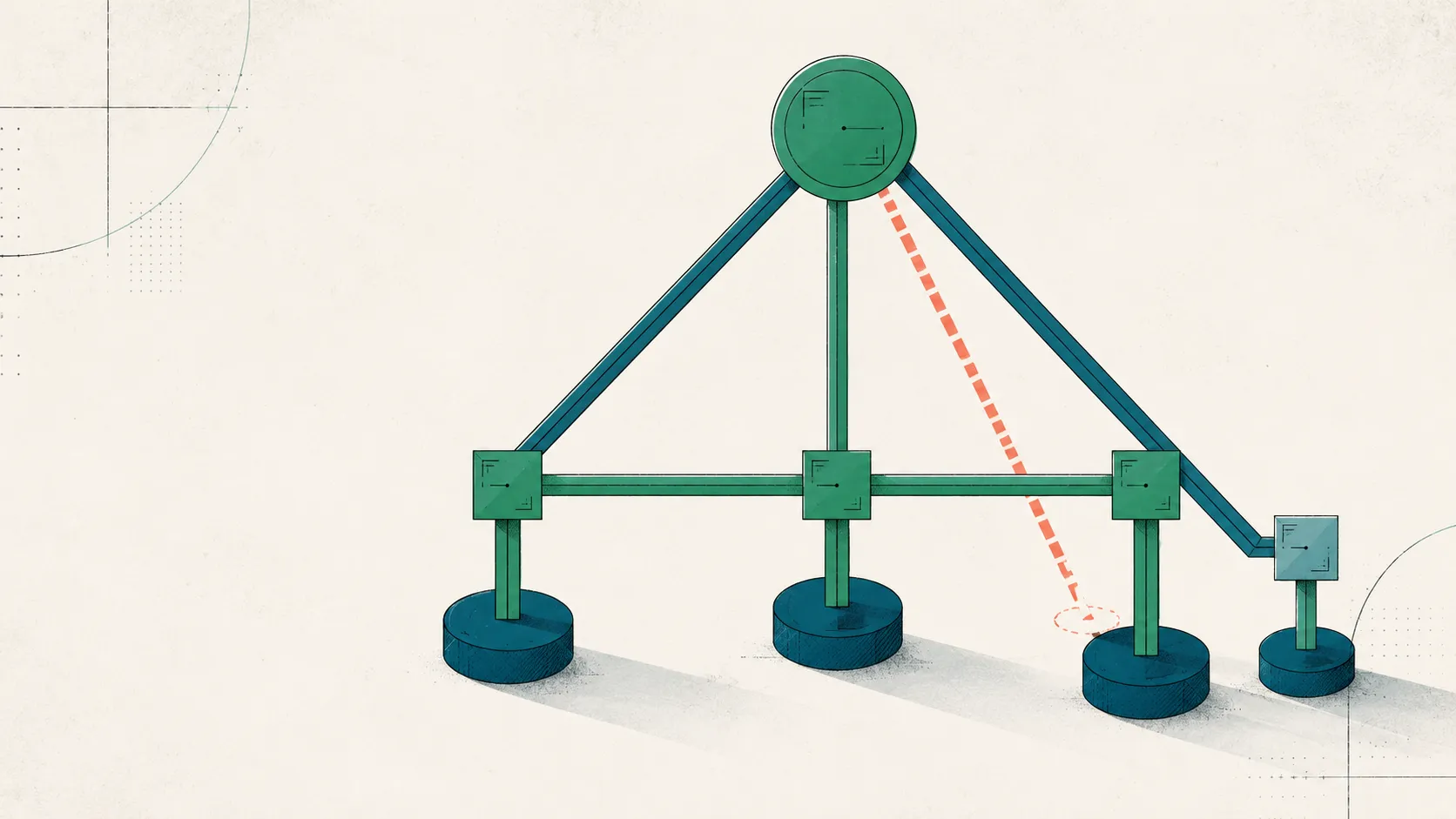
Every argument has moving parts, and most disagreements are really disagreements about one specific part. Stephen Toulmin’s insight, in The Uses of Argument (1958), was that you can lay those parts out on a diagram: not just the claim and the evidence, but the usually-unspoken principle connecting them, and the conditions under which the whole thing falls apart. The Toulmin model of argumentation is that layout, and because it labels the function each piece performs rather than its topic, it has become the standard scheme for annotating the structure of reasoning in everything from student essays to online debate.
What is the Toulmin model of argumentation?
The Toulmin model of argumentation is a scheme that analyzes an argument into six functional elements showing how a conclusion is supported (Toulmin, 1958). Stephen Toulmin, a British philosopher, built it partly as a critique of formal logic: he thought the syllogism was a poor picture of how people actually reason, and he wanted a layout that matched real, practical argument.
The key word is functional. The model does not ask whether an argument is good; it asks what job each part is doing. That makes it descriptive rather than prescriptive—a tool for analysis, not a rubric for scoring.
Toulmin also argued that the layout is field-invariant (arguments in law, science, and everyday life share the same skeleton) while the standards for what counts as adequate grounds are field-dependent. That thesis is still debated, and it is best attributed to Toulmin rather than stated as settled fact (Hitchcock & Verheij, 2006).
The six elements of the Toulmin model
The six elements each answer a different question about how the argument hangs together. The table defines each with the question it answers and a fragment of a running example.
| Element | Question it answers | Example fragment |
|---|---|---|
| Claim | What are you asking me to accept? | "We should move the 9 a.m. meeting." |
| Grounds | What's your evidence? | "Three of the five attendees are on the West Coast." |
| Warrant | Why does that evidence count? | "People contribute less when they join at 6 a.m. their time." |
| Backing | Why should we accept that principle? | "Studies of distributed teams show early calls depress participation." |
| Qualifier | How strong is the claim? | "Probably / in most cases." |
| Rebuttal | When would the claim not hold? | "Unless the West Coast attendees say they prefer early calls." |
One naming note prevents confusion: Toulmin’s original 1958 term for grounds was data, and he later preferred grounds. The two are synonyms for the same element—the evidence you rest the claim on.
Grounds vs warrant vs backing: the distinction people get wrong
Grounds, warrant, and backing form the confusable core of the model, and getting them apart is most of what it takes to code Toulmin well. Grounds are the specific, case-particular evidence for this claim. The warrant is the general, categorical bridge explaining why evidence of that kind supports a claim of this kind. Backing is the credential behind the warrant—the body of fact that makes the bridge trustworthy.
The clean test is three questions. Grounds answer “What’s your evidence?” The warrant answers “Why does that evidence count?” Backing answers “Why should we accept that rule?” Grounds and backing can both look like plain facts, but they sit at different levels: grounds are appealed to directly to establish the claim, while backing is invoked only when someone challenges the warrant, one step up the chain. The warrant itself is usually left unsaid, which is exactly why people mistake it for the grounds.
Why are warrants so hard to annotate?
Warrants are the hardest element to annotate because they are usually implicit. Ordinary arguments are stated as enthymemes—the connecting principle is left unspoken because it is obvious to speaker and listener—so there is frequently no span of text to point at (Habernal et al., 2018).
That changes the annotator’s job from marking to reconstructing. You are not highlighting the warrant; you are inferring a proposition that was never said, and different readers reconstruct it differently.
Reconstruction is open-ended, so warrant and backing layers are the least reliable part of the scheme. This is why the large natural-language-processing corpora largely sidestep them: they annotate claims and premises with support and attack relations rather than warrants (Stab & Gurevych, 2017), and researchers had to build a dedicated task just to reconstruct implicit warrants (Habernal et al., 2018). In messy user-generated text the problem is starker still: backing and warrant components turn out to be rare and hard to annotate at all (Habernal & Gurevych, 2017). If a component resists reliable annotation, that is a fact about the component, not a failure of the coder.
How is the Toulmin model used in argument mining?
Argument mining—teaching machines to find argument structure in text—leans heavily on Toulmin-derived schemes, and its published reliability numbers are a useful reality check on how hard this is. On a corpus of 402 persuasive essays containing 6,089 argument components, trained annotators using a careful codebook reached high agreement on some elements and much lower agreement on others (Stab & Gurevych, 2017).
That claims scored only κ = 0.635 while major claims reached 0.877 is the single most instructive figure in argument mining: the layout is easy to state and hard to apply consistently, even for trained annotators (Stab & Gurevych, 2017). Models trained on that data identified argument components at a best F1 of 0.867—but that number is for one domain, student persuasive essays, and cross-domain generalization is notoriously weak; models tend to learn a corpus rather than “argument” in general (Lawrence & Reed, 2020). Treat domain-specific accuracy as domain-specific. If you are computing agreement between your own annotators, the Cohen’s kappa and inter-rater reliability guide explains why a coefficient like 0.635 signals a codebook that needs sharpening on the claim boundary.
The model also has a long life in education. Erduran, Simon, and Osborne turned it into “Toulmin’s Argument Pattern” (TAP) for coding the quality of argumentation in science classrooms, using the presence of rebuttals as a marker of more sophisticated argument (Erduran et al., 2004). Same layout, different use: measuring how students reason rather than training a model.
How do you annotate an argument with the Toulmin model?
To annotate an argument, tag each span with the element it performs—instance-mode annotation, where the label names the function the span serves in the argument rather than its subject. Warrants are the exception: code an explicit span only when the speaker actually states the connecting principle, and reconstruct it in the rationale when they don’t.
Take one synthetic argument, fully labeled:
We should move the 9 a.m. meeting [claim] because three of the five attendees are on the West Coast [grounds], and people contribute less when they join at 6 a.m. their time [warrant]—studies of distributed teams back that up [backing]. Probably [qualifier], unless the West Coast folks say they actually prefer the early slot [rebuttal].
Every element is present and marked to the exact span that carries it, which is what lets a second annotator check each call and compute agreement. That span-level discipline is what makes the Toulmin coding scheme reproducible, and it is the same logic behind labeling what an utterance does with Searle’s speech acts or how a story is told with the Labov narrative model. If you work with real discussion transcripts, the sane default is de-identified text and a privacy-first setup; Tagaroo supports a browser-side anonymous mode so content can stay local.
Common mistakes when coding the Toulmin model
The recurring errors cluster around the same few boundaries:
- Confusing grounds and backing. Both look like facts. Grounds support the claim directly; backing supports the warrant, and only when the warrant is questioned. Ask which one the fact is answering.
- Trying to mark an implicit warrant as a span. If the principle isn’t stated, don’t invent a span—reconstruct it in the rationale and flag it as inferred (Habernal et al., 2018).
- Treating the model as a scoring rubric. It describes structure, not quality. A fully-formed argument can still be wrong.
- Overstating field-invariance. The claim that the layout is universal while standards vary is Toulmin’s thesis, not a proven law—attribute it (Hitchcock & Verheij, 2006).
The practical upshot: the Toulmin model of argumentation earns its place because it separates the parts of an argument that people actually argue about. Code claim, grounds, and the rest by the function each span performs, keep grounds and backing on their separate levels, and accept that the warrant—being usually unsaid—will always be the element you reconstruct rather than the one you mark.
References
- Toulmin, S. E. (1958). The Uses of Argument. Cambridge University Press. (Updated ed., 2003.)
- Stab, C., & Gurevych, I. (2017). Parsing argumentation structures in persuasive essays. Computational Linguistics, 43(3), 619–659. doi:10.1162/coli_a_00295
- Lawrence, J., & Reed, C. (2020). Argument mining: a survey. Computational Linguistics, 45(4), 765–818. doi:10.1162/coli_a_00364
- Erduran, S., Simon, S., & Osborne, J. (2004). TAPping into argumentation: developments in the application of Toulmin’s argument pattern for studying science discourse. Science Education, 88(6), 915–933. doi:10.1002/sce.20012
- Habernal, I., & Gurevych, I. (2017). Argumentation mining in user-generated web discourse. Computational Linguistics, 43(1), 125–179. doi:10.1162/coli_a_00276
- Habernal, I., Wachsmuth, H., Gurevych, I., & Stein, B. (2018). The argument reasoning comprehension task: identification and reconstruction of implicit warrants. Proceedings of NAACL-HLT 2018, 1930–1940. doi:10.18653/v1/N18-1175
- Hitchcock, D., & Verheij, B. (Eds.). (2006). Arguing on the Toulmin Model: New Essays in Argument Analysis and Evaluation. Springer. doi:10.1007/978-1-4020-4938-5
If you annotate argument structure in essays, debates, or transcripts, Tagaroo turns the Toulmin model into a guided, evidence-anchored annotation workflow—with inter-rater reliability computed as your annotators work. It sits alongside related discourse schemes like Searle’s speech acts in the scale library.
Frequently asked questions
- What are the six elements of the Toulmin model?
- The six elements commonly drawn from Toulmin's layout are the claim (the conclusion argued for), grounds (the evidence supporting it), warrant (the principle linking grounds to claim), backing (support for the warrant itself), qualifier (the strength or scope of the claim), and rebuttal (conditions under which the claim would not hold) (Toulmin, 1958). Toulmin first developed claim, grounds, and warrant, then added backing, qualifier, and rebuttal as refinements.
- What is the difference between grounds, warrant, and backing?
- Grounds are the specific evidence you appeal to directly for a claim; the warrant is the general principle explaining why that kind of evidence supports that kind of claim; and backing is the credential that makes the warrant trustworthy, invoked only when the warrant is doubted. A clean test: grounds answer 'What's your evidence?', the warrant answers 'Why does that evidence count?', and backing answers 'Why should we accept that rule?'
- Why are warrants hard to identify in the Toulmin model?
- Warrants are usually left implicit—arguments are typically stated as enthymemes, with the connecting principle unspoken—so there is often no span of text to mark, and an annotator must reconstruct the missing proposition rather than tag it (Habernal et al., 2018). This makes warrants the least reliably codable part of the model, which is why large argument-mining corpora annotate only claims and premises.
- Is the Toulmin model a way to score arguments?
- No. The Toulmin model is descriptive and analytic, not a prescriptive scoring rubric. Toulmin (1958) set out to describe the functional layout of real arguments—partly to critique formal syllogistic logic—not to provide a checklist for good arguments. It tells you what parts an argument has, not whether the argument is a good one.
- How is the Toulmin model used in argument mining?
- Argument-mining research uses Toulmin-derived schemes to annotate argument structure in text and train models to detect it. On a corpus of 402 persuasive essays, trained annotators reached Cohen's kappa of 0.877 on major claims but only 0.635 on claims, and the best model identified argument components at F1 0.867 (Stab & Gurevych, 2017). Those figures are for one domain, so they do not generalize to arguments in general.
Keep reading
 Methods & Frameworks
Searle's Speech Acts: The Five Illocutionary Types
Searle's speech acts sort every utterance into five illocutionary types. See the classes, direction of fit, examples, and the tie to dialogue-act tagging.
 Methods & Frameworks
Labov and Waletzky Narrative Analysis: The Six Parts
Labov and Waletzky narrative analysis breaks an oral story into six parts. See each part, why evaluation is the heart, and how reliably it can be coded.
 Reliability & Agreement
Cohen's Kappa: How to Compute and Interpret Agreement
How to compute Cohen's kappa and weighted kappa by hand, read the result honestly, and know when to use Krippendorff's alpha, ICC, or Gwet's AC1 instead.
Put this into practice
Tagaroo turns any rating scale or coding scheme into a guided annotation workflow—with inter-rater reliability computed as you go.