BPRS vs PANSS: The Two Standard Psychosis Rating Scales
BPRS vs PANSS compared: item overlap, the positive-negative-general structure, trial usage, and score linking. See which psychosis scale to use.
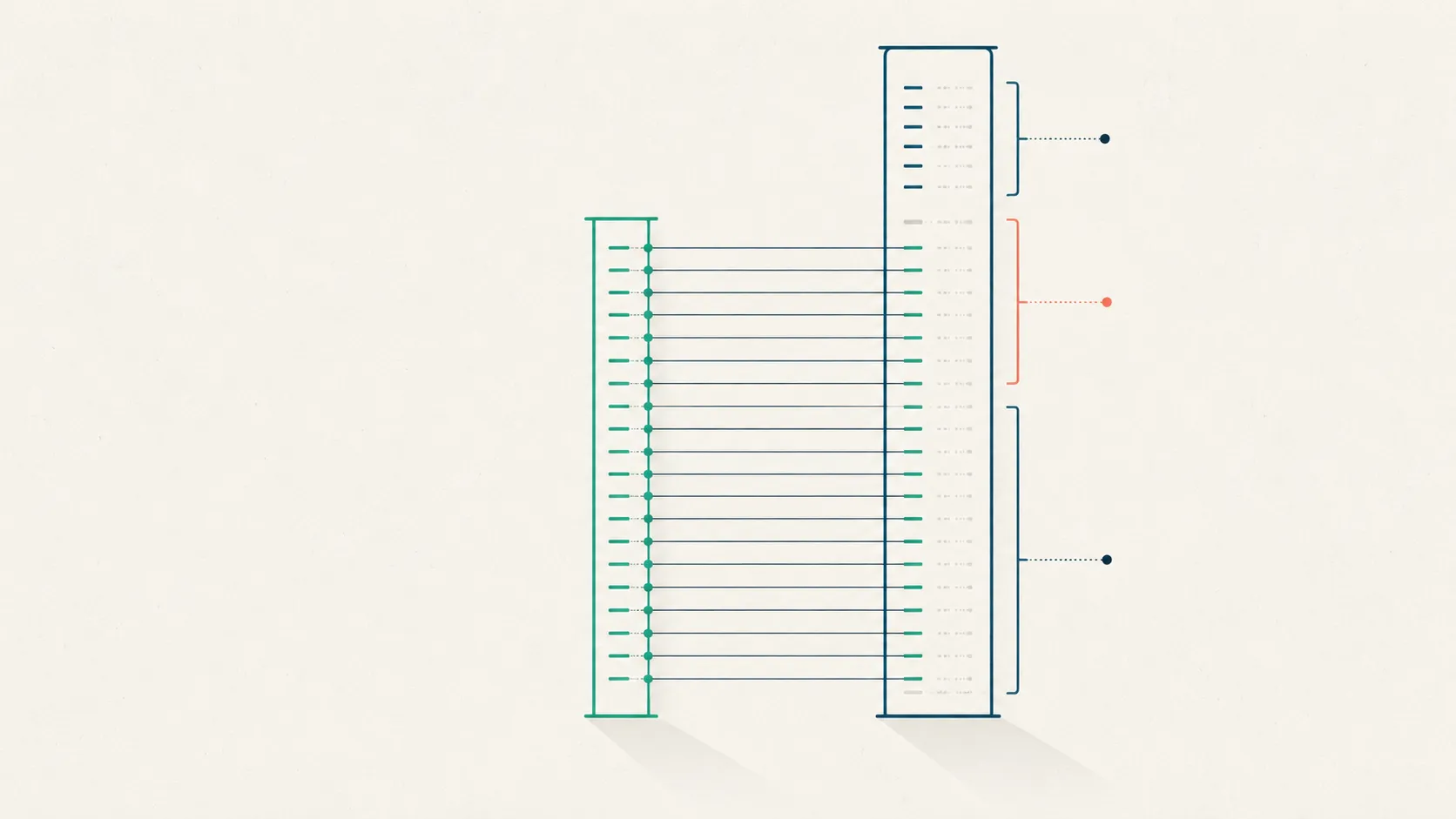
The choice between the BPRS vs PANSS is really a choice between breadth and depth. The Brief Psychiatric Rating Scale (BPRS) is a fast, broad, 16-to-18-item measure of overall psychopathology that has been in use since 1962; the Positive and Negative Syndrome Scale (PANSS) is a 30-item, schizophrenia-specific scale that grew directly out of the BPRS to fix its two biggest weaknesses—thin negative-symptom coverage and the absence of defined anchor points. Pick the BPRS when you want a rapid, transdiagnostic snapshot; pick the PANSS when you need the anchored, subscale-resolved detail that antipsychotic trials demand. Both are clinician-rated severity measures, and neither is a diagnosis.
BPRS vs PANSS at a glance
The BPRS and the PANSS measure the same territory—the severity of psychotic and related symptoms—but were built a quarter-century apart for different jobs, and the design choices decide which one fits your study. The table below sets them side by side on the axes that matter.
| Axis | BPRS | PANSS |
|---|---|---|
| Items | 16–18 (24 in BPRS-E) | 30 |
| Structure | Broad psychopathology (5 factors) | Positive (7) / Negative (7) / General (16) |
| Item range | 7-point (0–6 or 1–7) | 1–7 (anchored) |
| Total range | 0–108 or 18–126 (18-item) | 30–210 |
| Anchor points | None in the 1962 original | Defined for every item |
| Administration | ~20–30 min | ~45–50 min |
| Scope | Transdiagnostic | Schizophrenia-focused |
| Trial role | Legacy / rapid measure | Regulatory gold standard |
| In Tagaroo's library | Yes | No (route via BPRS) |
| Original source | Overall & Gorham, 1962 | Kay, Fiszbein & Opler, 1987 |
The BPRS itself comes in versions—16 items in the 1962 original, a common 18-item revision, and the anchored 24-item expanded BPRS-E (Ventura et al., 1993)—so pin down which one a study used before comparing totals. Each scale has its own full explainer worth reading first: the Brief Psychiatric Rating Scale guide walks through the BPRS items, the scoring conventions, and the factor structure. There is no separate PANSS page here, and that is deliberate—this comparison exists partly to answer the PANSS questions honestly while pointing to the scale Tagaroo actually supports.
What’s the core difference between the BPRS and PANSS?
The core difference is that the PANSS turned the BPRS’s broad symptom list into a structured, anchored, schizophrenia-specific instrument. The BPRS gives you one flat list of 16-to-18 symptoms rated for severity; the PANSS reorganizes overlapping content into three explicit subscales—a 7-item Positive scale, a 7-item Negative scale, and a 16-item General Psychopathology scale—each item rated 1 to 7 for a total of 30 to 210 (Kay, Fiszbein & Opler, 1987).
That reorganization solved two specific BPRS problems. The first was negative symptoms. The BPRS touches them with only a couple of items (emotional withdrawal, blunted affect), which is too thin to characterize a predominantly negative presentation. The PANSS devotes a dedicated seven-item subscale to them, so a patient’s negative burden gets its own score rather than being buried in a total.
The second was rater drift. The original 1962 BPRS printed verbal category labels with no operational anchor points, leaving raters to interpret “moderate” for themselves (Overall & Gorham, 1962). The PANSS defines anchored criteria for every item at every severity level, which is the main reason it tends to edge the BPRS on inter-rater reliability for the symptoms they share. In a head-to-head study, the PANSS showed higher inter-rater reliability than the BPRS on 14 of the 18 items the two scales have in common (Bell et al., 1992).
How much do the BPRS and PANSS overlap?
They overlap heavily, because the PANSS was assembled out of the BPRS. Kay and colleagues built the 30-item scale from two existing instruments: the full 18-item BPRS, every item retained, plus 12 items from the Psychopathology Rating Schedule (Singh & Kay, 1975). So 18 of the 30 PANSS items are the BPRS, reworded and anchored (Kay, Fiszbein & Opler, 1987); Bell and colleagues confirmed the arithmetic from the other side, counting the twelve PANSS items not drawn from the BPRS (Bell et al., 1992). The PANSS is less a rival to the BPRS than an expansion of it.
You can see the overlap in the factor structure. A meta-analysis of BPRS factor analyses across more than 17,000 subjects found five stable dimensions—affect, positive symptoms, negative symptoms, resistance, and activation (Shafer, 2005)—and each maps onto the PANSS architecture.
| BPRS factor domain (Shafer, 2005) | Nearest PANSS home |
|---|---|
| Positive symptoms (unusual thought content, conceptual disorganization, grandiosity) | Positive scale |
| Negative symptoms (emotional withdrawal, blunted affect) | Negative scale |
| Affect (anxiety, depression, guilt, somatic concern) | General Psychopathology |
| Resistance (hostility, suspiciousness) | Positive / General (hostility, suspiciousness) |
| Activation (excitement, motor hyperactivity) | General / Positive (excitement) |
The practical reading of that table: if you already code the BPRS, you are most of the way to the PANSS’s conceptual content. What you gain by moving up is resolution on the negative-symptom axis and the discipline of anchored ratings—not a new set of constructs.
How do BPRS and PANSS scores convert?
Convert between them with an equipercentile crosswalk at the group level, and translate change through percentage reduction rather than raw points. The two totals sit on different scales—0–108 or 18–126 for an 18-item BPRS versus 30–210 for the PANSS—so a raw number from one means nothing on the other without linking.
| BPRS total | ≈ PANSS total |
|---|---|
| 18 | ≈ 31 |
| 30 | ≈ 55 |
| 40 | ≈ 73 |
| 50 | ≈ 90 |
In the source analysis, “BPRS total scores of 18, 30, 40 and 50 roughly corresponded to PANSS total scores of 31, 55, 73 and 90” (Leucht et al., 2013). For an absolute read, the same group anchored BPRS totals to clinician impressions of severity—roughly mildly, moderately, and markedly ill—so a total can be interpreted, not just compared (Leucht et al., 2005).
The durable rule underneath is that a percentage reduction from baseline travels between the scales far better than the raw totals do: a 50% BPRS drop corresponds to roughly a 50% PANSS drop. Even that is not perfect—the same equipercentile analysis found a given PANSS percentage improvement runs about 4–5% lower than the matched BPRS improvement, because the PANSS floor of 30 compresses its percentage scale (Leucht et al., 2013). So when you compare a BPRS study against the PANSS literature, translate response and remission through percentage change, keep that small offset in mind, and treat any point-for-point total conversion as an approximation with error bars.
Which is used in clinical trials?
The PANSS is the efficacy standard for antipsychotic and schizophrenia trials, and the BPRS is the older, faster instrument that still shows up where speed and breadth matter more than subscale resolution. Reviewing the scales adopted as outcome measures across schizophrenia trials in 1999, 2004, and 2009, Suzuki and colleagues found the PANSS was “by far the most frequently utilized scale,” used in 46%, 79%, and 78% of trials across those years (Suzuki et al., 2011).
When a modern registration program reports a primary endpoint for a schizophrenia drug, it is almost always change in PANSS total, with responder analyses layered on top. The recommended responder cut-offs are a reduction of at least 50% from baseline for acutely ill, non-refractory patients and at least 25% for treatment-resistant patients (Leucht et al., 2007). Those percentages get their clinical meaning from linkage studies—an absolute drop of roughly 15 PANSS points corresponds to being “minimally improved” and to a one-step change on the Clinical Global Impression severity scale (Leucht et al., 2006).
The BPRS keeps its place for reasons the PANSS cannot match. It is faster to administer, it is public domain, it spans affective and anxious symptoms that a schizophrenia-specific scale would miss, and it carries six decades of longitudinal data for anyone extending an older program. In transdiagnostic or naturalistic samples—where not every patient has schizophrenia—the BPRS’s breadth is an asset rather than a gap.
So the honest picture of BPRS vs PANSS is not that the PANSS replaced the BPRS but that the two split the work: the PANSS for anchored, subscale-resolved schizophrenia trials, the BPRS for rapid, broad, cross-diagnostic measurement. Their linkability (Leucht et al., 2013) is what lets a field with both instruments still pool its evidence.
BPRS vs PANSS: which should you use?
The BPRS vs PANSS choice has a clean rule once you separate the science question from the tooling question. Pick the instrument for the study, and know which one you can actually code here.
- Choose the PANSS when you are running a schizophrenia trial, when negative symptoms are a primary outcome, or when anchored inter-rater reliability is non-negotiable. It is the regulatory standard, and its dedicated Negative scale is the coverage the BPRS lacks (Kay, Fiszbein & Opler, 1987).
- Choose the BPRS when you need a fast, broad, transdiagnostic measure, when your sample is not purely schizophrenia, when you want a public-domain instrument, or when you must stay comparable with decades of BPRS data (Overall & Gorham, 1962).
- Whichever you choose, confirm the scoring convention and administration guide before you compare totals—an unanchored, untrained rating erodes reliability faster than the choice of scale.
Now the honest part, because it decides what you can do in this tool. The PANSS is not in Tagaroo’s supported library. The BPRS scale is the curated psychosis instrument, and it is a fair starting point for two reasons: the PANSS was built on the BPRS, so you are coding largely the same content, and the Leucht crosswalk lets you approximate PANSS-comparable totals when a study needs them. For the negative-symptom and disorganized-speech detail the BPRS only samples, Tagaroo also curates focused instruments—the SANS alogia subscale for poverty of speech and the Thought, Language and Communication scale for formal thought disorder—which together cover much of what the PANSS Negative scale is reaching for.
How do you code the BPRS from a transcript?
To code the BPRS from an interview, highlight the passage that supports each item’s rating, then score it on the 7-point scale—most items are evidence-mode, grounded in what the subject reports, while conceptual disorganization and unusual thought content are instance-like, marked on the specific utterances that are disorganized or delusional. This produces an auditable score: every rating points back to the exact words that justify it. Tagaroo models 11 of the BPRS’s speech- and content-localizable items rather than the full 18—the ones an annotator can ground in what the subject actually says, leaving aside items like motor tension that are not codable from language alone.
Consider a short synthetic exchange:
Interviewer: How have things been with the people you live with?
Subject: I keep my door locked now. I’m fairly sure they’ve been going through my things when I’m out, probably reporting back to someone.
That reply supports rating suspiciousness above zero, with the span “going through my things … reporting back to someone” attached as evidence—and, as mistrust hardens toward a fixed persecutory belief, a rater has to decide where suspiciousness ends and unusual thought content begins. On the PANSS, the same evidence would land on the Positive scale’s suspiciousness/persecution and delusions items; the coding judgment is the same, the anchors differ. Attaching the span is what makes either call auditable: a second coder can check it against the exact words, which is what lets you compute inter-rater reliability across raters. The same span-level logic codes the negative-symptom side through the SANS alogia subscale and the disorganized-speech side through the TLC scale; for the two Andreasen thought-disorder instruments in particular, see TLC vs SAPS for disorganized speech.
On data handling: coding psychiatric interviews means working with sensitive clinical language, so the sane default is de-identified text and a privacy-first setup. Tagaroo supports a browser-side anonymous mode, so transcript content can stay local rather than being uploaded—worth checking against your ethics approval before any real interview data touches a tool.
BPRS vs PANSS, in one decision
The practical upshot of BPRS vs PANSS: the PANSS is the anchored, subscale-resolved schizophrenia standard, the BPRS is the faster, broader instrument it was built from, and because the PANSS subsumes most BPRS content their totals link through the Leucht crosswalk. If your work is a schizophrenia registration trial, the PANSS is the endpoint. If you want a rapid, transdiagnostic measure—or you want to code psychotic symptoms from transcripts in Tagaroo—the BPRS scale is the supported path, with evidence-anchored annotation and inter-rater reliability computed as your coders work.
References
- Overall, J. E., & Gorham, D. R. (1962). The Brief Psychiatric Rating Scale. Psychological Reports, 10(3), 799–812. doi:10.2466/pr0.1962.10.3.799
- Kay, S. R., Fiszbein, A., & Opler, L. A. (1987). The Positive and Negative Syndrome Scale (PANSS) for schizophrenia. Schizophrenia Bulletin, 13(2), 261–276. doi:10.1093/schbul/13.2.261
- Leucht, S., Rothe, P., Davis, J. M., & Engel, R. R. (2013). Equipercentile linking of the BPRS and the PANSS. European Neuropsychopharmacology, 23(8), 956–959. doi:10.1016/j.euroneuro.2012.11.004
- Leucht, S., Kane, J. M., Kissling, W., Hamann, J., Etschel, E., & Engel, R. (2005). Clinical implications of Brief Psychiatric Rating Scale scores. British Journal of Psychiatry, 187(4), 366–371. doi:10.1192/bjp.187.4.366
- Leucht, S., Kane, J. M., Kissling, W., Hamann, J., Etschel, E., & Engel, R. (2006). Linking the PANSS, BPRS, and CGI: clinical implications. Neuropsychopharmacology, 31(10), 2318–2325. doi:10.1038/sj.npp.1301147
- Leucht, S., Davis, J. M., Engel, R. R., Kane, J. M., & Wagenpfeil, S. (2007). Defining ‘response’ in antipsychotic drug trials: recommendations for the use of scale-derived cutoffs. Neuropsychopharmacology, 32(9), 1903–1910. doi:10.1038/sj.npp.1301325
- Suzuki, T., et al. (2011). Which rating scales are regarded as ‘the standard’ in clinical trials for schizophrenia? A critical review. Psychopharmacology Bulletin, 44(1). pubmed
- Shafer, A. (2005). Meta-analysis of the Brief Psychiatric Rating Scale factor structure. Psychological Assessment, 17(3), 324–335. doi:10.1037/1040-3590.17.3.324
- Bell, M., Milstein, R., Beam-Goulet, J., Lysaker, P., & Cicchetti, D. (1992). The Positive and Negative Syndrome Scale and the Brief Psychiatric Rating Scale: reliability, comparability, and predictive validity. Journal of Nervous and Mental Disease, 180(11), 723–728. pubmed
- Ventura, J., Lukoff, D., Nuechterlein, K. H., Liberman, R. P., Green, M. F., & Shaner, A. (1993). Brief Psychiatric Rating Scale (BPRS) Expanded Version (4.0): scales, anchor points, and administration manual. International Journal of Methods in Psychiatric Research, 3, 227–244.
- Singh, M. M., & Kay, S. R. (1975). A comparative study of haloperidol and chlorpromazine in terms of clinical effects and therapeutic reversal with benztropine in schizophrenia. Psychopharmacologia, 43(2), 103–113. doi:10.1007/BF00421012
If you code psychiatric symptoms from clinical interviews, Tagaroo turns the BPRS scale into a guided, evidence-anchored annotation workflow—with inter-rater reliability computed as your coders work.
Frequently asked questions
- What is the difference between the BPRS and PANSS?
- The BPRS is an older, broader 16-to-18-item scale that rates overall psychopathology in about 20–30 minutes; the PANSS is a 30-item, schizophrenia-focused scale with defined anchor points and three subscales—positive, negative, and general psychopathology—that takes about 45–50 minutes (Overall & Gorham, 1962; Kay, Fiszbein & Opler, 1987). The PANSS was built on the BPRS to fix its thin negative-symptom coverage and its missing anchors.
- Is the PANSS better than the BPRS?
- Neither is universally better; they suit different jobs. The PANSS has better negative-symptom coverage and anchored items that raise inter-rater reliability (Kay, Fiszbein & Opler, 1987), and it is the most frequently used efficacy measure in schizophrenia trials (Suzuki et al., 2011). The BPRS is faster, transdiagnostic, public-domain, and carries six decades of comparability. Choose the PANSS for a schizophrenia trial; choose the BPRS for a rapid, broad measure across mixed diagnoses.
- How do you convert a BPRS score to a PANSS score?
- Use an equipercentile crosswalk at the group level, not a point-for-point formula. In an analysis of 3,767 patients, BPRS totals of 18, 30, 40, and 50 corresponded to PANSS totals of about 31, 55, 73, and 90 (Leucht et al., 2013). These equivalences shift with the sample, so treat them as approximations and, when comparing trials, bridge through percentage change from baseline rather than raw totals.
- What are the three subscales of the PANSS?
- The PANSS has 30 items split into a 7-item Positive scale, a 7-item Negative scale, and a 16-item General Psychopathology scale, each item rated 1 to 7, for a total of 30 to 210 (Kay, Fiszbein & Opler, 1987). The positive/negative split is the scale's defining feature and the reason it displaced the BPRS as the schizophrenia-trial standard.
- Is the PANSS available in Tagaroo?
- No. The PANSS is not in Tagaroo's supported library; the Brief Psychiatric Rating Scale is the curated psychosis scale, and it is a fair starting point because the PANSS was built on it and their totals can be linked (Leucht et al., 2013). For structured psychotic-symptom annotation you code the BPRS, then use the equipercentile crosswalk to approximate PANSS-comparable totals when a study needs them.
Tagaroo builds an annotation tool, so we appear in some comparisons ourselves. How we evaluate tools is documented in our editorial policy.
Keep reading
 Rating Scales
The Brief Psychiatric Rating Scale (BPRS), Explained
The Brief Psychiatric Rating Scale (BPRS) rates psychopathology on 7-point items. See the scoring, the factor structure, BPRS vs PANSS, and how to code it.
 Clinical Phenomena
Poverty of Speech and Alogia: Coding the SANS Subscale
Poverty of speech is the core of alogia. See the four SANS alogia items, how they differ from poverty of content, and how to code each from a transcript.
 Clinical Phenomena
The Thought Language and Communication Scale, Explained
The Thought Language and Communication scale (TLC) is Andreasen's glossary of disordered speech. See the items, the reliability data, and how to code them.
Put this into practice
Tagaroo turns any rating scale or coding scheme into a guided annotation workflow—with inter-rater reliability computed as you go.