Poverty of Speech and Alogia: Coding the SANS Subscale
Poverty of speech is the core of alogia. See the four SANS alogia items, how they differ from poverty of content, and how to code each from a transcript.
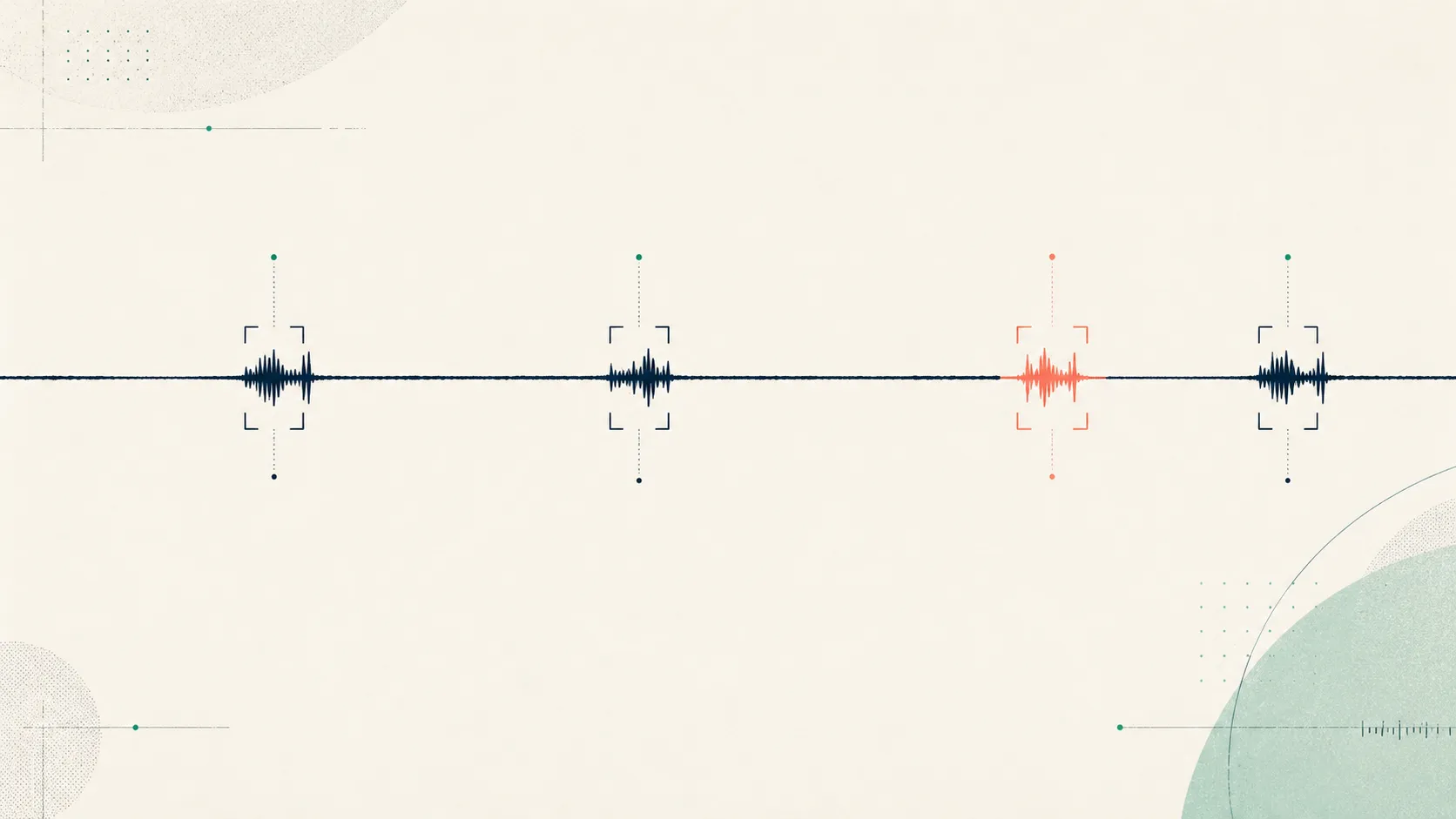
Poverty of speech is the hardest kind of clinical sign to measure, because you are measuring an absence. There is no bizarre utterance to point at, no delusion to quote back—just a person answering in three words where most people would use thirty. Nancy Andreasen built the alogia subscale of the Scale for the Assessment of Negative Symptoms (SANS) to make that absence countable, and in doing so she produced something close to an annotation scheme: four operationally defined features of speech that a rater can recognize in a transcript and mark (Andreasen, 1982, 1984).
What is poverty of speech, and what is alogia?
Poverty of speech is a restriction in the amount of spontaneous speech, so that replies are brief, terse, and unelaborated (Andreasen, 1982). It is the central sign of alogia, one of the five negative-symptom complexes Andreasen defined in the SANS: affective flattening, alogia, avolition-apathy, anhedonia-asociality, and attentional impairment. Alogia names an impoverishment of thinking, inferred from what the speech does or fails to do.
The distinction between the symptom and the sign matters for coding. Alogia is the clinical construct—poverty of thought. Poverty of speech is the observable evidence you can actually mark in a transcript.
You never annotate “alogia” directly; you annotate the brief reply, the unfilled pause, the answer that stops short, and let those instances add up to the construct. That is why the subscale is a good fit for span-level annotation and a poor fit for a single global impression.
What are the four SANS alogia items?
The alogia subscale rates four specific items plus a global rating, each on a 0–5 scale from absent to severe (Andreasen, 1984). The table below gives each item’s operational definition, phrased so you can recognize it in speech rather than infer it from a diagnosis.
| Item | Operational definition | What it counts |
|---|---|---|
| Poverty of Speech | Restriction in the amount of spontaneous speech; replies are brief, terse, and unelaborated | Too little speech (quantity) |
| Poverty of Content of Speech | Adequate amount of speech that conveys little information—vague, over-abstract, or repetitive | Too little information (quality) |
| Blocking | Interruption of a train of speech before an idea is completed; the thought cannot be recovered | A break mid-thought |
| Increased Latency of Response | Unusually long pauses before answering, longer than the flow of conversation warrants | Delay before speech |
Two of these are about the shape of speech over time—Blocking is a break inside a thought, Increased Latency is a delay before it starts—while the other two are about its substance. Getting the substance pair right, Poverty of Speech versus Poverty of Content, is where most coding disagreements live.
Poverty of speech vs poverty of content: what’s the difference?
Poverty of speech is too little speech; poverty of content is enough speech carrying too little information (Andreasen, 1982). The discriminator is not how the reply feels but what you measure: count the amount of speech produced, or judge the information each unit of speech carries. A one-word answer is a quantity deficit. A long, fluent answer that circles and never lands on anything is a content deficit.
Here is the subtle part, and it is a genuine, live debate rather than settled fact. Poverty of content does not sit cleanly among the negative symptoms at all.
In factor-analytic work, and in the modern two-domain consensus that shaped DSM-5’s negative-symptom criteria, the “true” expressive deficit is restricted to reduced quantity and quality of speech. That tends to exclude poverty of content and group it instead with disorganization, closer to positive formal thought disorder (Kirkpatrick et al., 2006). Andreasen’s own Thought, Language and Communication framework lists poverty of content among the disorders of disorganized speech.
The practical consequence for an annotation project: treat poverty of content as a boundary item. When you tag it, be ready to defend why the span is empty rather than disorganized, and check it against the positive formal thought disorder items in the SAPS and the broader Thought, Language and Communication scale, where its neighbors live. Coding the same phenomenon under two headings across a project is how a codebook quietly loses reliability.
Why does alogia sit with the expressive-deficit factor?
Alogia loads on the expressive-deficit factor of negative symptoms, alongside blunted affect, and that factor is separable from the avolition-apathy factor that captures motivation and pleasure (Blanchard & Cohen, 2006; Kirkpatrick et al., 2006). The 2006 NIMH-MATRICS consensus statement codified this two-domain structure, and it is now the standard way to think about negative symptoms.
The split is not academic bookkeeping. Deconstructing the two clusters, Strauss and colleagues showed each predicts clinical presentation and functional outcome on its own, so measuring them together blurs a real signal (Strauss et al., 2013). For a coder, the takeaway is that alogia belongs with how a person expresses, not what a person is motivated to do—which keeps you from mislabeling a withdrawn, unmotivated silence as poverty of speech when it is really avolition wearing the same quiet face.
How reliable is the SANS alogia subscale?
The alogia subscale is reliable at the domain level and strongest on its frequent items. In a modern psychometric validation, the alogia domain reached an intraclass correlation of 0.837 (95% CI 0.62–0.92) and the alogia global rating reached 0.883 (Amin et al., 2023). Andreasen’s original SANS reports reflect excellent inter-rater agreement for the scale overall, though the primary paper describes it in words rather than a single alogia coefficient (Andreasen, 1982).
The item that drags on reliability is Blocking. It is rare, it overlaps phenomenologically with thought withdrawal and with increased latency, and rare items carry little variance for two coders to agree on. The lesson generalizes to any coding project: budget calibration effort on the common items and require clear, repeated instances before scoring the rare ones. If you compute agreement yourself, the Cohen’s kappa and inter-rater reliability guide explains why a low coefficient on a rare item is often a base-rate artifact rather than a coding failure.
Can you measure poverty of speech automatically?
Poverty of speech translates almost directly into acoustic and language features, which is why it has become a target for computational psychiatry. Because the sign is defined as reduced quantity and slowed production, the measurable proxies are obvious: words per second, pause duration, and the length of unvoiced segments.
Using an acoustic protocol, Cohen and colleagues found markedly reduced speech rate in patients with prominent expressive deficits, and their computerized speech-rate measure correlated with clinical ratings of poverty of speech, increased latency, and global alogia (Cohen et al., 2008). More recent machine-learning work classified predominantly-negative versus predominantly-positive symptom profiles from acoustic features alone at 74.2% accuracy, with pause length and pause variability among the top features (de Boer et al., 2023). Poverty of content, by contrast, needs semantic rather than acoustic measures—automated coherence metrics that quantify how little information the words carry (Elvevåg et al., 2007). The two negative-symptom deficits split the same way for a machine as they do for a human rater: count the silence for reduced quantity, measure the emptiness for reduced content.
How do you code poverty of speech from a transcript?
To code the alogia subscale, mark the specific utterance that shows the deficit and label it with the matching item—instance-mode annotation, where you tag the speech (or the pause) that is the phenomenon rather than rating the interview as a whole. Poverty of speech is a span-level event even when the “span” is conspicuously short.
Consider a short synthetic exchange:
Interviewer: Can you tell me about your week—what have you been up to?
Subject: Not much.
Interviewer: Anything at all stand out?
Subject: No.
Those two replies, offered without elaboration where the question invited it, are a clean instance of poverty of speech, tagged on the spans “Not much” and “No.” Marking the span keeps the evidence attached to the label, so a second coder can check the call against the exact words and the question that prompted them. That is what makes the SANS alogia coding scheme reproducible enough to compute agreement across raters, and it is the same instance-mode logic behind coding disorganized speech in the TLC scale.
On data handling: coding interview speech means working with sensitive clinical language, so the sane default is de-identified text and a privacy-first setup. Tagaroo supports a browser-side anonymous mode, so transcript content can stay local rather than being uploaded—worth checking against your ethics approval before any real interview data touches a tool.
Common mistakes when coding alogia
The most common mistake is scoring silence without asking what caused it, but a few others recur:
- Confusing poverty of speech with avolition. A withdrawn, unmotivated silence can look identical on the page. The discriminator is expressive capacity versus drive—alogia is a deficit of output, not of motivation (Strauss et al., 2013).
- Reading poverty of content as a shortage of words. A long, fluent, empty answer is poverty of content, not a quantity deficit. Count information, not just words.
- Over-scoring Blocking. It is genuinely rare and hard to distinguish from a long latency. Require a clear mid-thought interruption that the speaker cannot recover before you score it (Amin et al., 2023).
- Rating the interview, not the utterance. A single global impression hides the evidence. Tag the spans, then let the ratings follow from what you marked.
The practical upshot: poverty of speech is measurable precisely because Andreasen turned an impression of “not much said” into four concrete, observable items. Code the common ones with confidence, keep quantity and content on opposite sides of the line, and anchor every rating to the utterance—or the silence—that justifies it.
References
- Andreasen, N. C. (1982). Negative symptoms in schizophrenia: definition and reliability. Archives of General Psychiatry, 39(7), 784–788. doi:10.1001/archpsyc.1982.04290070020005
- Andreasen, N. C., & Olsen, S. (1982). Negative v positive schizophrenia: definition and validation. Archives of General Psychiatry, 39(7), 789–794. doi:10.1001/archpsyc.1982.04290070025006
- Andreasen, N. C. (1984). Scale for the Assessment of Negative Symptoms (SANS). Iowa City: University of Iowa.
- Blanchard, J. J., & Cohen, A. S. (2006). The structure of negative symptoms within schizophrenia: implications for assessment. Schizophrenia Bulletin, 32(2), 238–245. doi:10.1093/schbul/sbj013
- Kirkpatrick, B., Fenton, W. S., Carpenter, W. T., & Marder, S. R. (2006). The NIMH-MATRICS consensus statement on negative symptoms. Schizophrenia Bulletin, 32(2), 214–219. doi:10.1093/schbul/sbj053
- Strauss, G. P., Horan, W. P., Kirkpatrick, B., Fischer, B. A., Keller, W. R., Miski, P., et al. (2013). Deconstructing negative symptoms of schizophrenia: avolition-apathy and diminished expression clusters predict clinical presentation and functional outcome. Journal of Psychiatric Research, 47(6), 783–790. doi:10.1016/j.jpsychires.2013.01.015
- Cohen, A. S., Alpert, M., Nienow, T. M., Dinzeo, T. J., & Docherty, N. M. (2008). Computerized measurement of negative symptoms in schizophrenia. Journal of Psychiatric Research, 42(10), 827–836. doi:10.1016/j.jpsychires.2007.08.008
- de Boer, J. N., Voppel, A. E., Brederoo, S. G., Schnack, H. G., Truong, K. P., Wijnen, F. N. K., & Sommer, I. E. C. (2023). Acoustic speech markers for schizophrenia-spectrum disorders. Psychological Medicine, 53(4), 1302–1312. doi:10.1017/S0033291721002804
- Elvevåg, B., Foltz, P. W., Weinberger, D. R., & Goldberg, T. E. (2007). Quantifying incoherence in speech: an automated methodology and novel application to schizophrenia. Schizophrenia Research, 93(1–3), 304–316. doi:10.1016/j.schres.2007.03.001
- Amin, M. M., Effendy, E., Camellia, V., Saragih, M., Kamil, A., & Harsono, R. (2023). Validity and reliability of the Indonesian version of the SANS. Frontiers in Psychiatry, 13, 1045635. doi:10.3389/fpsyt.2022.1045635
If you code negative symptoms from clinical interviews, Tagaroo turns the SANS alogia subscale into a guided, evidence-anchored annotation workflow—with inter-rater reliability computed as your coders work.
Frequently asked questions
- What is poverty of speech?
- Poverty of speech is a restriction in the amount of spontaneous speech—replies are brief, terse, and unelaborated (Andreasen, 1982). It is the core item of the alogia subscale of the Scale for the Assessment of Negative Symptoms (SANS), where alogia refers to an impoverishment of thinking that shows up in speech. Poverty of speech is a deficit of quantity, distinct from poverty of content, which is a deficit of information.
- What is the difference between poverty of speech and poverty of content?
- Poverty of speech is too little speech—brief, unelaborated replies (a deficit of quantity). Poverty of content of speech is an adequate or even normal amount of speech that conveys little information—vague, over-abstract, or repetitive (a deficit of informativeness) (Andreasen, 1982). One is measured by counting how much is said; the other by judging how much information each unit of speech carries.
- What are the four items of the SANS alogia subscale?
- The SANS alogia subscale rates four items plus a global rating: Poverty of Speech (reduced amount of speech), Poverty of Content of Speech (adequate speech conveying little), Blocking (a train of speech interrupted before an idea is finished), and Increased Latency of Response (unusually long pauses before answering) (Andreasen, 1984). Each is rated 0–5, from absent to severe.
- Is alogia a positive or negative symptom of schizophrenia?
- Alogia is a negative symptom. In factor-analytic and consensus models it loads on the expressive-deficit factor alongside blunted affect, dissociable from the avolition-apathy factor (Blanchard & Cohen, 2006; Kirkpatrick et al., 2006). The diminished-expression cluster, where alogia sits, independently predicts clinical presentation and functional outcome (Strauss et al., 2013).
- How reliable is the SANS alogia subscale?
- In a modern psychometric validation, the SANS alogia domain reached an intraclass correlation of 0.837 and the alogia global rating 0.883 (Amin et al., 2023). Reliability is strongest for the frequent, prototypical signs; Blocking is rare and the least psychometrically robust of the four items, so it needs clear, repeated instances before it is scored.
Keep reading
 Clinical Phenomena
Positive Formal Thought Disorder: The SAPS Subscale
Positive formal thought disorder is disorganized speech you can see. Meet the SAPS FTD items, how they differ from the TLC and SANS, and how to code them.
 Clinical Phenomena
The Thought Language and Communication Scale, Explained
The Thought Language and Communication scale (TLC) is Andreasen's glossary of disordered speech. See the items, the reliability data, and how to code them.
 Reliability & Agreement
Cohen's Kappa: How to Compute and Interpret Agreement
How to compute Cohen's kappa and weighted kappa by hand, read the result honestly, and know when to use Krippendorff's alpha, ICC, or Gwet's AC1 instead.
Put this into practice
Tagaroo turns any rating scale or coding scheme into a guided annotation workflow—with inter-rater reliability computed as you go.