TLC vs SAPS Thought Disorder: Coding Disorganized Speech
TLC vs SAPS thought disorder, compared: the 18-item TLC glossary vs the 8-item SAPS positive-FTD subscale, with an overlap grid and when to use each.
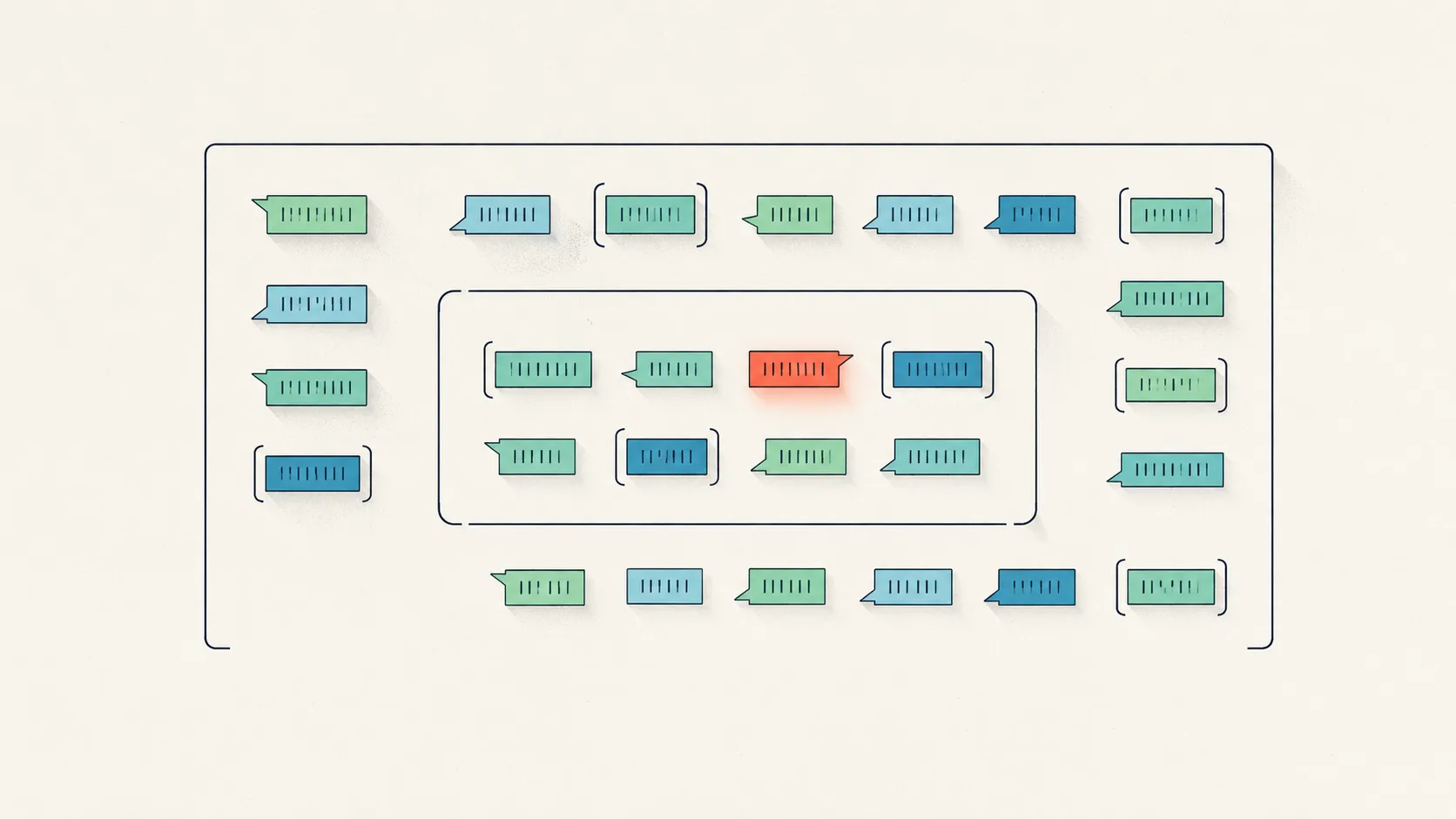
The TLC vs SAPS thought disorder choice comes down to scope. The Thought, Language and Communication scale (TLC) is Nancy Andreasen’s standalone glossary of 18 disordered-speech signs, covering both the “too much” of positive formal thought disorder and the “too little” of negative FTD (Andreasen, 1986). The SAPS positive formal thought disorder subscale is 8 of those signs, embedded as one domain inside the broader Scale for the Assessment of Positive Symptoms (Andreasen, 1984). They share Andreasen’s vocabulary and often the same words, so pick the TLC when disorganized speech is the object of study and the SAPS-FTD subscale when it is one slice of a full positive-symptom assessment.
TLC vs SAPS thought disorder at a glance
The TLC and the SAPS positive-FTD subscale rate the same phenomenon—disorganized speech—from a shared set of definitions, but one is a dedicated instrument and the other is a subscale of a larger battery. That single design difference drives everything else: item count, which poles are covered, and how each sign is scored. The table sets them side by side on the axes that decide which to reach for.
| Axis | TLC scale | SAPS positive-FTD subscale |
|---|---|---|
| What it is | Standalone thought-disorder instrument | One domain inside the 34-item SAPS |
| Scored items | 18 subtypes + global rating | 8 items + global rating |
| Poles covered | Positive and negative FTD | Positive FTD only |
| Item rating | 0–3 or 0–4 (by frequency) | 0–5 (severity: absent→severe) |
| Global rating | 0–4 | 0–5 |
| Optional weighting | ×2 for more pathological signs | None (uniform anchor) |
| Rater | Clinician | Clinician |
| Original source | Andreasen, 1986 | Andreasen, 1984 |
| Best for | Disorganized speech as the object | FTD within a positive-symptom picture |
Each instrument has a full explainer of its own: the Thought, Language and Communication scale guide walks through all the TLC items, and the SAPS positive formal thought disorder guide covers the subscale. This page is the head-to-head.
What’s the core difference in scope?
The core difference is that the TLC is the whole map and the SAPS-FTD subscale is one region of it. The TLC was built as a dedicated glossary: Andreasen recommended retiring the vague term “formal thought disorder” and replacing it with 18 operationally defined “disorders of thought, language, and communication,” each with a paragraph definition and verbatim examples (Andreasen, 1986). The SAPS-FTD subscale takes the positive, productive signs from that glossary and slots them into the Scale for the Assessment of Positive Symptoms, where formal thought disorder is one domain alongside hallucinations, delusions, and bizarre behavior (Andreasen, 1984).
That framing changes what you can measure. Because the TLC spans both poles, it captures negative FTD—poverty of speech and poverty of content—which is the variety that best predicts poor outcome in schizophrenia (Andreasen & Grove, 1986). The SAPS-FTD subscale, by design, sees only the positive side; the negative counterparts live in the SANS, where poverty of speech anchors the SANS alogia subscale. So a project that cares about impoverished speech cannot get it from the SAPS-FTD subscale alone.
The subscale gains something in return: context. Scored inside the SAPS, disorganized speech sits next to the other positive symptoms on a common scale, which is exactly what you want when the research question is about the positive-symptom syndrome as a whole rather than language specifically.
Which signs overlap, and which are unique?
In Andreasen’s published scales, every sign in the SAPS positive-FTD subscale is also a TLC sign, so the overlap is a clean subset relationship, not a Venn diagram with three regions. Both instruments inherit Andreasen’s 1979 definitions, which is why the wording often matches almost verbatim (Andreasen, 1979). What the TLC adds on top is the negative pole and the rarer signs. One product-level wrinkle to hold onto: Tagaroo’s TLC tool models 12 of the 18 published items and drops Incoherence, so inside Tagaroo’s tools that one SAPS-FTD sign has no TLC counterpart—the grid below is the published-scale membership.
| Sign | In TLC (published 18) | In SAPS-FTD (8) | Pole |
|---|---|---|---|
| Derailment | Yes | Yes | Positive |
| Tangentiality | Yes | Yes | Positive |
| Incoherence † | Yes | Yes | Positive |
| Illogicality | Yes | Yes | Positive |
| Circumstantiality | Yes | Yes | Positive |
| Pressure of speech | Yes | Yes | Positive |
| Distractible speech | Yes | Yes | Positive |
| Clanging | Yes | Yes | Positive |
| Poverty of speech | Yes | — | Negative |
| Poverty of content of speech | Yes | — | Negative* |
| Neologisms | Yes | — | Positive (rare) |
| Perseveration | Yes | — | Mixed |
| Loss of goal | Yes | — | Mixed |
| Blocking; word approximations; echolalia; stilted speech; self-reference | Yes | — | Rare/other |
Two honest caveats keep the grid accurate. First, Tagaroo’s TLC coding library models 12 of the 18 published items and omits Incoherence (along with the rarer word approximations, echolalia, and the like), so the strict-subset relationship holds for Andreasen’s published scales but not inside Tagaroo’s tools: there, Incoherence is a SAPS-FTD sign with no TLC counterpart. Second, poverty of content of speech is the boundary case: the original SAPS placed it in the SANS alogia subscale as a negative sign, but Andreasen’s 1995 structural revision and later factor-analytic work argued it belongs with disorganization, closer to positive FTD (Dazzi & Shafer, 2024). Code it under one heading per project, not both.
How does the rating philosophy differ?
The two scales score the same sign on different rulers: the TLC rates by frequency with variable ceilings, the SAPS by uniform severity. On the TLC, each item is rated 0–3 or 0–4 depending on the sign, anchored to how often the phenomenon appears over a standardized interview sample of roughly 45–50 minutes, with a separate global rating from 0 to 4 (Andreasen, 1986). The SAPS rates every item—formal thought disorder included—on a single 0–5 anchor running from absent (0) through questionable, mild, moderate, and marked to severe (5), so the FTD items are scored exactly like hallucinations and delusions (Andreasen, 1984).
The TLC also carries a weighting option the SAPS does not. Andreasen grouped the more pathological signs (incoherence, derailment) ahead of the milder ones (circumstantiality) and offered a summing method that multiplies the pathological signs by two before totaling, so a global TLC score can reflect that not all disorganization is equally severe (Andreasen, 1986). The SAPS keeps a flat severity anchor across all its symptoms, trading that nuance for comparability across domains.
For a coding project, the practical consequence is about what your total means. A TLC total is a frequency-weighted, severity-graded index of disordered speech specifically; a SAPS positive-FTD score is a severity rating that sits on the same scale as the rest of the positive syndrome, which makes it easy to relate FTD to delusions and hallucinations but harder to treat as a fine-grained language measure.
Is the reliability the same for both?
The reliability figures are literally the same numbers, because the SAPS positive-FTD subscale has no separately published inter-rater reliability of its own—researchers quote Andreasen’s TLC study, since the items are shared (Andreasen, 1986). That provenance is worth stating out loud: when a paper reports “good reliability” for the SAPS thought-disorder items, it is almost always borrowing the TLC kappas from a sample of 113 patients, not citing a fresh SAPS validation.
Within those shared items, agreement tracks how often each sign actually appears. The frequent, prototypical signs are rated reliably; the rarer ones sit lower and carry little variance for two coders to agree on.
| Shared item | Weighted kappa | Reliability |
|---|---|---|
| Pressure of speech | 0.89 | High |
| Incoherence | 0.88 | High |
| Derailment | 0.83 | High |
| Illogicality | 0.80 | High |
| Distractible speech | 0.78 | Good |
| Circumstantiality | 0.74 | Good |
| Tangentiality | 0.58 | Fair |
| Clanging | 0.58 | Fair |
The lesson generalizes to either instrument: budget calibration effort on the frequent signs and require clear, repeated instances before scoring the rare ones. If you compute agreement yourself, the Cohen’s kappa and inter-rater reliability guide explains why a low coefficient on a rare item is usually a base-rate artifact, not a coding failure.
Where does positive FTD sit in the wider factor structure?
Positive FTD is not simply a slice of “positive symptoms”—it loads on a separate disorganization dimension, which is one reason the SAPS-FTD subscale behaves like its own thing inside the SAPS. Pooling 55 factor analyses across 5,219 patients, a recent meta-analysis found a stable three-factor structure: positive symptoms (hallucinations and delusions), negative symptoms, and disorganization, with positive formal thought disorder and bizarre behavior anchoring that third factor (Dazzi & Shafer, 2024). An earlier item-level analysis of the SAPS and SANS reached the same conclusion, placing positive FTD on a disorganization dimension distinct from both reality distortion and negative symptoms (Peralta & Cuesta, 1999).
That precision is not academic. Prevalence estimates for formal thought disorder range from 5% to 91% across studies, a spread driven more by which instrument and definition a study uses than by the biology (Roche et al., 2015)—which is the whole case for choosing one operationalized scale and citing it exactly, rather than treating “the TLC” and “the SAPS thought-disorder scale” as interchangeable.
The positive-versus-negative split the TLC captures carries diagnostic and prognostic weight the SAPS-FTD subscale cannot see on its own. Comparing 94 controls with 100 patients, Andreasen and Grove found positive FTD more prominent in mania and negative FTD more characteristic of schizophrenia, with negative thought disorder the single strongest predictor of poor outcome (Andreasen & Grove, 1986). Since the SAPS-FTD subscale rates only the positive pole, a study that needs that prognostic signal has to bring in the SANS alogia items or use the full TLC. This is also why modern reviews increasingly treat FTD as a dimensional construct spanning phenomenology to neurobiology rather than a single positive/negative switch (Kircher et al., 2018).
When should you use the TLC vs the SAPS-FTD subscale?
Choose the instrument that matches your unit of analysis, not its reputation. The evidence points to a clean rule.
- Choose the TLC when disorganized speech is the primary object of study, when you need both poles (including the prognostically important negative FTD), when you want the finer subtypes, or when you are grounding a computational-linguistics phenotype—the TLC’s operational definitions are the reference vocabulary for that work (Kircher et al., 2018).
- Choose the SAPS positive-FTD subscale when you are already scoring the full positive-symptom picture and want disorganized speech on the same 0–5 anchor as hallucinations and delusions, when you need the disorganization factor to sit inside a SAPS/SANS battery, or when comparability across the positive syndrome matters more than fine-grained language detail.
- Use both frameworks when you need positive and negative FTD scored comparably: pair the SAPS positive-FTD subscale with the SANS alogia subscale, which is how Andreasen’s positive/negative system was meant to be run. For a parallel scale-versus-scale decision in general psychopathology, the BPRS vs PANSS comparison walks through the same “subscale inside a battery” trade-off.
The one thing to avoid is citing them as if they were interchangeable. Reviewers notice when “the SAPS thought-disorder scale” and “the TLC” are treated as one instrument—keep the citations separate, Andreasen 1984 for the SAPS and 1986 for the TLC.
How do you code either from a transcript?
To code either instrument from an interview, mark the specific utterance that shows the sign and label it with the matching item, rather than rating the whole interview from memory. Disorganized speech is a span-level event almost by definition, so the same instance-mode annotation works for the TLC and the SAPS-FTD subscale; only the item menu and the rating anchor change.
Consider a short synthetic exchange, coded both ways:
Interviewer: How has the new job been going?
Subject: It’s fine, I suppose, but Thursdays have that light in the stairwell, and the whole point of a stairwell is really the going-up of it, isn’t it, which is why the bus was late.
That reply drifts from the job to a stairwell to a late bus, obliquely and without the speaker noticing—a clean instance of derailment. On the TLC you tag the span and rate derailment 0–4 by how often such drift recurs across the sample; on the SAPS positive-FTD subscale you tag the same span and rate it 0–5 for severity within the positive-symptom picture. Marking the span keeps the evidence attached to the label, so a second coder can check the call against the exact words and you can compute agreement across raters. That shared span-logic is what makes both the TLC coding scheme and the SAPS positive-FTD subscale reproducible.
The TLC card lists the 12 items Tagaroo models—the highest-yield subset of Andreasen’s published 18. Incoherence is one of the 6 published TLC items outside that set, which is why it appears on the SAPS-FTD card below but not here.
On data handling: coding interview speech means working with sensitive clinical language, so the sane default is de-identified text and a privacy-first setup. Tagaroo supports a browser-side anonymous mode, so transcript content can stay local rather than being uploaded—worth checking against your ethics approval before any real interview data touches a tool. See the Tagaroo privacy policy for how transcript data is handled.
TLC vs SAPS thought disorder: which should you use?
Pick the instrument for the question. The TLC is the full glossary of disordered speech—18 signs across both poles, rated by frequency, with the negative FTD that carries the prognostic signal. The SAPS positive-FTD subscale is 8 of those same signs, scored on a uniform 0–5 anchor inside a positive-symptom battery, ideal when disorganized speech is one part of a larger picture rather than the whole study. They are not rivals with different facts; they are the same vocabulary drawn at two scales, so the honest move is to match the tool to your unit of analysis and cite each to its own source.
The practical upshot of TLC vs SAPS thought disorder: in Andreasen’s published scales the subscale is a strict subset of the TLC’s positive pole (Tagaroo’s 12-item TLC tool omits one shared sign, Incoherence, so treat that as the in-app exception), the reliability numbers are literally shared, and the real decision is scope—do you want the whole map of disordered speech, or the positive-FTD region scored alongside the rest of the positive syndrome? If you code disorganized speech from interviews, Tagaroo turns both the TLC scale and the SAPS positive-FTD subscale into guided, evidence-anchored annotation workflows, with inter-rater reliability computed as your coders work.
References
- Andreasen, N. C. (1979). Thought, language, and communication disorders. I. Clinical assessment, definition of terms, and evaluation of their reliability. Archives of General Psychiatry, 36(12), 1315–1321. doi:10.1001/archpsyc.1979.01780120045006
- Andreasen, N. C. (1979). Thought, language, and communication disorders. II. Diagnostic significance. Archives of General Psychiatry, 36(12), 1325–1330. doi:10.1001/archpsyc.1979.01780120055007
- Andreasen, N. C. (1984). Scale for the Assessment of Positive Symptoms (SAPS). Iowa City: University of Iowa.
- Andreasen, N. C. (1986). Scale for the Assessment of Thought, Language, and Communication (TLC). Schizophrenia Bulletin, 12(3), 473–482. doi:10.1093/schbul/12.3.473
- Andreasen, N. C., & Grove, W. M. (1986). Thought, language, and communication in schizophrenia: diagnosis and prognosis. Schizophrenia Bulletin, 12(3), 348–359. doi:10.1093/schbul/12.3.348
- Peralta, V., & Cuesta, M. J. (1999). Dimensional structure of psychotic symptoms: an item-level analysis of SAPS and SANS symptoms in psychotic disorders. Schizophrenia Research, 38(1), 13–26. doi:10.1016/S0920-9964(99)00003-1
- Kircher, T., Bröhl, H., Meier, F., & Engelen, J. (2018). Formal thought disorders: from phenomenology to neurobiology. The Lancet Psychiatry, 5(6), 515–526. doi:10.1016/S2215-0366(18)30059-2
- Roche, E., Creed, L., MacMahon, D., Brennan, D., & Clarke, M. (2015). The epidemiology and associated phenomenology of formal thought disorder: a systematic review. Schizophrenia Bulletin, 41(4), 951–962. doi:10.1093/schbul/sbu129
- Dazzi, F., & Shafer, A. (2024). Meta-analysis of the factor structure of the Scale for the Assessment of Negative Symptoms (SANS) and the Scale for the Assessment of Positive Symptoms (SAPS). Schizophrenia Research, 274, 464–472. doi:10.1016/j.schres.2024.10.027
If you code disorganized speech from clinical interviews, Tagaroo turns both the TLC scale and the SAPS positive-FTD subscale into guided, evidence-anchored annotation workflows—with inter-rater reliability computed as your coders work.
Frequently asked questions
- What is the difference between the TLC and the SAPS thought disorder subscale?
- The TLC (Thought, Language and Communication scale) is a standalone instrument that operationally defines 18 subtypes of disordered speech, covering both positive FTD (derailment, tangentiality) and negative FTD (poverty of speech, poverty of content) (Andreasen, 1986). The SAPS positive formal thought disorder subscale is an 8-item block embedded in the 34-item Scale for the Assessment of Positive Symptoms, and it rates only the positive signs (Andreasen, 1984). In Andreasen's published scales every one of the 8 SAPS-FTD signs is also among the 18 TLC signs, so the subscale is essentially the positive-FTD slice of the TLC surfaced inside a positive-symptom battery. (One caveat for Tagaroo users: Tagaroo's TLC tool models 12 of the 18 published items and omits Incoherence, so within Tagaroo's tools Incoherence is the one SAPS-FTD sign without a TLC counterpart.)
- Do the TLC and SAPS positive-FTD subscale share the same items?
- Yes, but only partly. In Andreasen's published scales, all 8 SAPS positive-FTD items—derailment, tangentiality, incoherence, illogicality, circumstantiality, pressure of speech, distractible speech, and clanging—appear in the 18-item TLC, because both descend from Andreasen's 1979 definitions. The TLC then adds the negative signs (poverty of speech, poverty of content) and rarer ones (neologisms, perseveration, loss of goal, blocking) that the SAPS-FTD subscale leaves out, so no published SAPS-FTD sign is unique to the subscale. Note that Tagaroo's TLC tool models 12 of the 18 published items and omits Incoherence, so within Tagaroo's tools Incoherence is the one SAPS-FTD sign with no TLC counterpart.
- How are the TLC and SAPS rated differently?
- The TLC rates each item 0–3 or 0–4 by how often the sign appears in the speech sample, with a global 0–4 rating and an option to weight the more pathological signs double (Andreasen, 1986). The SAPS rates every item, formal thought disorder included, on a uniform 0–5 severity anchor (0 absent to 5 severe), so the FTD subscale is scored on the same scale as hallucinations and delusions (Andreasen, 1984).
- Should I use the TLC or SAPS for formal thought disorder?
- Use the TLC when disorganized speech is the primary object of study and you want the full positive-and-negative vocabulary and finer subtypes. Use the SAPS positive-FTD subscale when you are already assessing the whole positive-symptom picture and want disorganized speech scored on the same 0–5 anchor as the rest, where it loads on a disorganization factor distinct from reality distortion (Dazzi & Shafer, 2024).
- Is the SAPS positive-FTD subscale as reliable as the TLC?
- There is no separately published inter-rater reliability for the SAPS positive-FTD subscale; the kappas researchers cite come from Andreasen's TLC study of 113 patients, because the items are shared (Andreasen, 1986). Agreement is item-dependent and strongest for the frequent signs (pressure of speech κ = 0.89, derailment κ = 0.83) and weaker for rarer ones (tangentiality and clanging κ = 0.58).
Tagaroo builds an annotation tool, so we appear in some comparisons ourselves. How we evaluate tools is documented in our editorial policy.
Keep reading
 Clinical Phenomena
The Thought Language and Communication Scale, Explained
The Thought Language and Communication scale (TLC) is Andreasen's glossary of disordered speech. See the items, the reliability data, and how to code them.
 Clinical Phenomena
Positive Formal Thought Disorder: The SAPS Subscale
Positive formal thought disorder is disorganized speech you can see. Meet the SAPS FTD items, how they differ from the TLC and SANS, and how to code them.
 Clinical Phenomena
Poverty of Speech and Alogia: Coding the SANS Subscale
Poverty of speech is the core of alogia. See the four SANS alogia items, how they differ from poverty of content, and how to code each from a transcript.
Put this into practice
Tagaroo turns any rating scale or coding scheme into a guided annotation workflow—with inter-rater reliability computed as you go.