Clinical Transcript Annotation Tools: A Buyer's Shortlist
Which clinical transcript annotation tool fits psychiatric, therapy, or SLP research? Compare options on HIPAA, speaker roles, severity scales, and IRR.
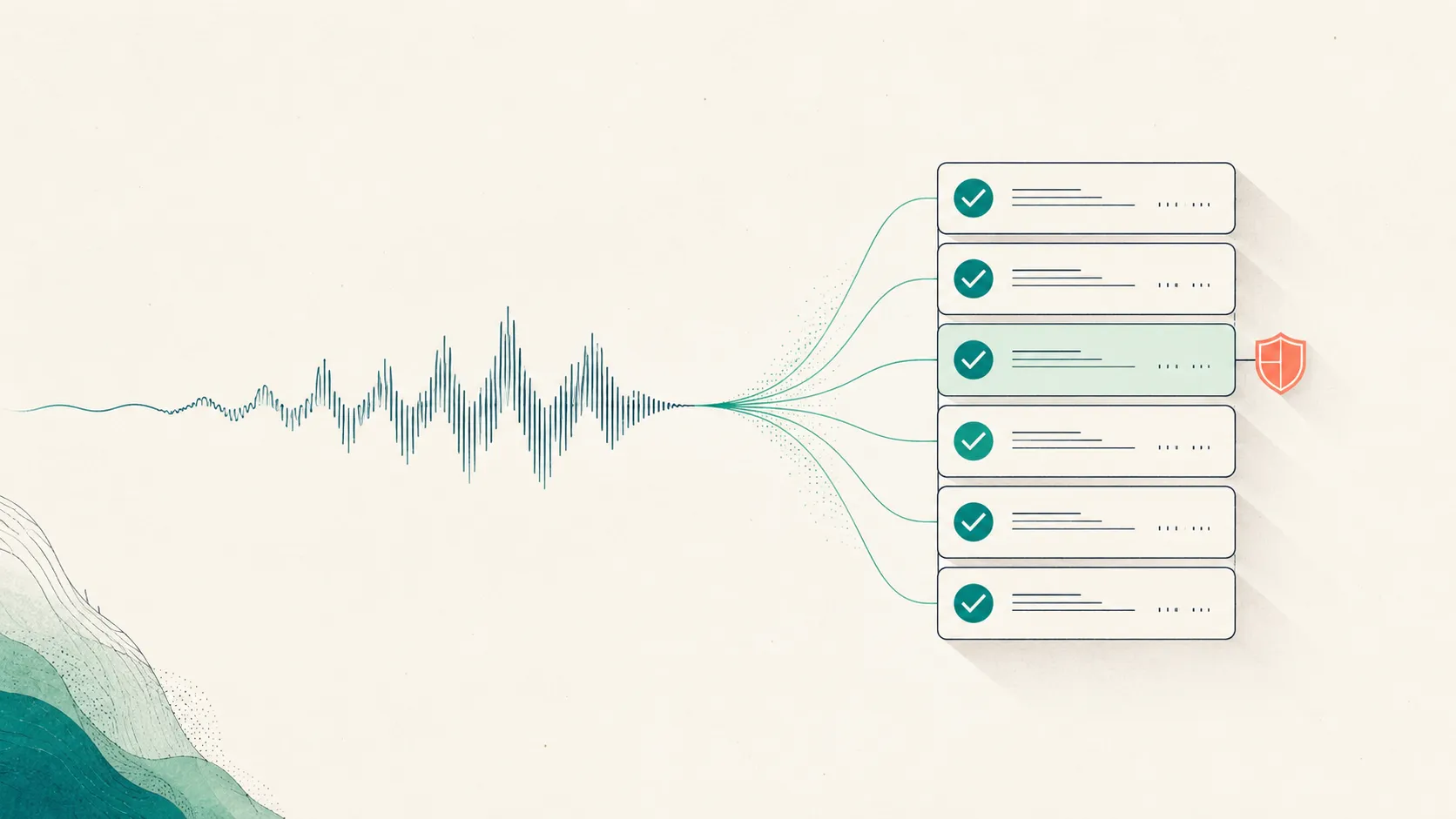
Most annotation software was built to draw boxes on images or tag entities in product reviews. Almost none of it was built for a psychiatric interview, where the label is a severity rating, the speaker changes every turn, and the thing you are tagging is a pattern of disordered thought spread across three sentences. A clinical transcript annotation tool has to do that second job, and the honest truth is that the shortlist of tools that actually can is short.
This is a buyer’s guide for anyone coding clinical or research interviews: psychiatric symptom ratings, therapy-process coding, speech-language transcripts, or clinical NLP training data. It leads with the requirements that matter for clinical constructs—HIPAA handling, multi-speaker roles, validated severity scales, span-level evidence, inter-rater reliability, and AI pre-labeling—then compares the real options against that checklist. Where a general tool is the better fit, this guide says so.
What makes a clinical transcript annotation tool different?
A clinical transcript annotation tool is software for attaching clinical labels to spans of interview or therapy transcript—a symptom’s severity rating, a thought-disorder code, a motivational-interviewing behavior, a speaker role—so those labels can be counted, compared across raters, and traced back to the exact utterance that justifies them. The defining feature is that the label carries clinical structure, not just a category name.
That structure is what generic tools lack. A product-review labeler treats “positive” and “negative” as flat tags. A clinical instrument treats apparent sadness as an ordinal item scored 0 to 6 against published anchors, rated from observable dejection rather than self-report (Montgomery & Åsberg, 1979). Same interface metaphor—highlight a span, apply a label—but a completely different data model underneath.
It is also worth drawing a line that confuses a lot of buyers. An AI medical scribe—the ambient assistants that draft a note from a live visit—is not an annotation tool. A scribe produces prose for the chart; a clinical transcript annotation tool produces structured, analyzable labels for research and reliability. If your goal is a labeled dataset, a computed kappa, or an audit trail from score to sentence, you want the second category, and this guide is about that category.
The clinical annotation requirements checklist
Six requirements separate a clinical-grade transcript tool from a general-purpose labeler. Use this as a buyer’s shortlist: score each candidate on all six rather than on feature-count or price alone. The first column is the requirement, the last two show where the two big families of general tools tend to fall short.
| Requirement | Why it matters for clinical transcripts | Generic CV/NLP labelers | CAQDAS (qualitative software) |
|---|---|---|---|
| HIPAA / de-identification posture | Interview text is often PHI; you need a BAA or a de-identify-first workflow | Self-hosted options keep data local; SaaS BAA varies | Cloud BAA varies by vendor; verify per product |
| Multi-speaker roles | Interviewer vs subject changes what a line means and who is being rated | Not modeled—flat text by default | Speaker turns supported via transcript import |
| Clinical severity scales | Ordinal items with validated anchors, not flat categories | None built in—you encode them | None built in—you build a codebook |
| Span-level evidence | Each rating should point to the utterance that justifies it | Spans yes, but no rating-to-evidence link | Quote-to-code links yes; ordinal scoring no |
| Inter-rater reliability | Two raters, one construct—agreement must be computable | Not built in; export and compute externally | Kappa / alpha in some tools, not all |
| AI pre-labeling | A first pass on tedious symptom tagging saves expert time | Model-assist in some; not clinical-aware | AI assist emerging; general-purpose |
The row that trips up almost every generic tool is clinical severity scales. You can bolt a labeling scheme onto Label Studio or build a codebook in NVivo, but you are then re-implementing a validated instrument by hand—its items, its ordinal anchors, its scoring logic—and hoping you got it right. That is the gap a clinical-specific tool is meant to close.
The last two rows carry the project’s economics. Expert clinical annotation is slow and expensive—annotation studies routinely lean on physicians and describe the work as “time consuming and costly” (Ogren et al., 2012)—which is why an AI first pass on the tedious tagging is worth real money. And reliable coding is not a nicety: because inter-annotator agreement sets the ceiling on how well any downstream model can perform, your reliability number is effectively an upper bound on your results (Boguslav & Cohen, 2017).
HIPAA, BAAs, and de-identification: what do you actually need?
There is no such thing as “HIPAA-certified software.” HIPAA is a US federal rule, not a certification program; the HHS Office for Civil Rights explicitly warns that it does not endorse private “certifications” and that no such badge absolves you of your own obligations (HHS OCR, “Be Aware of Misleading Marketing Claims”). So a vendor page that says “HIPAA compliant” is a self-description, not a stamp from a regulator. What the rule actually requires is concrete: if a vendor creates, receives, maintains, or transmits protected health information on your behalf, you must have a signed Business Associate Agreement (BAA) with them (45 CFR 164.502(e); 164.504(e); 45 CFR 164.308(b)). No BAA, no lawful PHI in that tool.
The cleaner path for most research work is to never put PHI in the tool at all. Under the HIPAA Privacy Rule, data that meets the de-identification standard—either Safe Harbor (removing the 18 listed identifiers) or Expert Determination—is no longer protected health information, and the rule’s restrictions no longer apply (45 CFR 164.514(a)-(b); HHS de-identification guidance). De-identify the transcript first, and the BAA question largely disappears. For a first pass at that, our transcript de-identifier runs entirely in the browser: it flags names, dates, contact details and record numbers for your review and substitutes consistent pseudonyms, with nothing uploaded.
For teams under EU rules, the parallel is Article 9 of the GDPR: data concerning health is a special category with heightened protections, and processing it needs a specific lawful basis (such as explicit consent or the scientific-research condition). Pseudonymized data still counts as personal data, but data anonymized so that no individual is identifiable falls outside the GDPR entirely (GDPR Recital 26). Note the bar is higher than HIPAA’s: GDPR anonymisation demands the link be genuinely irreversible, so stripping the HIPAA Safe Harbor identifiers is not automatically enough. The practical takeaway is the same on both sides of the Atlantic: de-identify early, and know your tool’s data-handling posture before you upload.
The best clinical transcript annotation tools compared
The realistic options fall into three families: qualitative-analysis software (CAQDAS) that codes text but ships no clinical scales; general NLP/data-labeling platforms that give you a flexible blank canvas; and clinical-specific tools built around validated instruments. No single tool wins every row—the right pick depends on which requirements are non-negotiable for your project.
| Tool | Best for | Clinical scales built in | IRR built in | AI pre-labeling | Data-handling note |
|---|---|---|---|---|---|
| Tagaroo | AI-guided clinical/research coding | Yes—curated Scale Library | Yes (Cohen's kappa) | Yes—AI agent first pass | De-identify-first; browser-side trial mode; EU-hosted |
| NVivo (Lumivero) | Mixed-methods qualitative research | No—build your own codebook | Coding comparison (kappa) | AI Assistant add-on | Claims HIPAA compliance; confirm a BAA in writing |
| ATLAS.ti | Deep qualitative coding | No | Inter-coder agreement | AI coding (OpenAI, opt-out of training) | Desktop keeps data local; claims HIPAA in its whitepaper |
| MAXQDA | Mixed-methods + stats | No | Intercoder agreement | AI Assist add-on | GDPR-oriented; HIPAA not advertised |
| Dedoose | Web-based team coding | No | Training/reliability tests | Emerging | Claims HIPAA; BAA offered to Premier/Enterprise |
| Label Studio / Prodigy / Doccano | Custom NLP labeling | No—fully DIY | No—compute externally | Model-assist (Studio/Prodigy) | Self-hostable; Label Studio Enterprise is HIPAA-compliant |
| SALT / CLAN | Speech-language sample analysis | No—linguistic coding | No built-in kappa | No | Local desktop; no cloud PHI |
The three families, and where each wins
Qualitative software (NVivo, ATLAS.ti, MAXQDA, Dedoose) is the traditional home of transcript coding, and it is genuinely good at it: rich code hierarchies, quote-to-code links, query tools, and—in most of these—an inter-coder agreement calculation. What none of them ship is a validated clinical scale. You import your transcript, build a codebook from scratch, and hand-encode the MADRS items or the TLC phenomena yourself.
Several have added LLM-backed “AI coding,” which is worth a hard look at one thing: where does your text go when the AI runs? ATLAS.ti and MAXQDA route AI coding through OpenAI-family models with a stated opt-out from training, which is a data-handling decision your ethics board will want to hear about. On compliance, the honest picture is uneven: most of these vendors claim HIPAA alignment, but only Dedoose openly advertises that it will sign a Business Associate Agreement (for Premier and Enterprise plans), while MAXQDA documents a GDPR posture and does not market HIPAA at all. For a full four-way CAQDAS breakdown, see the companion guide on NVivo, ATLAS.ti, MAXQDA and Dedoose compared.
General NLP and data-labeling platforms (Label Studio, Prodigy, Doccano, Argilla) are the opposite trade-off: maximum flexibility, zero clinical opinion. They are excellent for custom NER, span classification, and building ML training data, and the self-hostable ones (Prodigy runs locally; Label Studio and Doccano can be self-hosted) sidestep the cloud-BAA question by keeping data on your own infrastructure. But every clinical construct—severity anchors, speaker roles, the scoring math—is yours to build and validate. If your task is broad data labeling, or building LLM preference and RLHF evaluation data rather than clinical coding specifically, start with the wider roundup of the best data annotation tools instead of forcing a clinical lens.
Speech-language tools (SALT, CLAN/TalkBank) deserve a mention because SLP researchers live in them. They are purpose-built for language-sample analysis—CHAT transcription, morphosyntactic coding, fluency measures—and run locally, which keeps recordings off the cloud. What they are not is a psychiatric severity-scale tool; the coding vocabulary is linguistic, not symptom-based.
Why do generic CV/NLP tools fall short for clinical constructs?
Generic tools fall short on clinical transcripts for a specific reason: clinical constructs are ordinal, speaker-dependent, and often distributed across an utterance rather than pinned to a single token. A bounding-box or entity-tagging model has no place to put “severity 3 of 6,” no notion that the interviewer’s question reframes the subject’s answer, and no way to represent a phenomenon like derailment, where the pathology is the drift between clauses, not any one word (Andreasen, 1986).
Take formal thought disorder. Coding it means recognizing that a reply slides off-topic across several sentences, then rating how severe that slippage is against a scale’s anchors. A flat NER schema can mark “this span is disorganized,” but it cannot express the ordinal judgment or bind it to the item definition.
That mismatch is why teams who start in a generic labeler so often end up maintaining a spreadsheet of scale rules on the side—the tool holds the spans, but the clinical logic lives outside it. The full vocabulary of these phenomena lives in the Thought, Language and Communication scale, and it does not survive translation into a generic tag set.
Speaker roles are the other quiet failure. In a clinical interview, who is speaking changes the meaning of a line: a subject’s “I don’t see the point in any of it” is a codable symptom; the same words from the interviewer are a paraphrase. Tools that model transcripts as flat text lose that distinction, and with it the ability to rate only the subject while still reading the interviewer’s prompts for context.
Where the Scale Library fits
The differentiator for clinical work is a library of validated scales you can apply without rebuilding them. Tagaroo ships a curated Scale Library: each scale arrives as a ready-made annotation scheme—its items, its ordinal anchors, and its scoring model—so you code against the published instrument instead of reconstructing it in a blank codebook. The Montgomery-Åsberg Depression Rating Scale is there as a ten-item clinician rating; the PHQ-9 as a nine-item self-report screen; the Thought, Language and Communication scale as a formal-thought-disorder scheme.
Two capabilities make those scales trustworthy in practice. First, evidence-mode span annotation: every rating is anchored to the utterance that justifies it, so a second coder—or an auditor, or a regulator—can check the call against the exact words. Second, inter-rater reliability out of the box: two annotators code the same transcript, and Tagaroo computes Cohen’s kappa on their labels rather than making you export and script it. (For the statistics themselves, and their failure modes, see how to compute and interpret Cohen’s kappa.)
Consider a short synthetic exchange:
Interviewer: How have you been sleeping this week?
Subject: Sleep’s fine, I think—the neighbors have rerouted the water pipes so my dreams come through the wall now, which is actually convenient.
A rater working the TLC scheme would mark the span “the neighbors have rerouted the water pipes … through the wall” as evidence of derailment plus delusional content, attach the ordinal severity, and leave the interviewer’s neutral question untagged. The label, the score, and the evidence travel together—which is exactly what makes the result reproducible enough to compute reliability on.
On data handling, Tagaroo takes the de-identify-first path described above rather than positioning itself as a PHI processor. Its terms require removing direct identifiers before upload; its anonymous trial mode runs entirely in the browser, so trial transcripts never leave your machine; and the stack is EU-hosted and GDPR-oriented. It is not a medical device, and AI output is a first pass for a qualified human to review, never a diagnosis. If your project must process raw PHI in the cloud under a signed BAA, that is a question to put to any vendor—including this one—before uploading identifiable data.
Which tool should you choose?
Match the tool to the non-negotiable requirement, not to the longest feature list. If you need validated clinical scales, evidence-anchored ratings, and built-in IRR with an AI first pass, a clinical-specific tool like Tagaroo is the closest fit to the full checklist.
If you are doing open-ended mixed-methods coding and are content to build your own codebook, mature CAQDAS (NVivo, ATLAS.ti, MAXQDA, Dedoose) is the deeper qualitative environment—and if budget or AI-assisted coding is the deciding factor, weigh the best NVivo alternatives for clinical research. If you need fully custom NLP labeling and want data on your own servers, a self-hosted general platform wins on flexibility and control. And if you are in speech-language research, SALT or CLAN speak your dialect natively.
The one requirement to settle before anything else is the compliance path: BAA-and-PHI, or de-identify-first. That single decision removes more candidates than any feature comparison, and it is the one buyers most often leave until last.
If you code clinical or research interviews and want validated scales, span-level evidence, and inter-rater reliability without rebuilding an instrument by hand, that is the exact gap a clinical transcript annotation tool like Tagaroo is built to fill—explore the Scale Library or start a browser-side trial where your data never leaves your machine. Plans and prices are public and flat, with a permanent free tier.
References
- U.S. Department of Health & Human Services. Business Associate Contracts / 45 CFR 164.502(e), 164.504(e), 164.308(b). HHS.gov: Business Associates
- U.S. Department of Health & Human Services, Office for Civil Rights. Be Aware of Misleading Marketing Claims (no HHS-recognized HIPAA “certification”). HHS.gov: Misleading Marketing Claims
- U.S. Department of Health & Human Services. Guidance Regarding Methods for De-identification of PHI (45 CFR 164.514(a)-(b)). HHS.gov: De-identification guidance
- Regulation (EU) 2016/679 (GDPR), Article 9 (processing of special categories of personal data) and Recital 26 (anonymous vs personal data). gdpr-info.eu: Article 9
- Montgomery, S. A., & Åsberg, M. (1979). A new depression scale designed to be sensitive to change. British Journal of Psychiatry, 134, 382-389. doi:10.1192/bjp.134.4.382
- Kroenke, K., Spitzer, R. L., & Williams, J. B. W. (2001). The PHQ-9: validity of a brief depression severity measure. Journal of General Internal Medicine, 16(9), 606-613. doi:10.1046/j.1525-1497.2001.016009606.x
- Andreasen, N. C. (1986). The Scale for the Assessment of Thought, Language, and Communication (TLC). Schizophrenia Bulletin, 12(3), 473-482. doi:10.1093/schbul/12.3.473
- Landis, J. R., & Koch, G. G. (1977). The measurement of observer agreement for categorical data. Biometrics, 33(1), 159-174. doi:10.2307/2529310
- Ogren, P. V., Savova, G. K., & Chute, C. G. (2012). Inter-annotator reliability of medical events, coreferences and temporal relations in clinical narratives. AMIA Annual Symposium Proceedings, 2012, 1372-1381. PMC3540452
- Boguslav, M., & Cohen, K. B. (2017). Inter-annotator agreement and the upper limit on machine performance: evidence from biomedical natural language processing. Studies in Health Technology and Informatics, 245, 298-302. PMID:29295107
If your shortlist turns on whether an AI first pass can be trusted, answer that with numbers rather than a demo. How Tagaroo’s annotation agent is evaluated sets out the validation arms, says what each one fails to show, and lists which suites have been run. Two walkthroughs pick up from there: supervision and training for coding trainee sessions, and OSCE and clinical skills for standardized-patient encounters.
Frequently asked questions
- What is a clinical transcript annotation tool?
- A clinical transcript annotation tool is software for tagging spans of an interview or therapy transcript with clinical meaning—a symptom rating on a scale, a speech-act or thought-disorder code, or a speaker role—so the labels can be counted, checked between raters, and audited back to the exact words. It differs from an AI medical scribe, which drafts a clinical note from a live encounter but does not produce structured, span-level research annotations.
- Do I need a HIPAA Business Associate Agreement for annotation software?
- If a cloud vendor creates, receives, maintains, or transmits protected health information on your behalf, HIPAA requires a signed Business Associate Agreement with that vendor (45 CFR 164.502(e); 45 CFR 164.308(b)). There is no official 'HIPAA certification,' so a marketing claim of 'HIPAA compliant' is not a substitute for a BAA. The alternative is to de-identify transcripts before they touch the tool: once data meets the HIPAA Safe Harbor or Expert Determination standard (45 CFR 164.514(b)), it is no longer PHI and no BAA is required.
- Can general NLP tools like Label Studio or Prodigy code clinical severity scales?
- They can be configured to, but nothing about a clinical construct is built in. Tools like Label Studio, Prodigy, and Doccano give you a blank labeling interface; you have to encode the item definitions, the ordinal severity anchors, the speaker roles, and the inter-rater math yourself. For a validated scale such as the MADRS or the TLC, that means rebuilding an instrument that a clinical-specific tool ships ready to use.
- What is the difference between an AI medical scribe and a transcript annotation tool?
- An AI medical scribe (for example, ambient documentation assistants) listens to a live visit and drafts a clinical note; the output is prose for the chart. A clinical transcript annotation tool takes an existing transcript and produces structured labels—severity ratings, coded utterances, speaker-tagged spans—for research, reliability testing, or building a labeled dataset. Scribes automate documentation; annotation tools produce analyzable, auditable data.
- How do you measure inter-rater reliability when annotating transcripts?
- You have two or more raters code the same transcripts independently, then compute an agreement statistic on their labels—Cohen's kappa for two raters on categorical codes, weighted kappa or an intraclass correlation for ordinal severity ratings, and Krippendorff's alpha for many raters or missing data. Landis and Koch (1977) offer common benchmarks (0.61-0.80 substantial, 0.81-1.00 almost perfect), though the right threshold depends on the construct.
- Does Tagaroo handle protected health information (PHI)?
- Tagaroo is built de-identify-first: its terms require you to remove direct identifiers before uploading, and its anonymous trial mode runs entirely in the browser so trial transcripts never leave your machine. It is EU-hosted and GDPR-oriented, and it is not a medical device. If your workflow requires processing raw PHI in the cloud under a signed BAA, confirm that posture with any vendor—including Tagaroo—before you upload identifiable data.
Tagaroo builds an annotation tool, so we appear in some comparisons ourselves. How we evaluate tools is documented in our editorial policy.
Keep reading
 Tools & Comparisons
Qualitative Data Analysis Software Comparison (2026)
A fair, four-way qualitative data analysis software comparison of NVivo, ATLAS.ti, MAXQDA and Dedoose: pricing, AI coding and built-in IRR, side by side.
 Tools & Comparisons
Best Data Annotation Tools in 2026: An Honest Guide
Compare the best data annotation tools of 2026 by open-source status, pricing, modalities, and workforce—one master table, honest picks by use case.
 Tools & Comparisons
The Best NVivo Alternatives for Qualitative Research 2026
Looking for an NVivo alternative? Compare the best free, modern, and AI-guided qualitative coding tools by price, platform, and clinical fit.
Put this into practice
Tagaroo turns any rating scale or coding scheme into a guided annotation workflow—with inter-rater reliability computed as you go.