Qualitative Data Analysis Software Comparison (2026)
A fair, four-way qualitative data analysis software comparison of NVivo, ATLAS.ti, MAXQDA and Dedoose: pricing, AI coding and built-in IRR, side by side.
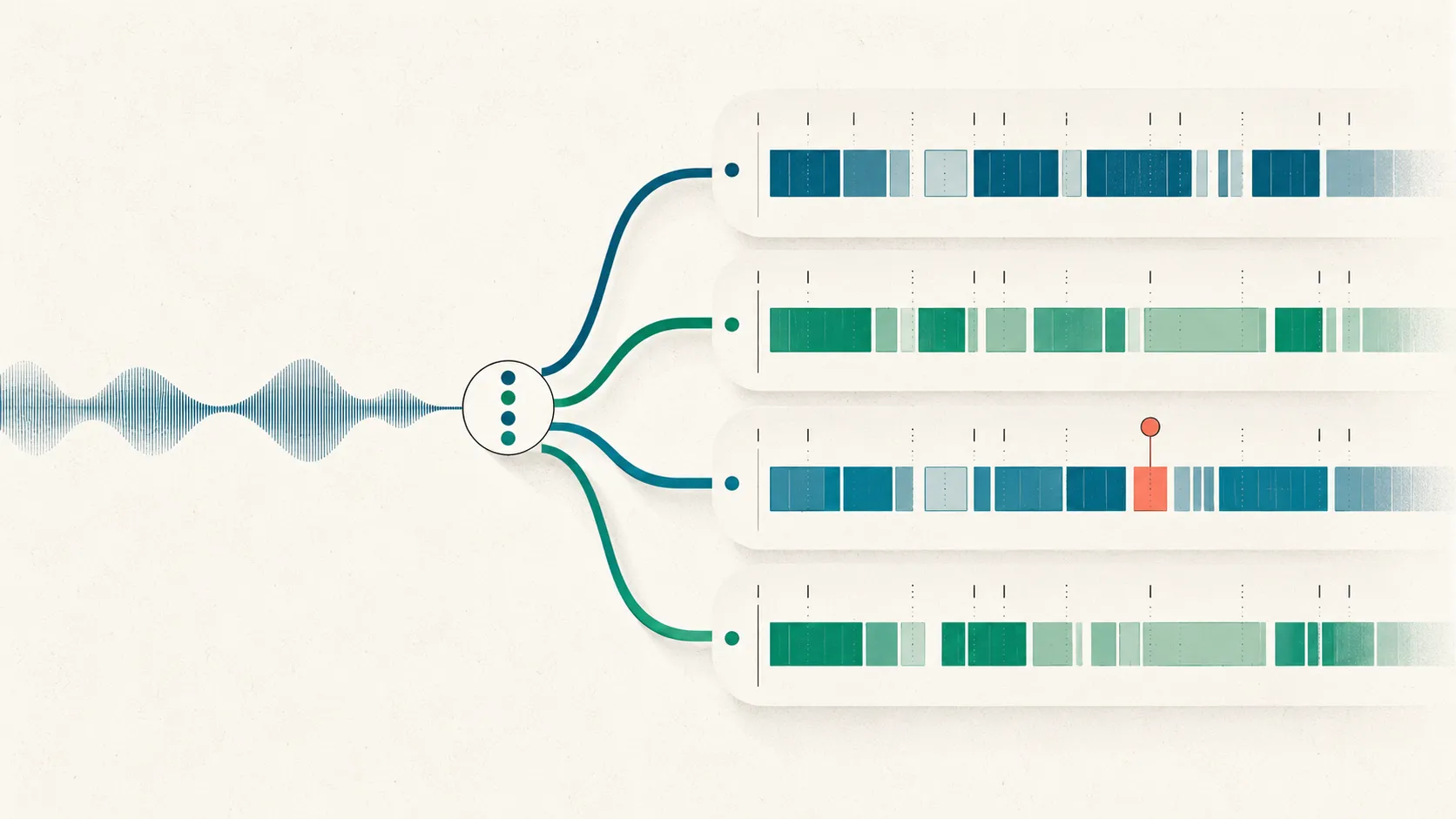
If you are choosing between NVivo, ATLAS.ti, MAXQDA and Dedoose, the honest starting point for any qualitative data analysis software comparison is that all four will code your interview transcripts competently. The differences that actually decide your purchase are narrower and more practical: how you pay, whether your team can code together, how much the AI helps, and whether inter-rater reliability is built in. This guide puts those four axes side by side, fairly, with current pricing models and features verified against each vendor as of July 2026.
What is the best qualitative data analysis software?
There is no single best qualitative analysis tool; the right choice depends on your budget, your team size, and how much you want AI to do. The four packages that dominate academic qualitative work are NVivo (owned by Lumivero), ATLAS.ti, MAXQDA, and Dedoose. They are all CAQDAS tools, meaning computer-assisted qualitative data analysis software, and they share the same core loop: import documents, build a codebook, tag segments, then query and visualize the coded data.
The standard neutral reference for this field is Silver and Lewins, Using Software in Qualitative Research: A Step-by-Step Guide, which profiles seven CAQDAS packages and insists the tool should follow your methodology, not the reverse. That framing matters here: the “best” package is the one whose pricing model, collaboration story, and AI posture fit how you actually work.
The four-way qualitative data analysis software comparison table
Here is the artifact most grad students are searching for: the four leading tools scored on the six decisions that matter. Read across a row to understand one tool; read down a column to compare all four on one axis.
| Tool | Pricing model | Collaboration | AI coding | IRR built-in | Learning curve | Best for |
|---|---|---|---|---|---|---|
| NVivo (Lumivero) | Annual subscription (perpetual de-emphasized); AI Assistant is a paid add-on | Collaboration Cloud / server add-ons; desktop-rooted | Lumivero AI Assistant (OpenAI): summaries, code suggestions | Cohen's kappa + percent agreement (Coding Comparison) | Steep | Large mixed-methods projects; the established academic default |
| ATLAS.ti | Desktop perpetual OR web subscription; low-cost student licenses | ATLAS.ti Web (browser) plus desktop project merge | AI coding, sentiment, NER included in paid licenses | Krippendorff's alpha (built with Krippendorff); 2+ coders | Moderate to steep | Theory-building, multimedia, teams wanting Krippendorff's alpha |
| MAXQDA | Subscription + fixed 3/5-year terms (perpetual retired in v26); free course license | MAXQDA TeamCloud add-on; network licenses | AI Assist (OpenAI): summaries, code suggestions | Cohen's kappa + percent agreement (Intercoder Agreement) | Moderate | Mixed methods and visualization; most approachable of the big three |
| Dedoose | Subscription only, pay-per-active-month; no perpetual | Cloud-native, real-time; team-first | Keyword auto-coding only; no generative AI (2026) | Cohen's kappa + Pearson's r (Testing Center) | Low | Budget or intermittent use; collaborative mixed methods; students |
If your decision comes down to leaving a specific incumbent rather than picking from scratch, the buyer’s-eye view lives in our companion piece on NVivo alternatives for researchers; this page stays neutral and methodical.
How much does qualitative analysis software cost?
Cost is now as much about the model as the number, because the four vendors moved in different directions. The old shorthand that “NVivo, ATLAS.ti and MAXQDA are one-time buys while Dedoose is a subscription” is out of date for 2026.
MAXQDA retired the perpetual license in version 26; you now buy an annual subscription or a fixed 3-year or 5-year term license, with a free course license for verified methods classes and cheaper 6- or 12-month student licenses. NVivo under Lumivero leads with annual subscriptions and has quietly de-emphasized (though not fully removed) its perpetual option; its AI Assistant is a separate annual add-on, listed at 230 euros per year. ATLAS.ti is the outlier that still sells a genuine one-time desktop license alongside its monthly or annual web subscription, plus heavily discounted student licenses. Dedoose never had a perpetual license and bills purely per active month.
Dedoose’s active-month billing is genuinely different and often the cheapest path for a time-boxed dissertation study: skip a summer, pay nothing that summer, and your project data stays put. The trade-off is that intermittent billing over a multi-year program can total more than one ATLAS.ti desktop purchase you keep forever. Exact figures shift with academic discounts and region, so treat any specific price you read elsewhere as a starting estimate and confirm on the vendor’s own store before you commit.
Which QDA software has the best AI coding?
For generative AI, the three desktop suites lead and Dedoose trails. NVivo’s Lumivero AI Assistant, MAXQDA’s AI Assist, and ATLAS.ti’s AI features all use large language models (OpenAI-backed) to summarize documents, suggest codes, and answer questions about your data. In NVivo and MAXQDA the AI is a paid add-on layered on the base license; in ATLAS.ti, AI coding, sentiment analysis, and named-entity recognition come with any paid license.
Dedoose is the honest exception. As of 2026 its automation is keyword-based auto-coding (a keyword-in-context search), not generative AI; there is no natural-language querying and no automated theme extraction. If AI readiness is a top purchase criterion, Dedoose is currently the weakest of the four.
This is where the Five-Level QDA method (Woolf and Silver, 2018) is worth internalizing before you buy on AI features alone: the software executes tactics, but your analytic strategy, the codebook and the interpretive decisions, stays yours. A tool that codes faster is not the same as a tool that codes better.
Which tools have inter-rater reliability built in?
All four leading packages compute inter-rater reliability natively, which is a real dividing line against most free and lightweight tools. Where they differ is the coefficient and the workflow.
| Tool | IRR feature | Coefficient(s) | Coders |
|---|---|---|---|
| NVivo | Coding Comparison query | Cohen's kappa + percent agreement | Two (or two teams) |
| ATLAS.ti | Inter-Coder Agreement (ICA) | Krippendorff's alpha, percent agreement, Holsti | Two or more |
| MAXQDA | Intercoder Agreement | Cohen's kappa + percentage | Two |
| Dedoose | Training / Testing Center | Cohen's kappa; Pearson's r for weightings | Two |
The distinction is not cosmetic. Cohen’s kappa (NVivo, MAXQDA, Dedoose) is a chance-corrected agreement statistic for two raters, while Krippendorff’s alpha (ATLAS.ti) generalizes to any number of coders, any measurement level, and missing data, which is why it is often preferred for content analysis. If reliability reporting is central to your work, that difference can decide the tool on its own. For the full picture of how these coefficients behave and where they mislead, see our deep dive on computing and interpreting Cohen’s kappa; the short version is that a bare kappa without base rates and a confidence interval is close to meaningless (Landis and Koch, 1977).
One caveat worth stating: a built-in kappa button does not make coding reliable. It measures whether two people applied the same codebook the same way. A vague codebook produces a low number in every tool equally, and no software fixes that for you.
NVivo vs ATLAS.ti vs MAXQDA vs Dedoose: which should you choose?
Pick the tool for your constraints, not its brand. The four map cleanly onto four common situations.
Choose NVivo if you are in a discipline where it is the default, your library already provides a license, and you are running a large, long-horizon mixed-methods project. It is the most feature-dense and the most cited, and its literature-review and framework-matrix tooling is mature. The cost is a steep learning curve and subscription-plus-add-on pricing that adds up.
Choose ATLAS.ti if you value a one-time desktop purchase, work with multimedia, or need rigorous inter-coder agreement. Its Krippendorff’s alpha implementation, built with Krippendorff himself, is the strongest reliability story in the group, and it is the only major tool still offering a perpetual license alongside a browser-based cloud version.
Choose MAXQDA if you want the gentlest on-ramp of the three desktop suites and lean on visualization and mixed methods. Its Windows and Mac builds are near-identical, its stats and dictionary modules are genuinely useful, and the free course license makes it friendly for teaching, even though perpetual buying is gone as of version 26.
Choose Dedoose if budget, collaboration, or intermittent use dominate. It is browser-based with nothing to install, real-time collaborative by design, and the active-month billing suits a student who codes in bursts. Accept that you are giving up generative AI and some depth for that price and simplicity.
If you are specifically trying to replace NVivo rather than choose fresh, the migration-focused comparison is in our NVivo alternatives guide, which weighs export formats and switching cost in detail.
What about free qualitative analysis software?
Two free, open-source tools are worth knowing before you spend anything. Taguette is a simple tag-and-highlight coder that imports PDFs, Word, and text, supports collaboration, and runs in the browser or locally; it is excellent for teaching and small projects but has no AI and no reliability statistics. QualCoder handles text, image, audio, and video, added basic AI integration with external models, and generates coding-comparison and word-cloud reports, but it is desktop-only, effectively single-user, and rougher around the edges.
The broader universe of general-purpose and computer-vision labeling platforms is a different market with different tools; if that is what you actually need, see our roundup of the best data annotation tools rather than a CAQDAS package.
Where does Tagaroo fit?
Tagaroo is not trying to be a general-purpose QDA suite, and it would be dishonest to pretend otherwise. NVivo, ATLAS.ti, and MAXQDA are more mature for open-ended, grounded-theory, whole-corpus exploration, and if your work is unstructured thematic analysis, one of them is the right tool.
Tagaroo sits in a narrower lane: AI-guided, clinically-templated, and inter-rater-reliability-native annotation. Instead of building a codebook from a blank page, you start from a curated instrument in the Scale Library, a validated coding system rendered as a live annotation workflow, and an AI agent proposes span-level annotations from skill files that you accept, reject, or edit. Coding runs in evidence mode, so every applied code points back to the exact span of transcript that justifies it, producing an auditable trail rather than a bare label. Reliability is computed as raters work, not bolted on at the end.
That makes Tagaroo a good fit when your qualitative coding is against a defined scheme rather than emergent, for example rating clinician behaviors with the OPTION shared decision-making scale, coding empathic responses with the ECCS, or scoring depressive content with Gottschalk-Gleser content analysis. It is also why teams building labeled datasets for models find it useful; the same evidence-mode workflow underlies our guidance on annotation tools for LLM and RLHF work and on clinical transcript annotation. Where you need broad, exploratory QDA, reach for the established suites; where you need guided, templated, auditable coding with reliability from the first rating, that is the gap Tagaroo fills. For line-by-line, dated tables against each suite, see the standing comparisons with NVivo, ATLAS.ti, MAXQDA, and Dedoose; live plan prices are on the pricing page.
How should you decide?
Run the choice through four questions, in order:
- Budget and horizon. Intermittent or tight, look at Dedoose or a free tool; long and funded, the desktop suites earn their keep.
- Licensing preference. If owning software outright matters, ATLAS.ti is the last major holdout for a perpetual desktop license.
- AI appetite. If you want generative help, the three desktop suites lead and Dedoose does not.
- Reliability. If your credibility rests on inter-coder agreement, weigh Cohen’s kappa against ATLAS.ti’s Krippendorff’s alpha, or a workflow like Tagaroo’s that computes it as you code.
The practical upshot of this qualitative data analysis software comparison: match the tool to the question and the constraint, not to its reputation. If your coding is exploratory and unstructured, buy one of the mature CAQDAS suites; if it is guided, templated, and reliability-first, start a scale-based project in Tagaroo and code against a validated instrument from day one.
References
- Silver, C., & Lewins, A. (2014). Using Software in Qualitative Research: A Step-by-Step Guide (2nd ed.). SAGE. Publisher page
- Woolf, N., & Silver, C. (2018). Qualitative Analysis Using NVivo / ATLAS.ti / MAXQDA: The Five-Level QDA Method. Routledge. Publisher page
- Cohen, J. (1960). A coefficient of agreement for nominal scales. Educational and Psychological Measurement, 20(1), 37–46. doi:10.1177/001316446002000104
- Landis, J. R., & Koch, G. G. (1977). The measurement of observer agreement for categorical data. Biometrics, 33(1), 159–174. doi:10.2307/2529310
- Krippendorff, K. (2019). Content Analysis: An Introduction to Its Methodology (4th ed.). SAGE.
- ATLAS.ti. Inter-Coder Agreement (ICA), user manual. Vendor documentation
- Dedoose. Testing Center: inter-rater reliability using Cohen’s kappa. Vendor documentation
- Lumivero. NVivo licenses and AI Assistant pricing. Vendor store
- MAXQDA. Pricing and license options. Vendor pricing · Licenses
- Dedoose. Subscription pricing. Vendor pricing
Frequently asked questions
- What is the best qualitative data analysis software?
- There is no single best CAQDAS package; the right one depends on your budget, team, and how much AI help you want. Among the four leading tools in 2026, NVivo is the established academic default, ATLAS.ti offers Krippendorff's alpha and both perpetual and cloud licensing, MAXQDA is the most approachable of the big three for mixed methods, and Dedoose is the cheapest, cloud-native, pay-per-active-month option.
- What is the real difference between NVivo, ATLAS.ti and MAXQDA?
- All three are mature desktop-plus-cloud CAQDAS suites with paid AI add-ons and built-in inter-rater reliability. NVivo (Lumivero) is feature-dense and steep to learn; ATLAS.ti computes Krippendorff's alpha inter-coder agreement developed with Klaus Krippendorff and still sells a one-time desktop license; MAXQDA retired perpetual licenses in version 26 but is usually rated the easiest of the three and strongest on mixed-methods visualization.
- Is Dedoose cheaper than NVivo?
- For short or intermittent projects, yes. Dedoose bills per active month (about US$17.95 for individuals and US$12.95 for students in 2026) and only charges for months you log in, while NVivo is an annual subscription. Dedoose is the budget and collaboration choice, but it has no generative AI coding, whereas NVivo, ATLAS.ti and MAXQDA all sell AI assistants.
- Which qualitative software has inter-rater reliability built in?
- All four leading packages do. NVivo and MAXQDA report percent agreement and Cohen's kappa; ATLAS.ti reports Krippendorff's alpha (plus percent agreement and Holsti); Dedoose's Testing Center reports Cohen's kappa for code application and Pearson's correlation for code weighting. Free tools like Taguette have no IRR statistics.
- Are there free qualitative data analysis software options?
- Yes. Taguette is free and open source, good for simple tag-and-highlight coding and collaboration, but has no AI and no reliability statistics. QualCoder is free, works with text, image, audio and video, added basic AI integration, and runs offline, but is single-user and less polished than the paid suites.
- Does AI qualitative software do the coding for you?
- No. The AI assistants in NVivo, ATLAS.ti and MAXQDA suggest codes and summaries, but you still define the codebook and verify every applied code. Woolf and Silver's Five-Level QDA method (2018) makes the point directly: the software supports your analytic strategy, it does not replace the analytic thinking.
Tagaroo builds an annotation tool, so we appear in some comparisons ourselves. How we evaluate tools is documented in our editorial policy.
Keep reading
 Reliability & Agreement
Cohen's Kappa: How to Compute and Interpret Agreement
How to compute Cohen's kappa and weighted kappa by hand, read the result honestly, and know when to use Krippendorff's alpha, ICC, or Gwet's AC1 instead.
 Tools & Comparisons
The Best NVivo Alternatives for Qualitative Research 2026
Looking for an NVivo alternative? Compare the best free, modern, and AI-guided qualitative coding tools by price, platform, and clinical fit.
 Tools & Comparisons
RLHF Data Annotation: A Playbook for Preference & Eval
An RLHF data annotation playbook: pairwise preference vs Likert rubrics, reward-model data, eval sets, and rater agreement. See the decision guide.
Put this into practice
Tagaroo turns any rating scale or coding scheme into a guided annotation workflow—with inter-rater reliability computed as you go.