RLHF Annotation Tools: Match the Task to the Right Tool
Compare RLHF annotation tools by task—SFT demos, preference ranking, red-teaming, eval rubrics—and find which tool fits each. See the matrix.
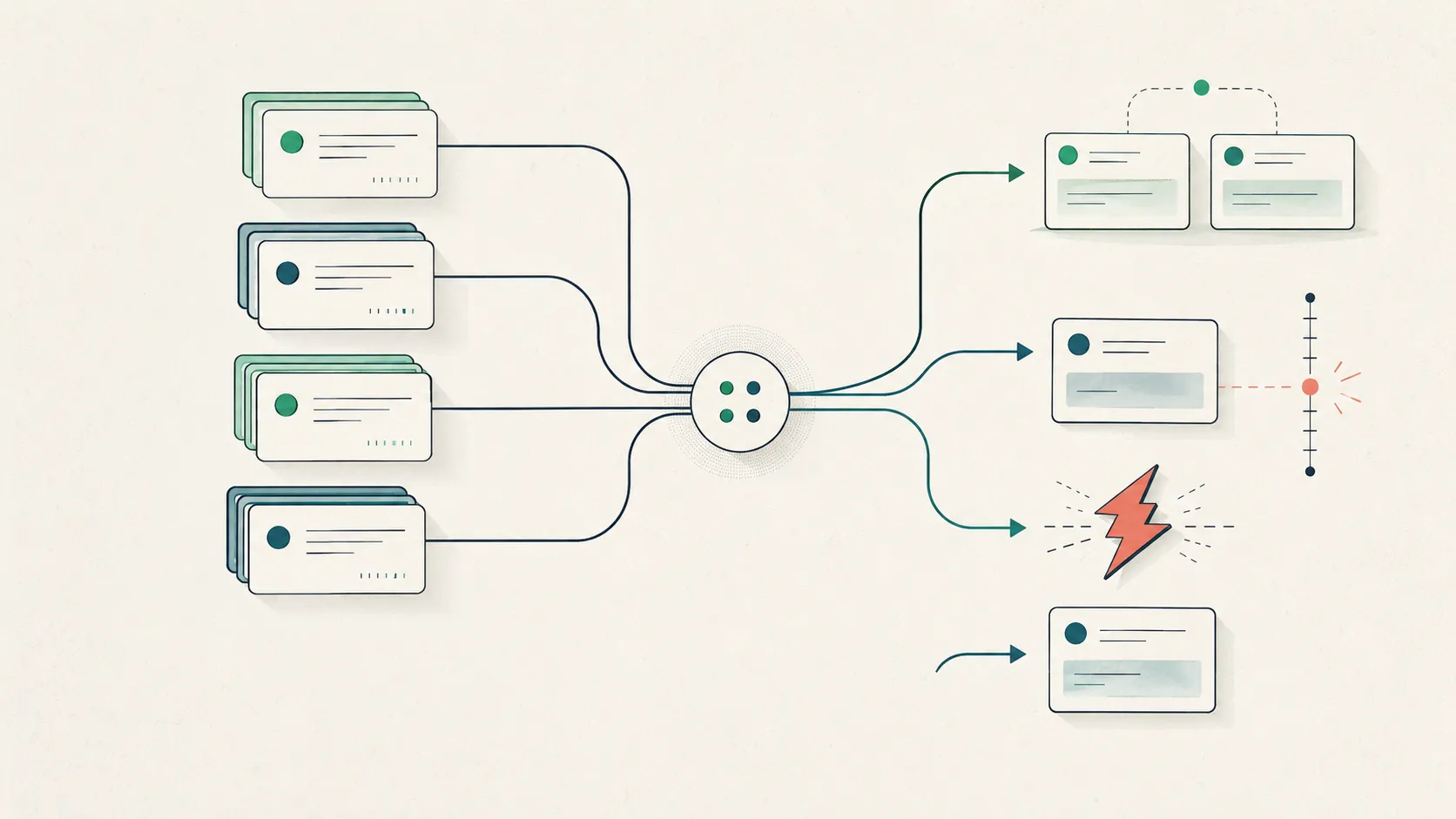
Pick the wrong tool for a reinforcement-learning-from-human-feedback (RLHF) job and you don’t just waste budget—you poison the training signal. RLHF annotation tools are not interchangeable: the software that shines at collecting preference rankings is often the wrong choice for writing supervised demonstrations, and neither is built for red-teaming. This guide maps the four core LLM data tasks to the tools that actually fit each, so you can choose by the job in front of you instead of by whichever platform markets hardest.
What are RLHF annotation tools?
RLHF annotation tools are the software and human workforces that produce the labeled data used to align large language models with human intent. That data comes in a few distinct shapes: written demonstrations of good answers, human rankings of competing model outputs, adversarial prompts that try to break the model, and structured scores against an evaluation rubric. The tools that collect each shape are genuinely different products, even when a vendor sells all of them under one banner.
The reason this matters is baked into how RLHF works. Starting from a base model, you collect demonstrations to fine-tune it (supervised fine-tuning, or SFT), then collect human rankings of its outputs, train a reward model to predict those rankings, and finally optimize the policy with reinforcement learning (Ouyang et al., 2022). Each stage needs a different interface, a different kind of rater, and a different quality bar.
This post lives at the RLHF-and-evaluation edge of annotation. For the full market of general labeling platforms—vision, audio, enterprise-managed, self-hosted—see our roundup of the best data annotation tools; here we stay narrow and practical.
The four LLM data tasks (and why one tool rarely covers all)
There are four jobs human annotators do for a modern LLM, and they pull in different directions. Getting the taxonomy right is most of the battle, because the tool you need follows from the task, not the other way round.
- SFT demonstrations. A human writes the ideal response to a prompt. You need a clean authoring surface, prompt context, and reviewer workflows. This is content creation, not judgment.
- Preference and ranking. A human compares two or more model outputs and ranks them. This is the signal a reward model learns from, and it is the heart of RLHF (Stiennon et al., 2020). You need side-by-side layouts, pairwise or listwise ranking, and tie handling.
- Red-teaming and adversarial testing. A human deliberately probes the model for unsafe, biased, or policy-violating behavior. You need an interactive chat surface, attack taxonomies, and a way to log and categorize failures.
- Evaluation rubrics and scoring. A human rates one output against fixed criteria—accuracy, faithfulness, safety, tone—on a defined scale. This measures a model rather than training it, and it lives or dies on rubric clarity and rater agreement.
Which RLHF annotation tools fit which task?
Match the task to the tool type first, then pick a specific product. The matrix below is the fastest way to narrow the field—open-source and programmatic tools own the SFT and preference work when you have engineers, managed workforces own the tasks where you need people and scale, and guided rubric tools own defensible, agreement-checked evaluation.
| LLM data task | What you collect | Best-fit tool type | Example tools |
|---|---|---|---|
| SFT demonstrations | Human-written ideal responses | Programmatic / open-source, or managed workforce | Argilla, Label Studio; Surge AI, Scale AI |
| Preference / ranking | Pairwise or listwise output rankings | Open-source ranking UIs, or managed RLHF workforce | Label Studio (LLM Ranker), Argilla; Surge AI, Toloka |
| Red-teaming / adversarial | Attack prompts + categorized failures | Managed workforce with red-team tooling | Surge AI, Scale AI, Toloka |
| Eval rubrics / scoring | Rubric scores + rationale, with agreement | Guided evaluation tools; recruited raters | Tagaroo, Label Studio; Prolific for raters |
Two things to notice. First, managed workforces appear in almost every row, because they sell people plus tooling, not tooling alone. Second, evaluation is the one row where a guided, rubric-first tool earns its place—and where inter-rater reliability, not raw throughput, is the metric that matters.
Open-source and programmatic tools: Argilla vs Label Studio
If you have engineers and want to own your data and pipeline, the two default open-source choices are Argilla and Label Studio. Both are Apache-2.0 licensed and self-hostable, and both have leaned hard into LLM work. The argilla vs label studio decision usually comes down to how code-first your team is and whether you want ready-made templates.
Argilla joined Hugging Face in 2024 and is built dataset-first around a Python SDK (Argilla docs, 2026). You define fields and questions in code, deploy free on Hugging Face Spaces, and push or pull datasets straight to the HF Hub—which makes it a natural fit for collecting preference and feedback data that flows into open fine-tuning stacks. It pairs with the distilabel library to mix human curation with AI feedback, the pattern behind community preference datasets like UltraFeedback.
Label Studio, maintained by HumanSignal, is broader and multi-modal, with a programmable XML labeling config and a large template gallery. It ships explicit generative-AI templates, including “Human Preference collection for RLHF” and an “LLM Ranker” that ranks responses by drag-and-drop into buckets (HumanSignal docs, 2026). The open-source core is free; Label Studio Enterprise adds SSO, quality-assurance workflows, and scale.
Managed-workforce platforms: Surge AI, Scale AI, Toloka, Prolific
When you need people—vetted, domain-expert annotators at scale—you buy a managed workforce. These platforms sell the humans plus the tooling and quality control around them, and the segment has been unusually turbulent over the past year.
Surge AI is now the largest data labeler by revenue, reporting more than $1 billion in 2024 while remaining bootstrapped (Reuters, July 2025). It is explicitly RLHF-first: live chat evaluation, asynchronous transcript rating, and red-teaming workflows, with a vetted expert network and clients including OpenAI, Google, and Anthropic. According to Anthropic co-founder Jared Kaplan, Surge’s “human data labeling platform is tailored to provide the unique, high-quality feedback needed for cutting-edge AI work” (Surge AI case study). Pricing is usage-based plus managed-service contracts and is quoted per project, not published.
Scale AI was the default for frontier labs for years, but the ground shifted in June 2025 when Meta took a 49% stake for about $14.3 billion and hired founder Alexandr Wang to lead its superintelligence lab (Reuters, June 2025). In the days after, Google—reportedly Scale’s largest customer at around $200 million a year—plus OpenAI and xAI moved to pull back, seeking “neutral” data partners (Reuters; Bloomberg, June 2025). Scale remains a serious managed vendor and has said it will double down on custom applications for enterprises and governments, but the neutrality question is now part of the buying decision.
Toloka evolved from a general crowdsourcing platform into an expert-data and agent-evaluation provider, with a network of 200,000-plus vetted experts and support for both RLHF and DPO workflows (Toloka, 2025). In May 2025 it took a $72 million investment led by Jeff Bezos’s Bezos Expeditions and gained governance independence from its former parent Nebius (Reuters, May 2025). It is a credible choice for red-teaming and agent-safety evaluation.
Prolific is different in kind: it recruits vetted human participants rather than running an annotation UI. You bring your own tool—Prolific “works with any annotation tool that generates URLs”—and it supplies the people, with 300,000-plus vetted participants and AI-evaluation specialists (Prolific, 2026). Pricing is transparent pay-as-you-go: you set the participant reward, then pay a platform fee of about 42.8% for corporate customers or 33.3% for academic and non-profit accounts. It is a strong fit for RLHF data collection, model evaluation, and safety testing when you want to control the interface yourself.
Where guided evaluation tools like Tagaroo fit
Guided evaluation tools own one specific slice: structured, rubric-based human evaluation of model outputs, scored against a defined scale, with inter-rater reliability and an audit trail. This is the eval-rubrics row of the matrix, and it is where measurement discipline matters more than annotator volume.
Where it genuinely fits the LLM world is guideline-driven human evaluation. If your rubric is a real instrument—rating an assistant’s empathy, its adherence to a safety policy, or whether it followed clinical guidance—you need the same machinery clinical raters have used for decades: a defined scale, spans of evidence, and defensible agreement statistics. Scoring communication quality with the Empathic Communication Coding System (ECCS) or shared decision-making with the OPTION scale is structurally identical to scoring whether a chatbot’s reply is empathic or leaves the user in control. Tagaroo computes inter-rater reliability as raters work, and ties every score to the highlighted span behind it, which is what makes an evaluation auditable rather than a vibe.
Be clear about the boundary, though. For collecting SFT demonstrations at volume, running large-scale pairwise preference ranking, building reward-model datasets, or managing a crowd workforce, a guided clinical tool is the wrong instrument—reach for Argilla or Label Studio (programmatic) or Surge, Scale, Toloka, or Prolific (managed). Guided evaluation is the adjacent, honest fit: high-stakes rubric scoring where an evidence-linked, agreement-checked judgment is the whole point. When those evaluations involve real interview transcripts or clinical text, Tagaroo supports de-identified, access-controlled handling, and the same span-linked evidence approach carries over to clinical transcript annotation.
How to choose RLHF annotation tools for your stack
Work the decision top-down. The task sets the tool type; everything else narrows it. Here is the order that saves the most rework:
- Name the task. SFT, preference, red-team, or eval? Use the matrix above—do not shop for a platform before you know which of the four jobs you’re funding.
- Own the pipeline or outsource the people? Open-source (Argilla, Label Studio) gives you the software and control; managed (Surge, Scale, Toloka) gives you vetted humans and quality control; Prolific gives you people to plug into your own tool.
- Check the subjectivity of the label. Subjective or rubric-based labels need inter-rater reliability and an adjudication step. A tool that reports agreement natively saves you a spreadsheet and a fight later.
- Weigh auditability. If a regulator, a journal, or a safety review might ask “why this score?”, pick a tool that links every judgment to its evidence. That requirement points toward guided evaluation, not raw throughput.
- Confirm the vendor is alive. This space churns—Humanloop, a well-known LLM-evaluation and prompt tool, was acqui-hired by Anthropic and its platform was sunset on September 8, 2025, with all data deleted (Humanloop, 2025). Verify a tool is maintained before you build on it.
The pattern most teams land on is a split stack: an open-source or managed pipeline for training data, and a separate, discipline-first tool for evaluation, so the numbers you report are defensible. For a wider methods lens on choosing across categories, the qualitative analysis software comparison and our NVivo alternatives guide cover the adjacent research-tooling ground.
The practical upshot: there is no single best set of RLHF annotation tools, only the right tool for the task in front of you. Name the job, pick the family, and hold evaluation to a higher bar than training—that’s the difference between a model you can ship and a number you can defend. If your job is rubric-based evaluation with real inter-rater reliability, try a scale in Tagaroo and see what auditable scoring looks like.
References
- Ouyang, L., Wu, J., Jiang, X., et al. (2022). Training language models to follow instructions with human feedback. Advances in Neural Information Processing Systems (NeurIPS 2022). arXiv:2203.02155
- Stiennon, N., Ouyang, L., Wu, J., et al. (2020). Learning to summarize from human feedback. Advances in Neural Information Processing Systems (NeurIPS 2020). arXiv:2009.01325
- Argilla / Hugging Face. Argilla documentation and repository. github.com/argilla-io/argilla
- HumanSignal. Label Studio and RLHF preference-collection template. Label Studio (GitHub); Human preference collection for RLHF
- Reuters (2025). Scale AI’s bigger rival Surge AI seeks up to $1 billion capital raise. reuters.com
- Reuters (2025). Google, Scale AI’s largest customer, plans split after Meta deal. reuters.com
- Reuters (2025). Amazon’s Bezos leads new investment in AI data company Toloka. reuters.com
- Prolific. Pricing and how it works for AI teams. prolific.com/pricing
- Humanloop (2025). Humanloop joins Anthropic: platform sunset. humanloop.com
Frequently asked questions
- What are RLHF annotation tools?
- RLHF annotation tools are the software and workforces that collect the human data used to align large language models: supervised demonstrations, preference rankings of model outputs, red-teaming attacks, and rubric-based evaluations. They fall into three families—open-source and programmatic (Argilla, Label Studio), managed expert workforces (Surge AI, Scale AI, Toloka, Prolific), and guided rubric-evaluation tools like Tagaroo. No single tool is best at every task.
- Is Argilla or Label Studio better for RLHF?
- Both are open-source and Apache-2.0 licensed. Argilla is Hugging Face-native and built dataset-first around a Python SDK, so it fits teams collecting preference and feedback data straight into the HF ecosystem. Label Studio (by HumanSignal) is broader and multi-modal, with ready-made 'Human Preference collection for RLHF' and 'LLM Ranker' templates and a paid enterprise tier. Choose Argilla for a code-first HF workflow, Label Studio for a flexible labeling UI plus templates.
- Do I need a managed workforce like Surge AI or Scale AI?
- Only if you lack annotators or need to scale expert labeling fast. Managed platforms (Surge AI, Scale AI, Toloka, Prolific) supply vetted people and run quality control; open-source tools (Argilla, Label Studio) supply the software but not the labelers. If you already have domain experts, a self-hosted tool plus a clear rubric is often cheaper and more controllable.
- What is the difference between preference-data annotation and eval-rubric scoring?
- Preference-data annotation asks a human to rank or choose between model outputs so a reward model can learn the ranking (the core RLHF signal, per Stiennon et al., 2020). Eval-rubric scoring asks a human to rate one output against fixed criteria—accuracy, safety, tone—on a defined scale. Preference data trains models; rubric scores measure them. Many teams need both, and the right tool differs for each.
- Can a clinical annotation tool like Tagaroo be used for LLM evaluation?
- Yes, for the rubric-scoring slice of the problem. Tagaroo is built for structured, guideline-driven span annotation with severity scales and built-in inter-rater reliability, which maps directly onto rubric-based human evaluation of model outputs with auditable, evidence-linked judgments. It is not a general-purpose preference-collection or full RLHF pipeline—for that, use Argilla, Surge AI, or Scale AI.
Tagaroo builds an annotation tool, so we appear in some comparisons ourselves. How we evaluate tools is documented in our editorial policy.
Keep reading
 Tools & Comparisons
Best Data Annotation Tools in 2026: An Honest Guide
Compare the best data annotation tools of 2026 by open-source status, pricing, modalities, and workforce—one master table, honest picks by use case.
 Reliability & Agreement
Cohen's Kappa: How to Compute and Interpret Agreement
How to compute Cohen's kappa and weighted kappa by hand, read the result honestly, and know when to use Krippendorff's alpha, ICC, or Gwet's AC1 instead.
 Tools & Comparisons
RLHF Data Annotation: A Playbook for Preference & Eval
An RLHF data annotation playbook: pairwise preference vs Likert rubrics, reward-model data, eval sets, and rater agreement. See the decision guide.
Put this into practice
Tagaroo turns any rating scale or coding scheme into a guided annotation workflow—with inter-rater reliability computed as you go.