IRF Classroom Discourse: Coding Teacher-Student Talk
IRF classroom discourse is the three-move Initiation-Response-Feedback exchange behind most teacher talk. Learn to code it and read the F move.
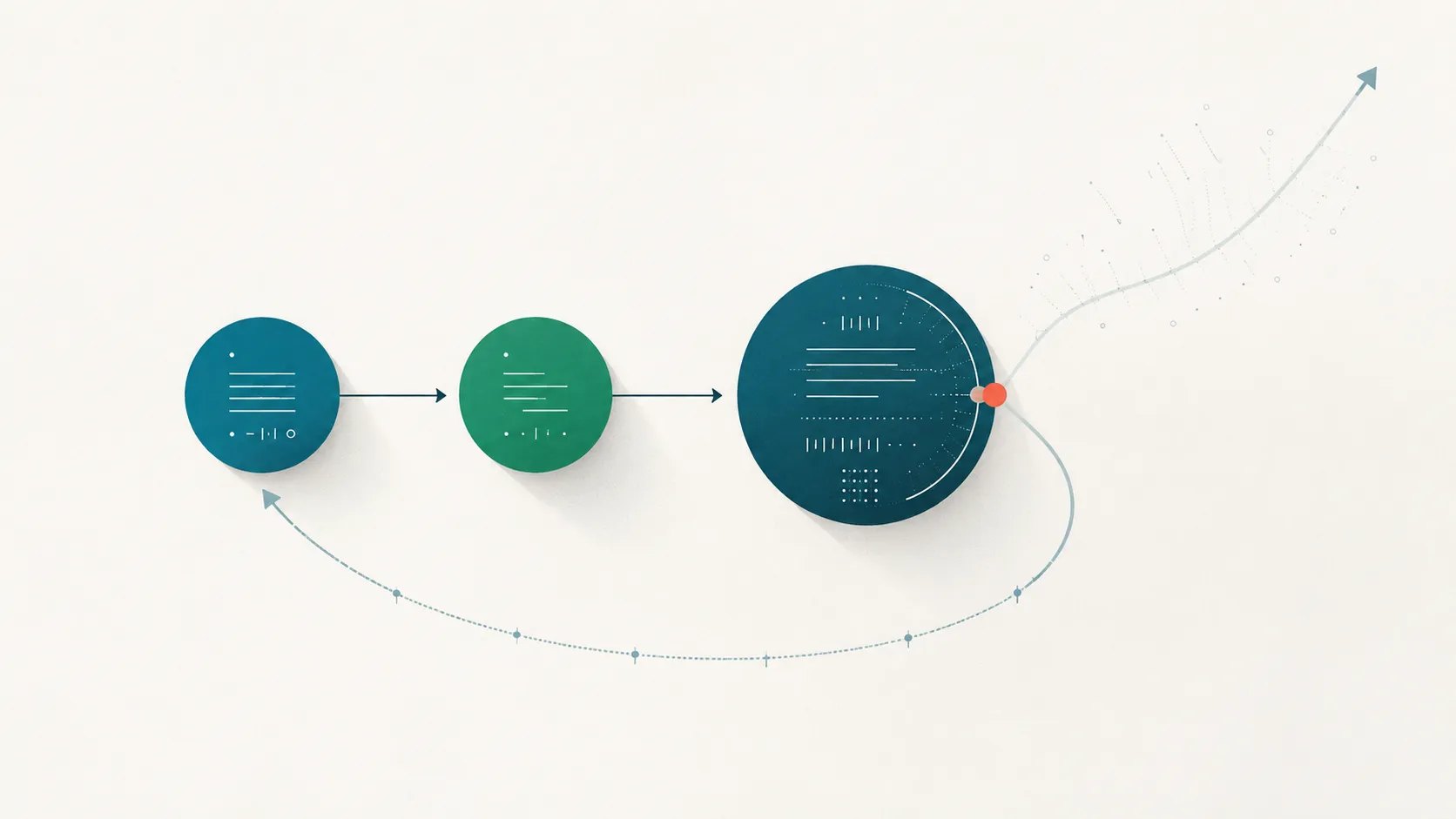
Watch any whole-class lesson and one rhythm repeats until you cannot unhear it: the teacher asks, a student answers, the teacher says whether the answer was any good, and the cycle starts again. That rhythm has a name. IRF classroom discourse is the three-move Initiation-Response-Feedback exchange that Sinclair and Coulthard (1975) identified as the basic building block of teacher-led talk, and once you can code it, you can measure something most lesson observation only gestures at: who does the thinking, and what the teacher does with a student’s words.
What is IRF classroom discourse?
IRF classroom discourse is a three-move exchange structure—Initiation, Response, Feedback—that recurs as the fundamental unit of teacher-led lessons (Sinclair & Coulthard, 1975). The teacher opens with an initiation, usually a question or prompt; a student produces a response; and the teacher closes the exchange with a feedback move that evaluates or follows up on what was said.
John Sinclair and Malcolm Coulthard derived the pattern from recordings of English primary-school lessons and published it in Towards an Analysis of Discourse (1975). What made it durable is that it is a claim about function, not content: whatever the subject, teacher-led talk keeps reassembling into this same triad. That is why it became the reference point for the whole field of classroom interaction analysis.
The pattern is not a curiosity at the margins of a lesson. It is the main event. In many secondary classrooms the three-move exchange accounts for roughly 70% of everything said between teacher and students (Wells, 1993), which means that if you want to describe how a class actually spends its talk, you are mostly describing IRF.
The three moves, in order
The three moves form an ordered slot structure: the initiation creates an expectation, the response satisfies it, and the feedback closes it (Sinclair & Coulthard, 1975). The order is the point—a response only counts as a response because an initiation opened the slot, and feedback only makes sense as the third beat. The table defines each move with a synthetic example.
| Move | What it does | Typical speaker | Synthetic example |
|---|---|---|---|
| Initiation (I) | Opens the exchange; sets up a slot for a reply | Teacher | "Who can tell me what a noun is?" |
| Response (R) | Fills the slot the initiation opened | Student | "A person, place, or thing." |
| Feedback (F) | Closes the exchange by evaluating or following up on the response | Teacher | "Exactly—and can you give me one?" |
A useful test when you are unsure: ask what the turn does, not who says it. A teacher can produce a response (modeling an answer), and a student can produce an initiation (asking a question). Coding by function rather than by role is the same discipline the NICHD protocol’s prompt-type coding uses on forensic interviewers, and the same move that makes Searle’s speech-act classes work: label the act, not the speaker.
IRF vs IRE: what does the third move reveal?
IRF and IRE label the same three-move exchange but disagree about the third move, and that disagreement is the most useful thing about the framework. Sinclair and Coulthard (1975) named the closing move Feedback; Hugh Mehan (1979), studying an American classroom in Learning Lessons, named it Evaluation and called the triad IRE. Same slot, different emphasis on what fills it.
The choice of word is not pedantry—it encodes a claim about teaching. An evaluation judges the response against a known answer: “Right.” “No, try again.” A follow-up, the broader reading Wells (1993) argued for, can do far more, asking the student to say more, connecting the answer to another idea, or handing the thought back to the class. Wells found that when the third move follows up rather than merely evaluates, the same three-move genre can co-construct knowledge instead of just testing recall.
So the third move is diagnostic. Code a stretch of lesson and look at what the F slot is doing: if it is almost all “correct/incorrect” verdicts, you are watching recitation; if it regularly reopens the thinking, you are watching something closer to dialogue. Courtney Cazden (2001) called the evaluative version the default pattern of classroom talk—the unmarked, school-type rhythm that separates a lesson from ordinary conversation.
Where does IRF sit in the rank scale?
The three-move exchange is one level inside a larger system, and keeping that in view prevents a common overreach. Sinclair and Coulthard (1975) built a five-rank scale: lesson at the top, then transaction, exchange, move, and act at the bottom. IRF describes the exchange rank—specifically the teaching exchange, as opposed to the boundary exchanges that mark transitions between phases of a lesson.
Below the move rank, the original system specifies 22 fine-grained acts (elicitation, directive, informative, nomination, prompt, evaluate, and so on) that spell out the internal structure of each move. Coding at the act level is far more demanding and far more contested than coding the three moves, which is why most applied classroom interaction analysis works at the exchange and move ranks and leaves the full act inventory to specialists.
That is exactly what Tagaroo’s curated scheme does. The IRF/IRE scheme in the Scale Library operationalizes the three moves—Initiation, Response, Feedback—as a compact, three-tag code, not the entire 22-act apparatus. The card below shows three items for that reason: it is the exchange-rank triad (Mehan’s IRE, Sinclair and Coulthard’s teaching exchange), deliberately set apart from the transactions, boundary exchanges, and lower-level acts that surround it in the 1975 book.
How do you code IRF classroom discourse?
To code IRF classroom discourse, tag each turn with the single move it performs in its exchange—instance-mode annotation over the turn-by-turn transcript. Start a new exchange at each initiation, attach the response and feedback that belong to it, and leave non-teaching talk (procedural asides, off-task chatter, managerial directives that open no answer slot) untagged.
Consider a short synthetic sequence from a science lesson:
Teacher: So, what happens to the water when we heat it? [Initiation]
Student: It turns into steam. [Response]
Teacher: Good—it turns into steam. And what do we call that? [Feedback, then a new Initiation]
Student: Evaporation. [Response]
Teacher: Evaporation, exactly. [Feedback]
Two things are worth noticing. First, a single teacher turn can close one exchange and open the next (“Good—it turns into steam. And what do we call that?”), so move boundaries do not line up neatly with speaker turns. Second, the feedback here is evaluative, which tells you this is recitation-style IRE rather than a dialogic follow-up.
Coding at the move level is tractable enough to be reliable, because the three moves are surface-structural features of the exchange rather than interpretive judgments about a student’s mind. That reliability is worth measuring: if two coders segment the same lesson into IRF exchanges, you can quantify their agreement with a coefficient like Cohen’s kappa, and the inter-rater reliability guide explains why chance-corrected agreement matters more than raw percent agreement. Narrative and argument coding—for instance the interpretive spans in Labov and Waletzky’s narrative structure—tend to attract lower agreement precisely because they ask coders to judge meaning rather than mark structure.
What does the feedback move tell you about teaching?
The distribution of feedback moves is a compact, codeable measure of a teacher’s discourse style, which is the practical reason to code IRF at all. Because the third move is where the teacher decides what to do with a student’s contribution, a transcript coded for IRF turns an impression (“the discussion felt closed”) into a countable finding (“94% of feedback moves were right/wrong evaluations; 6% followed up”).
That finding is actionable in a way a global rating is not. A teacher told their lesson “could be more dialogic” has nowhere to start; a teacher shown that nearly every F move was a verdict has an obvious lever—convert some evaluations into follow-ups that ask the student to extend, justify, or connect. This is the same logic behind coding a professional’s own moves elsewhere: the NICHD prompt-type scheme codes an interviewer’s questions so interviewing can improve, and the IRF feedback move plays the analogous role for teaching.
It is also why the critique of IRF is really a critique of one use of the third move. Mehan (1979) and Cazden (2001) worried that a steady diet of evaluative IRE reduces students to suppliers of short, pre-known answers—a recitation script that offers little room to reason aloud or to respond to one another.
Wells (1993) did not dispute the pattern’s dominance; he showed that the same structure, with a follow-up rather than an evaluation in the third slot, can serve inquiry. The structure is neutral. The feedback move is where pedagogy shows up.
Limitations and common coding mistakes
IRF is a lens, not the whole picture, and the recurring coding errors come from forgetting that:
- Treating the three moves as the whole system. IRF is the exchange rank; the full 1975 apparatus also has transactions, boundary exchanges, and 22 lower-level acts (Sinclair & Coulthard, 1975). A three-tag code is a deliberate simplification, not the complete scheme.
- Coding by speaker instead of by function. The moves are defined by what the turn does. A student question is an initiation; a teacher’s worked answer is a response. Tag the act, not the role.
- Forcing every turn into the triad. Group work, student-to-student talk, and extended student explanations often break the pattern—and that break is a finding, not noise. IRF only describes teacher-led whole-class exchange; it was never meant to capture everything a classroom says.
- Confusing F with E on the transcript alone. The third move’s form (a short “good”) can hide its function. Decide in advance how you distinguish a closing evaluation from a genuine follow-up, and code consistently.
The practical upshot: IRF classroom discourse gives you a small, reliable code—three moves in a fixed order—that turns the ambient rhythm of a lesson into data, and puts the analytic weight where it belongs, on what the teacher does with a student’s answer. Pick the move level for reliability, watch the third slot for pedagogy, and remember that the exchange is one rank in a larger system, not the system itself.
References
- Sinclair, J. M., & Coulthard, M. (1975). Towards an Analysis of Discourse: The English Used by Teachers and Pupils. Oxford University Press. (Scale citation, verbatim: “Sinclair JM, Coulthard M. Towards an Analysis of Discourse: The English Used by Teachers and Pupils. Oxford University Press; 1975. See also Mehan H. Learning Lessons: Social Organization in the Classroom. Harvard University Press; 1979.”)
- Mehan, H. (1979). Learning Lessons: Social Organization in the Classroom. Harvard University Press. doi:10.4159/harvard.9780674420106
- Wells, G. (1993). Reevaluating the IRF sequence: A proposal for the articulation of theories of activity and discourse for the analysis of teaching and learning in the classroom. Linguistics and Education, 5(1), 1–37. doi:10.1016/S0898-5898(05)80001-4
- Cazden, C. B. (2001). Classroom Discourse: The Language of Teaching and Learning (2nd ed.). Heinemann.
If you code classroom talk, Tagaroo turns the IRF/IRE three-move scheme into a guided, evidence-anchored annotation workflow—with inter-rater reliability computed as your coders work.
Frequently asked questions
- What is IRF in classroom discourse?
- IRF stands for Initiation-Response-Feedback, the three-move exchange that Sinclair and Coulthard (1975) identified as the basic unit of teacher-led talk. The teacher initiates (usually a question), a student responds, and the teacher gives feedback that closes the exchange. It is the most common structure in whole-class teaching, estimated to account for about 70% of teacher-student discourse in many secondary classrooms (Wells, 1993).
- What is the difference between IRF and IRE?
- IRF and IRE describe the same three-move exchange but name the third move differently. Sinclair and Coulthard (1975) called it Feedback (F); Mehan (1979) called it Evaluation (E). The distinction matters: an evaluative third move judges the answer right or wrong, while a follow-up move can take up and extend student thinking, which is why Wells (1993) argued the broader label 'follow-up' better captures what the move can do.
- Who developed the IRF model of classroom discourse?
- John Sinclair and Malcolm Coulthard developed the IRF model in Towards an Analysis of Discourse (1975), based on recordings of English primary lessons. Hugh Mehan independently described the same triad as IRE in Learning Lessons (1979), and Courtney Cazden (2001) established it as the recognized 'default pattern' of classroom talk.
- How do you code a classroom transcript into IRF moves?
- Tag each turn by its function in the exchange, not by who is speaking: an initiation opens a slot for a reply, a response fills it, and feedback closes the exchange by evaluating or taking up the response (Sinclair & Coulthard, 1975). Turns that are not part of a teaching exchange, such as procedural asides, are left untagged. Working at the move level keeps the coding tractable, unlike the 22 fine-grained acts in the full 1975 system.
- Why is the IRF pattern criticized?
- Critics argue that a steady diet of IRF limits student talk to short, teacher-evaluated answers, reproducing a 'recitation script' rather than genuine dialogue (Mehan, 1979; Cazden, 2001). The pattern positions the teacher as the sole evaluator and gives students little room to reason aloud or respond to each other. Wells (1993) tempered this critique by showing the third move can be used to co-construct knowledge when it follows up rather than merely evaluates.
Keep reading
 Methods & Frameworks
The NICHD Protocol: Coding Interviewer Prompt Types
The NICHD protocol classifies a forensic interviewer's prompts from open to suggestive. See the five types, why open prompts win, and how to code them.
 Methods & Frameworks
Searle's Speech Acts: The Five Illocutionary Types
Searle's speech acts sort every utterance into five illocutionary types. See the classes, direction of fit, examples, and the tie to dialogue-act tagging.
 Methods & Frameworks
Labov and Waletzky Narrative Analysis: The Six Parts
Labov and Waletzky narrative analysis breaks an oral story into six parts. See each part, why evaluation is the heart, and how reliably it can be coded.
Put this into practice
Tagaroo turns any rating scale or coding scheme into a guided annotation workflow—with inter-rater reliability computed as you go.