Positive Formal Thought Disorder: The SAPS Subscale
Positive formal thought disorder is disorganized speech you can see. Meet the SAPS FTD items, how they differ from the TLC and SANS, and how to code them.
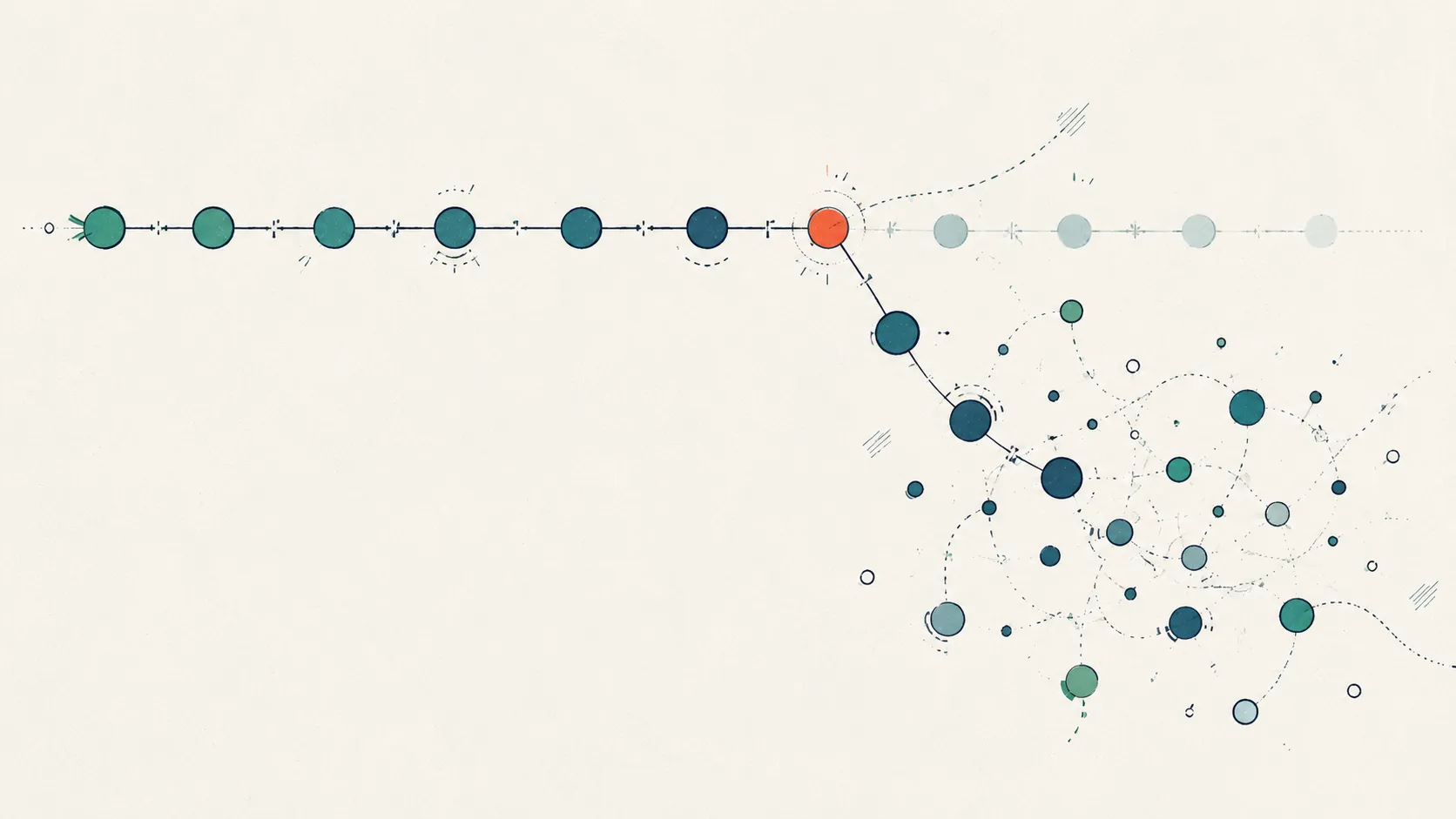
Positive formal thought disorder is the part of psychosis you can hear. Where a delusion is a belief you have to infer, disorganized speech is right there in the transcript: ideas sliding off track, a reply that never answers the question, sentences that stop making sense. Nancy Andreasen’s Scale for the Assessment of Positive Symptoms (SAPS) turns that observable disorganization into eight rated items, and because each item is defined by what the speech does, the subscale doubles as an annotation scheme (Andreasen, 1984).
What is positive formal thought disorder?
Positive formal thought disorder is disorganized speech marked by too much aberrant structure, as distinct from the impoverished speech of negative thought disorder (Andreasen & Grove, 1986). The “positive” label does not mean good; it means productive—an excess of derailed, tangential, or illogical output, rather than a deficit of it. The signs are the classics of disorganized psychosis: ideas that slip off track, replies that miss the question, speech that becomes locally incomprehensible.
The distinction between form and content is the first thing to keep straight. Positive formal thought disorder is about the form of speech, how ideas are connected and sequenced, not the content of beliefs. A bizarre belief is a delusion; a bizarrely structured sentence is thought disorder. Factor-analytic work reinforces the point: positive FTD loads on a disorganization dimension that is statistically distinct from both the reality-distortion (hallucinations and delusions) dimension and the negative-symptom dimension (Peralta & Cuesta, 1999).
What are the SAPS positive formal thought disorder items?
The SAPS positive-FTD subscale rates eight items plus a global rating, each on a 0–5 scale (Andreasen, 1984). The table below gives each item’s operational definition, written so you can recognize it in a transcript.
| Item | Operational definition |
|---|---|
| Derailment | Ideas slip off track onto obliquely related or unrelated topics, without the speaker noticing |
| Tangentiality | Answering a question in an oblique or irrelevant way; the question is never actually answered |
| Incoherence | Speech that is incomprehensible at times—words and phrases joined without logical or grammatical connection |
| Illogicality | Conclusions reached that do not follow logically—non-sequiturs and faulty inferences |
| Circumstantiality | Very indirect, over-detailed speech weighed down with tedious detail—but the point is eventually made |
| Pressure of Speech | Increased, rapid, hard-to-interrupt speech, often with an increased amount of talk |
| Distractible Speech | Stopping mid-sentence and changing the subject in response to a nearby stimulus |
| Clanging | Sound rather than meaning governs word choice—rhyming and punning drive the associations |
Positive FTD is only one quarter of the SAPS. The full scale runs to 34 items across four domains—hallucinations, delusions, bizarre behavior, and positive formal thought disorder (Andreasen, 1984)—so the subscale here is the language-and-communication slice of a much broader positive-symptom battery. That framing matters when you cite it: the SAPS is not a thought-disorder scale, it is a positive-symptom scale that contains one.
SAPS vs TLC vs SANS: which thought-disorder scale is which?
The SAPS-FTD items, the TLC scale, and the SANS alogia subscale all descend from Andreasen’s 1979 definitions, so the wording overlaps almost word-for-word—but their scope is different, and conflating them is the most common citation error in this area. The cleanest way to hold them apart is as a map and its two halves.
| Instrument | Scope | What it covers |
|---|---|---|
| TLC scale (Andreasen, 1986) | The whole map | 18 subtypes + global rating: both positive (derailment, incoherence) and negative (poverty of speech, poverty of content) thought-language disorders |
| SAPS positive-FTD subscale (Andreasen, 1984) | The positive half | 8 items + global, embedded in the positive-symptom scale: derailment, tangentiality, incoherence, illogicality, circumstantiality, pressure of speech, distractible speech, clanging |
| SANS alogia subscale (Andreasen, 1984) | The negative half | Poverty of speech, poverty of content, blocking, increased latency—negative formal thought disorder, in the negative-symptom scale |
So if you want the comprehensive vocabulary, cite the standalone Thought, Language and Communication scale. If you are scoring positive symptoms and need the disorganized-speech slice, that is the SAPS-FTD subscale. And if you are scoring negative symptoms, the impoverished-speech counterpart lives in the SANS alogia subscale. Keep the citations separate—Andreasen 1984 for the SAPS, 1986 for the TLC—because reviewers notice when “the SAPS thought-disorder scale” and “the TLC” are used as if they were one instrument.
Positive vs negative thought disorder: why the distinction predicts outcome
The split between positive and negative thought disorder is not a labeling convenience; it dissociates by diagnosis and carries prognostic weight. Studying 94 healthy volunteers and 100 patients across manic, schizoaffective, and schizophrenic groups, Andreasen and Grove found that thought disorder is not specific to schizophrenia at all—manic patients showed a great deal of it, and controls showed modest amounts (Andreasen & Grove, 1986).
What separated the groups was the type. Manic patients showed predominantly positive thought disorder, the derailment-and-pressure kind, and it largely remitted at follow-up. Schizophrenic patients showed more negative thought disorder, and it persisted. The strongest single predictor of poor outcome was the presence of negative thought disorder (Andreasen & Grove, 1986).
For anyone coding transcripts, this is the practical reason to separate the two: the same overall “thought disorder” score can mean a treatable manic episode or a poor-prognosis schizophrenic course, depending entirely on which items are driving it. The positive, pressured variety is also where this subscale meets the pressured speech of the Young Mania Rating Scale.
How reliable are the positive formal thought disorder items?
Reliability for these items is item-dependent, strong for the frequent signs and weak for the rare ones—and it comes with an important provenance caveat. There is no separately published inter-rater reliability for the SAPS positive-FTD global rating itself; the figures everyone cites come from Andreasen’s TLC study, which uses the same items (Andreasen, 1986).
| Item | Weighted kappa | Reliability |
|---|---|---|
| Pressure of speech | 0.89 | High |
| Incoherence | 0.88 | High |
| Derailment | 0.83 | High |
| Illogicality | 0.80 | High |
| Distractible speech | 0.78 | Good |
| Circumstantiality | 0.74 | Good |
| Tangentiality | 0.58 | Fair |
| Clanging | 0.58 | Fair |
The pattern is the same one that shows up across disorganized-speech scales: agreement tracks how often an item actually appears. Frequent, prototypical signs like pressure of speech and derailment are rated reliably; rarer items sit lower, and in the full TLC set the rarest items collapse entirely (neologisms κ = 0.39, word approximations κ = −0.02). Budget your calibration on the common items and require clear, repeated instances before scoring the rare ones. If you compute agreement yourself, the Cohen’s kappa and inter-rater reliability guide explains why a low coefficient on a rare item is usually a base-rate artifact, not a coding failure.
Can positive thought disorder be measured automatically?
Positive formal thought disorder has become a testbed for computational psychiatry, because “ideas slipping off track” translates surprisingly well into measurable language features. If derailment is a loss of semantic connection between one clause and the next, then a coherence metric should detect it—and it does.
In a cohort of clinical-high-risk youths, a classifier built from semantic coherence and syntactic features predicted transition to psychosis with 100% accuracy in that small sample, outperforming clinical ratings (Bedi et al., 2015). A cross-cohort replication generalized the approach at 79–83% accuracy and distinguished recent-onset psychosis speech from healthy controls at 72% (Corcoran et al., 2018). A different tack, representing speech as a word-network graph, quantified disorganization well enough to separate mania from schizophrenia (Mota et al., 2012).
The samples are small, so these are proofs of concept rather than clinical instruments—but they show how directly Andreasen’s operational definitions feed modern natural language processing. Her kappas quantified where human raters agree; the NLP work tries to compute the same signs automatically.
How do you code positive formal thought disorder from a transcript?
To code the positive-FTD subscale, mark the specific utterance that shows the disorder and label it with the matching item—instance-mode annotation, where you tag the speech that is the phenomenon rather than rating the interview as a whole. Disorganized speech is a span-level event almost by definition.
Consider a short synthetic exchange:
Interviewer: How did the new medication work out for you?
Subject: It was fine, I think, but Tuesdays are always harder, and my landlord repainted the hallway that awful green, which is really the color of the whole situation if you think about it.
That reply drifts from the medication to Tuesdays to a repainted hallway, obliquely and without the speaker noticing—a clean instance of derailment, tagged on the span “Tuesdays are always harder … the color of the whole situation.” Marking the span keeps the evidence attached to the label, so a second coder can check the call against the exact words. That is what makes the SAPS positive-FTD coding scheme reproducible enough to compute agreement, and it is the same instance-mode logic behind the standalone TLC scale.
On data handling: coding interview speech means working with sensitive clinical language, so the sane default is de-identified text and a privacy-first setup. Tagaroo supports a browser-side anonymous mode, so transcript content can stay local rather than being uploaded—worth checking against your ethics approval before any real interview data touches a tool.
Common mistakes when coding positive FTD
The recurring errors are mostly boundary problems—telling two adjacent items apart, or coding the wrong axis entirely:
- Coding content as form. A bizarre belief is a delusion; disorganized structure is thought disorder. The subscale rates form. Keep the two axes separate.
- Merging derailment and tangentiality. Both are drift, separated by their trigger. Derailment starts in the speaker’s own spontaneous speech; tangentiality is an off-target reply to a question.
- Calling everything incoherence. Incoherence is speech that is locally incomprehensible—words joined without connection. A reply you can follow but that wanders is derailment or circumstantiality, not incoherence.
- Ignoring which pole is driving the score. Positive and negative thought disorder mean very different things prognostically (Andreasen & Grove, 1986). Note which items are firing, not just the total.
The practical upshot: positive formal thought disorder is codable because Andreasen turned “disorganized speech” into eight concrete, observable signs. Code the frequent, reliable items with confidence, keep form separate from content, and tag the span that justifies each call so a second coder—or a model—can check it.
References
- Andreasen, N. C. (1984). Scale for the Assessment of Positive Symptoms (SAPS). Iowa City: University of Iowa.
- Andreasen, N. C. (1984). Scale for the Assessment of Negative Symptoms (SANS). Iowa City: University of Iowa.
- Andreasen, N. C. (1979). Thought, language, and communication disorders. I. Clinical assessment, definition of terms, and evaluation of their reliability. Archives of General Psychiatry, 36(12), 1315–1321. doi:10.1001/archpsyc.1979.01780120045006
- Andreasen, N. C. (1986). Scale for the Assessment of Thought, Language, and Communication (TLC). Schizophrenia Bulletin, 12(3), 473–482. doi:10.1093/schbul/12.3.473
- Andreasen, N. C., & Grove, W. M. (1986). Thought, language, and communication in schizophrenia: diagnosis and prognosis. Schizophrenia Bulletin, 12(3), 348–359. doi:10.1093/schbul/12.3.348
- Peralta, V., & Cuesta, M. J. (1999). Dimensional structure of psychotic symptoms: an item-level analysis of SAPS and SANS symptoms in psychotic disorders. Schizophrenia Research, 38(1), 13–26. doi:10.1016/S0920-9964(99)00003-1
- Bedi, G., Carrillo, F., Cecchi, G. A., Fernández Slezak, D., Sigman, M., Mota, N. B., et al. (2015). Automated analysis of free speech predicts psychosis onset in high-risk youths. npj Schizophrenia, 1, 15030. doi:10.1038/npjschz.2015.30
- Corcoran, C. M., Carrillo, F., Fernández-Slezak, D., Bedi, G., Klim, C., Javitt, D. C., et al. (2018). Prediction of psychosis across protocols and risk cohorts using automated language analysis. World Psychiatry, 17(1), 67–75. doi:10.1002/wps.20491
- Mota, N. B., Vasconcelos, N. A. P., Lemos, N., Pieretti, A. C., Kinouchi, O., Cecchi, G. A., et al. (2012). Speech graphs provide a quantitative measure of thought disorder in psychosis. PLoS ONE, 7(4), e34928. doi:10.1371/journal.pone.0034928
- Roche, E., Creed, L., MacMahon, D., Brennan, D., & Clarke, M. (2015). The epidemiology and associated phenomenology of formal thought disorder: a systematic review. Schizophrenia Bulletin, 41(4), 951–962. doi:10.1093/schbul/sbu129
If you code disorganized speech from clinical interviews, Tagaroo turns the SAPS positive-FTD subscale into a guided, evidence-anchored annotation workflow—with inter-rater reliability computed as your coders work.
Frequently asked questions
- What is positive formal thought disorder?
- Positive formal thought disorder is disorganized speech marked by too much aberrant structure—derailment, tangentiality, incoherence, illogicality, pressure of speech, and related signs (Andreasen & Grove, 1986). It contrasts with negative formal thought disorder (poverty of speech and content), and in factor-analytic work it loads on a disorganization dimension distinct from both the positive-psychosis and negative-symptom dimensions (Peralta & Cuesta, 1999).
- What are the SAPS positive formal thought disorder items?
- The SAPS positive formal thought disorder subscale rates eight items plus a global rating: derailment, tangentiality, incoherence, illogicality, circumstantiality, pressure of speech, distractible speech, and clanging (Andreasen, 1984). Positive FTD is one of the four domains of the Scale for the Assessment of Positive Symptoms, alongside hallucinations, delusions, and bizarre behavior.
- What is the difference between the SAPS, the TLC, and the SANS?
- All three use Andreasen's shared definitions but differ in scope. The TLC scale is the standalone, comprehensive instrument (18 subtypes plus a global rating) covering both positive and negative thought-language disorders. The SAPS positive formal thought disorder subscale is the positive subset embedded in the positive-symptom scale, and the SANS alogia subscale is the negative counterpart (poverty of speech and content). TLC is the whole map; SAPS-FTD and SANS-alogia are its two halves surfaced in the positive and negative scales.
- Is thought disorder specific to schizophrenia?
- No. Andreasen and Grove (1986) found substantial thought disorder in mania as well as schizophrenia, and even modest levels in healthy controls. The type dissociates by diagnosis: manic patients show predominantly positive thought disorder that tends to remit, while schizophrenic patients show more negative thought disorder that persists—and negative thought disorder was the strongest predictor of poor outcome.
- How reliable is the positive formal thought disorder subscale?
- There is no separately published inter-rater reliability for the SAPS positive-FTD global rating; the reliability figures come from the TLC scale, which shares the same items (Andreasen, 1986). Agreement is item-dependent and strongest for frequent signs—pressure of speech kappa 0.89, incoherence 0.88, derailment 0.83—but falls for rarer ones such as tangentiality and clanging at 0.58.
Keep reading
 Clinical Phenomena
Ekman vs Plutchik: Which Emotion Model to Label With?
Ekman vs Plutchik for annotation: 6 discrete emotions or 8 with intensities and dyads, and why more categories lower agreement. See which to pick.
 Clinical Phenomena
Cognitive Distortions List: 10 CBT Patterns, Coded
The cognitive distortions list, explained: all 10 CBT thinking errors with definitions and examples, where the list came from, and why they resist coding.
 Clinical Phenomena
Ekman's Basic Emotions: The Six, and How to Label Them
Ekman's basic emotions are six universal states: anger, disgust, fear, happiness, sadness, surprise. See why they anchor most emotion datasets.
Put this into practice
Tagaroo turns any rating scale or coding scheme into a guided annotation workflow—with inter-rater reliability computed as you go.