Synthetic Data vs Human Annotation: When to Use Which
Synthetic data vs human annotation: when LLM-generated labels are cheap and good, where they miss the tail, and how to build a hybrid you can trust.
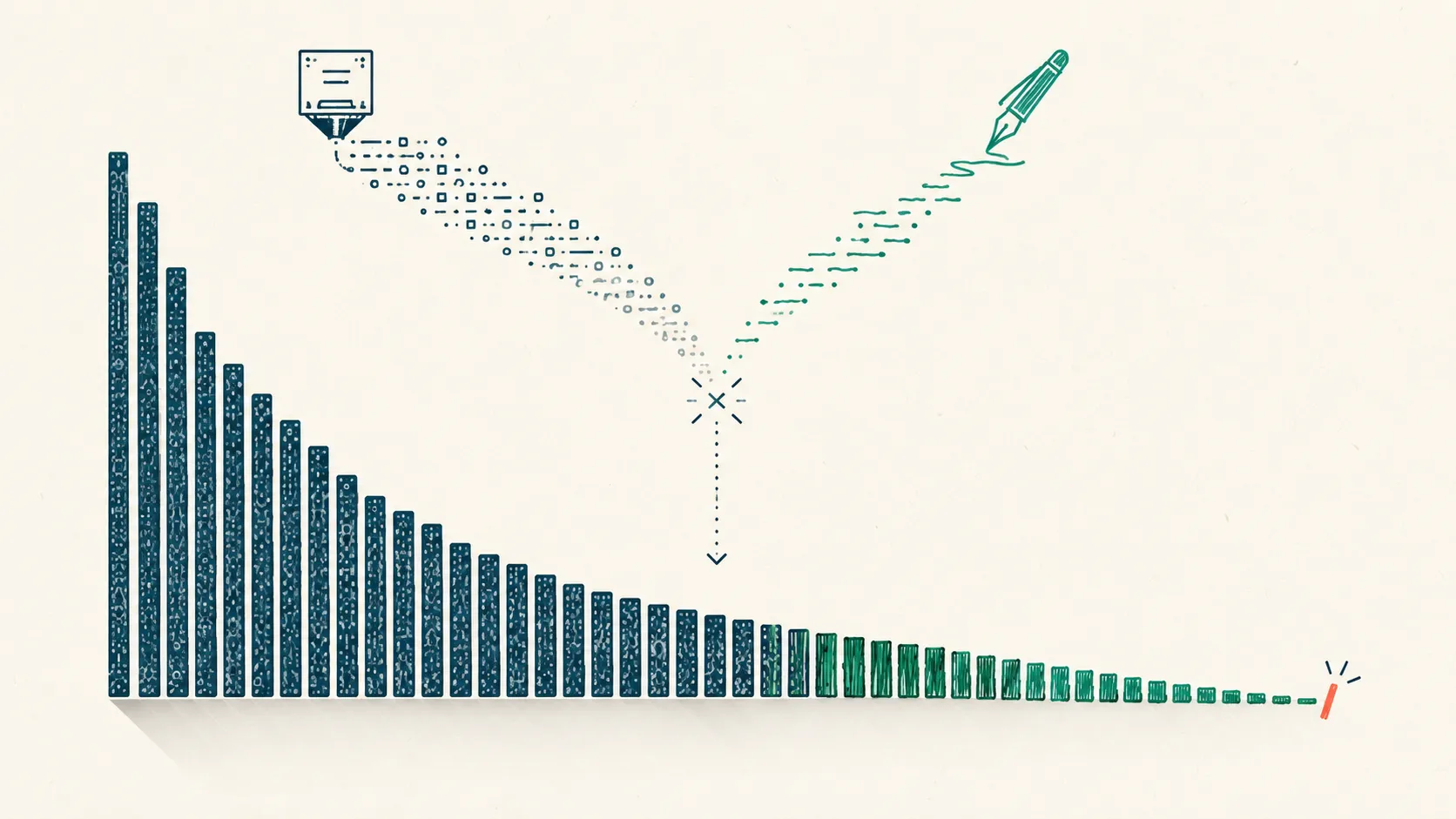
The honest answer to “synthetic data vs human annotation” is that it was never a two-way fight. LLM-generated labels are cheap, fast, and often accurate on the easy 80% of a dataset. Human labels are slow, expensive, and still the reference standard for the hard 20%—the subjective calls, the rare classes, the cases where being wrong is costly. The teams that win pick a boundary between the two and defend it, rather than betting the whole pipeline on either one.
This post draws that boundary. It covers what “synthetic” actually means (generation, LLM-as-labeler, distillation, weak supervision), the studies that show where cheap labels genuinely work, the failure modes that don’t show up in a demo, and the human-in-the-loop hybrid that most production teams should be building instead of choosing sides.
Synthetic data vs human annotation: which should you use?
Use synthetic or LLM labels when the task is objective, high-volume, low-stakes, and label-common; use human annotation when it is subjective, high-stakes, rare-class, or feeds an evaluation set that decides ship-or-no-ship. Most real projects sit in between, which is why the practical question is not “which one” but “which one for which slice of the data.” The table below is the decision most teams are actually making, factor by factor.
| Decision factor | Points to synthetic / LLM labels | Points to human labels | Hybrid move |
|---|---|---|---|
| Task stakes / risk | Low-stakes, reversible, internal-only | High-stakes: safety, clinical, legal, eval | LLM drafts; humans sign off on the high-risk slice |
| Label subjectivity | Objective, rule-based categories | Contested calls needing expert judgment | Human-label a calibration set; scale the rest with the model |
| Rare / tail classes | Common, high-frequency classes | Rare events, long tail, edge cases | Human-label the tail; synthetic-augment the head |
| Privacy / data access | Real data can't be shared; need stand-ins | Real labeled data available and permitted | Prototype on synthetic; validate on held-out real data |
| Budget / scale | Huge volume, thin budget | Small, high-value gold set | Spend the human budget on gold + an audit sample |
| Ground-truth need | Training-data augmentation | Reference sets that decide ship / no-ship | Human gold is the yardstick; LLM labels measured against it |
One rule cuts through the table: the more a wrong label costs, the more of the work a human has to own. A mislabeled meme is a rounding error; a mislabeled symptom in an evaluation set can send a model to production that shouldn’t ship. Match the labeling method to the cost of being wrong, not to the size of the dataset.
What counts as “synthetic data” here?
“Synthetic data” is an umbrella over four distinct techniques, and conflating them is the first mistake. Each generates labels or examples without a human coding every instance, but they fail in different ways and belong at different points in a pipeline.
- Synthetic generation: a model fabricates new examples (and often their labels), used to augment thin or imbalanced training data.
- LLM-as-labeler: a model annotates real examples you already have, replacing crowd or expert coders on the first pass (Gilardi, Alizadeh & Kubli, 2023).
- Distillation: a large “teacher” model labels data to train a smaller “student,” or a model bootstraps its own outputs into tuning data, as in Self-Instruct (Wang et al., 2023).
- Weak supervision: noisy, programmatic labels from heuristics are denoised into training labels without ground truth, the Snorkel approach (Ratner et al., 2017).
The common thread: all four produce training-grade labels cheaply. None of them, on its own, produces the gold evaluation labels that tell you whether the resulting model is any good. Keeping that line sharp—train on synthetic, evaluate against human—is most of the discipline.
When do synthetic and LLM labels actually work?
They work best on objective, well-specified tasks where cheap volume beats artisanal precision, and the evidence here is genuinely strong. Using four samples of tweets and news articles (n = 6,183), zero-shot ChatGPT outperformed crowd workers on relevance, stance, topic, and frame-detection tasks, and its intercoder agreement exceeded that of the crowd workers too (Gilardi, Alizadeh & Kubli, 2023). The economics are the headline.
Read the finding precisely, though, because the comparison is against crowd workers, not trained domain experts. “Beats MTurk on tweet stance” is a real and useful result; it is not the same claim as “matches a psychiatrist on a subjective clinical judgment.” The tasks where LLM labeling shines share a profile: clear category definitions, short inputs, and a right answer a careful reader would agree on.
Self-generated data pushes the idea further. Self-Instruct bootstraps a base model’s own generations into instruction-tuning data and yields a 33% absolute improvement over vanilla GPT-3, roughly on par with InstructGPT-001, which was trained on private human annotations (Wang et al., 2023).
Weak supervision attacks the same cost problem from another angle: instead of hand-labeling, users of Snorkel write labeling functions—heuristics with unknown accuracy—and the system denoises them into training labels without any ground truth (Ratner et al., 2017). Both are legitimate ways to skip hand-labeling for training. Neither absolves you of a human-labeled test set.
Where does synthetic data fail?
Synthetic data fails where the distribution has a tail, because models under-represent what they rarely saw and then compound the gap when trained on their own output. This is the failure mode a demo never shows you, and it has a name. Training generative models recursively on model-generated content causes model collapse: distributional errors accumulate, the tails of the original distribution disappear, and low-probability events are permanently forgotten (Shumailov et al., 2024). The tail is exactly where safety incidents, rare clinical presentations, and adversarial edge cases live.
Here is a synthetic illustration—round numbers, no real data—of how that looks in practice. Suppose an LLM labels 1,000 short clinical-style utterances against a symptom scheme with eight categories. On the five common categories it might agree with a human gold set at a Cohen’s κ around 0.80; on the two rarest categories, each under 3% of the set, agreement could collapse toward κ ≈ 0.30—and for the single rarest label, the model might never emit it at all.
The aggregate κ still reads “substantial,” which is exactly the trap: a healthy average hides a tail the model cannot see. You only catch it if a human labels the tail and you measure the LLM against that gold with Cohen’s kappa, category by category rather than in aggregate.
There is a second, quieter failure: ontology capture. An LLM labeler can only apply the categories it already knows, so annotators and downstream schemes drift toward the model’s vocabulary and genuinely novel phenomena go unrecorded. The same discipline that catches mislabeled majority cases—finding the label errors in your dataset—applies here: even human benchmarks carry an average 3.3% label error (Northcutt et al., 2021), so no source of labels, model or human, earns unaudited trust.
The hybrid: keep a human in the loop
The production-grade answer to synthetic data vs human annotation is a hybrid where the model drafts and the human decides, so you buy the model’s speed without inheriting its blind spots unchecked. The pattern is the same one that works for human-in-the-loop model-assisted labeling: the model takes the first pass, a qualified person corrects it, and the output is human-approved by construction. The work shifts from create to review, which is cheaper—but only if the review is real.
Three moves make the hybrid trustworthy rather than a rubber stamp:
- Keep a human-labeled gold set as the yardstick. Never let model labels grade the model. A held-out gold set, labeled and adjudicated by people, is what tells you whether the LLM’s cheap labels are good enough to trust—and it is non-negotiable for the reference and evaluation sets used in RLHF and LLM eval.
- Spend human effort on the tail and the audit, not the majority. Let the model label the easy, high-frequency cases; route the rare classes, low-confidence items, and a random audit sample to human coders. That is where a label is most likely wrong and most likely to matter.
- Measure agreement, don’t assume it. Compute per-category agreement between the model’s labels and human gold. If κ is strong on common classes and weak on rare ones, you have quantified exactly which slice the model can own and which slice it cannot.
Synthetic data vs human annotation: three quick scenarios
The boundary moves with the task, so it helps to see it drawn three times. Same techniques, three different risk profiles, three different splits.
- Content moderation triage (low stakes, high volume). Let the LLM label almost everything; humans handle appeals and a small audit sample. Synthetic augmentation is fine for balancing rare abuse categories, validated against a modest human gold set.
- Product-review sentiment for a dashboard (medium stakes). LLM-as-labeler for the bulk; a few hundred human-labeled reviews as the gold set to calibrate and monitor drift. Cheap, defensible, and re-checkable each quarter.
- Clinical interview coding (high stakes, high subjectivity). Humans own the labels; the model assists by drafting and flagging, never by finalizing. The gold standard is expert human judgment against a validated scheme, and synthetic examples are used only to train, never to evaluate.
Where do human labels stay non-negotiable?
Human annotation stays non-negotiable wherever the label is a subjective expert judgment, feeds a high-stakes decision, or serves as the evaluation ground truth that everything else is measured against. Clinical rating is the clearest case. Reading depressive severity out of an interview means weighing what a person reports against how they present—the ten-item, clinician-rated MADRS (Montgomery & Åsberg, 1979) exists precisely because that call requires trained judgment, not a keyword match. Formal thought disorder is harder still: the TLC (Andreasen, 1986) operationally defines disorders of thought, language, and communication that a model has barely seen and cannot reliably recognize—the definition of a tail class.
These are not tasks where you swap in cheap labels and hope. They are tasks where a curated, anchored human scheme is the ground truth, and any model assistance has to be measured against it.
Where Tagaroo fits
Tagaroo is a schema-first annotation workspace with an AI first pass: you define a coding scheme once, the agent takes the first pass at tagging against it—text, images, or samples—and a human corrects the draft, with inter-rater reliability and adjudication built into the workflow. It is the hybrid this post argues for, with the honest boundary wired in: the AI pass is a starting point a qualified reviewer signs off on, never a finished label and never a diagnosis.
If your project is pure high-volume synthetic generation with no human in the loop, that is a different tool. Tagaroo’s strength is the guided, schema-driven middle ground—model speed on the easy cases, human judgment on the tail, agreement measured rather than assumed. For the broader tooling picture, we survey the field in annotation tools for LLM and RLHF work.
On data handling, Tagaroo takes a de-identify-first path rather than positioning itself as a PHI processor: its terms require you to strip direct identifiers before upload, its anonymous trial mode runs in the browser so trial data never leaves your machine, and the stack is EU-hosted and GDPR-oriented. If your project must process raw identifiable data in the cloud, put that question to any vendor—including this one—before uploading; see the privacy policy for specifics.
The practical upshot
Stop framing it as synthetic data vs human annotation and start framing it as a split. Let cheap labels do the cheap work—the common, objective, low-stakes majority—and reserve human judgment for the tail, the subjective calls, and the gold set that grades everything else. The evidence supports both halves: LLM labels genuinely beat crowd workers on the easy tasks (Gilardi, Alizadeh & Kubli, 2023), and models trained on their own output genuinely lose the tail (Shumailov et al., 2024).
If you change one thing, change this: build a human-labeled gold set before you scale anything synthetic, and audit it—even human benchmarks are 3.3% wrong (Northcutt et al., 2021). Then define your scheme and run the AI first pass in Tagaroo so the model drafts and your reviewers decide.
References
- Gilardi F, Alizadeh M, Kubli M. ChatGPT outperforms crowd workers for text-annotation tasks. Proc Natl Acad Sci USA. 2023;120(30):e2305016120. doi:10.1073/pnas.2305016120
- Wang Y, Kordi Y, Mishra S, Liu A, Smith NA, Khashabi D, Hajishirzi H. Self-Instruct: Aligning Language Models with Self-Generated Instructions. Proceedings of ACL 2023. arXiv:2212.10560. arxiv.org/abs/2212.10560
- Ratner A, Bach SH, Ehrenberg H, Fries J, Wu S, Ré C. Snorkel: Rapid Training Data Creation with Weak Supervision. Proc VLDB Endow. 2017;11(3):269–282. arxiv.org/abs/1711.10160
- Shumailov I, Shumaylov Z, Zhao Y, Papernot N, Anderson R, Gal Y. AI models collapse when trained on recursively generated data. Nature. 2024;631(8022):755–759. doi:10.1038/s41586-024-07566-y
- Northcutt CG, Athalye A, Mueller J. Pervasive Label Errors in Test Sets Destabilize Machine Learning Benchmarks. NeurIPS Datasets and Benchmarks. 2021. arXiv:2103.14749. arxiv.org/abs/2103.14749
Frequently asked questions
- Is synthetic data better than human annotation?
- Neither is universally better—it depends on the task. Synthetic and LLM-generated labels are cheap and often accurate on objective, high-frequency categories: in one study, zero-shot ChatGPT beat crowd workers on four text-annotation tasks at under $0.003 per label (Gilardi, Alizadeh & Kubli, 2023). Human annotation stays the reference standard for subjective, high-stakes, or rare-case judgments, where models miss the tail and can amplify their own bias (Shumailov et al., 2024).
- Can I just use an LLM to label my whole dataset?
- For low-stakes, objective tasks, often yes—LLM-as-labeler can match or beat crowd workers cheaply (Gilardi, Alizadeh & Kubli, 2023). But you should never treat LLM labels as ground truth for evaluation. You still need a human-labeled gold set to measure the LLM against, because model labels inherit the model's blind spots and drop rare classes (Shumailov et al., 2024).
- What is weak supervision and how does it relate to synthetic labels?
- Weak supervision builds training labels from noisy, programmatic sources instead of hand-labeling every example. Snorkel lets users write labeling functions—heuristics with unknown accuracy—and denoises their outputs without ground truth (Ratner et al., 2017). Like synthetic generation, it produces training data at scale, not gold evaluation labels.
- Does training on synthetic data hurt model quality?
- It can, if you train recursively on model output without fresh human data. Repeatedly training generative models on their own generations causes model collapse: the tails of the distribution disappear and low-probability events are forgotten (Shumailov et al., 2024). Periodically injecting real, human-labeled data is what prevents the drift.
- Are human labels perfect?
- No—human gold is the reference standard, but it is not error-free. An audit of ten widely used benchmark test sets found an average of 3.3% label errors, including about 6% of the ImageNet validation set (Northcutt et al., 2021). That is an argument for auditing your gold set, not for abandoning human labels.
Keep reading
 Image & Multimodal Annotation
Model-Assisted Labeling for Images: Label Less, Cover More
Model-assisted labeling lets a model draft image labels so annotators correct, not create. How pre-labeling and active learning cut work honestly.
 Tools & Comparisons
RLHF Data Annotation: A Playbook for Preference & Eval
An RLHF data annotation playbook: pairwise preference vs Likert rubrics, reward-model data, eval sets, and rater agreement. See the decision guide.
 Annotation Operations & Ethics
How to Find Label Errors in Dataset Quality Audits
Label errors hide in almost every dataset. Learn how to find label errors in dataset audits with disagreement, model confidence, and confident learning.
Put this into practice
Tagaroo turns any rating scale or coding scheme into a guided annotation workflow—with inter-rater reliability computed as you go.